Gender Role Test
Answer 24 short scenarios, picking whichever option feels closest to how you’d actually act. At the end, you’ll get one of four results based on how strongly your answers lean on two separate sets of traits — it takes about 5 minutes.


Androgynous self-description: you describe yourself through both sets of traits at once.
Your answers lean strongly toward both sets of traits at once: you step up and hold your position the way the masculine-coded questions describe, and you notice moods and adjust for others the way the feminine-coded questions describe.
That combination shows up as range more than a fixed style — assertive when a situation calls for pushing, warmer and more accommodating when a situation calls for that instead, without one crowding out the other in how you see yourself.
This is a description of self-description, not a statement about your gender or gender identity. The test never asked about either one, and it isn't answering that question here.
Whether drawing on both trait sets predicts real flexibility is genuinely unsettled: one line of research ties it to handling a situation either way it calls for, while a broader review credits most of the benefit to the masculine-coded side alone. Nothing about that makes this result better than the other three — just a different, equally ordinary pattern.
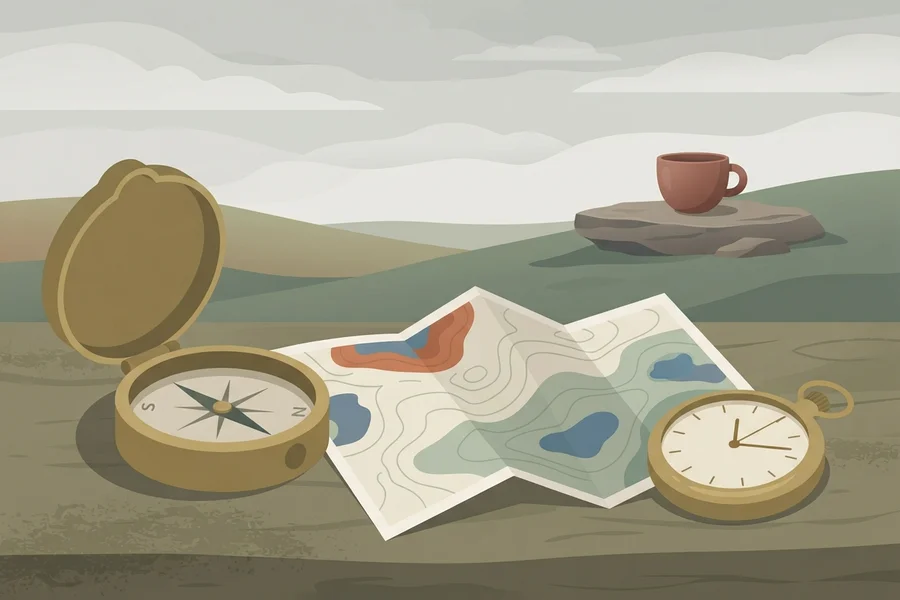
Masculine-typed self-description: you describe yourself mostly through masculine-coded traits.
Across your answers, the masculine-coded traits — stepping up, holding your position, deciding without waiting on others — came through strongly, while the feminine-coded ones showed up far less.
That's a specific, sourced pattern: leaning on instrumental, take-charge traits as your default way of describing yourself, rather than the noticing-and-accommodating traits the other set measures.
It describes how you tend to present yourself day to day, not your gender or gender identity — this test doesn't ask about either and can't determine them.
It isn't a stronger or better result than a feminine-typed, androgynous, or undifferentiated one. It's simply where your answers landed on two independent scales, and plenty of people land in each of the four spots.
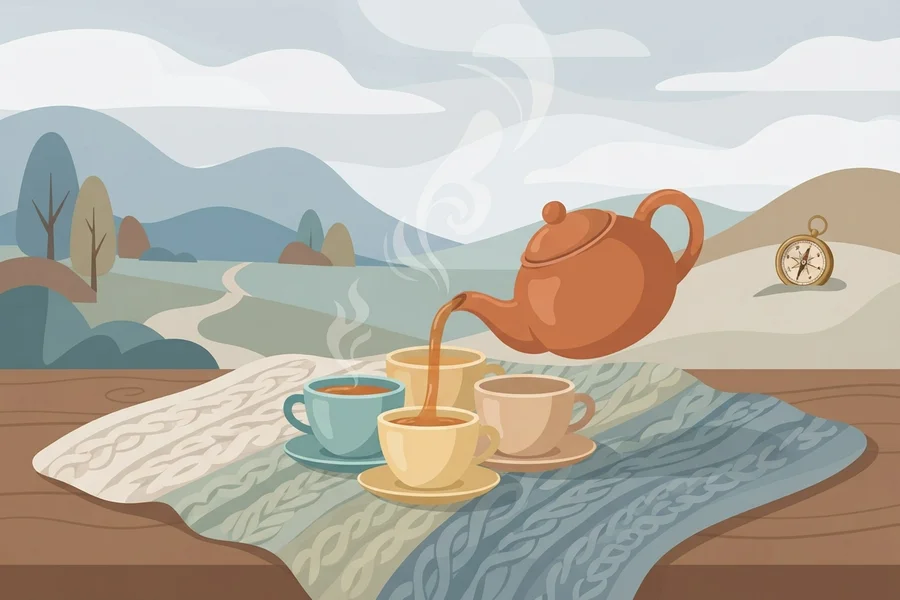
Feminine-typed self-description: you describe yourself mostly through feminine-coded traits.
Your answers lean the other way: the feminine-coded traits — noticing how people around you feel, comforting first, valuing closeness — came through strongly, while the masculine-coded ones showed up far less.
That's the mirror pattern to masculine-typed self-description: expressive, relationship-oriented traits organizing how you describe yourself more than take-charge, competitive ones do.
What this describes is a pattern in how you see yourself, not your gender or gender identity — the test measures neither, and doesn't try to.
Nothing here ranks above or below a masculine-typed, androgynous, or undifferentiated result. The four patterns sit side by side, and this is simply where your answers put you.
Undifferentiated self-description: neither set of traits organizes how you describe yourself.
Your answers didn't lean hard on either set of traits — not strongly on the masculine-coded ones, and not strongly on the feminine-coded ones either.
That's a distinct pattern in its own right, not a blank or "a little of everything." Your sense of yourself just isn't organized tightly around either stereotyped trait cluster the way the other three results are.
This describes how you tend to see yourself day to day, not your gender or gender identity — this test doesn't measure or reveal either one.
It's not a thinner or lesser result than the other three. A lot of people's self-descriptions work this way, without either trait cluster doing much of the organizing.
Your results are no accident
The classic 16-type personality test rooted in Jung's typology has been rebuilt from the ground up: a new CoreTypes methodology, and a far higher level of accuracy. These might be the most useful ten minutes you'll ever spend on yourself: you walk away with the key to your decisions, your relationships and your results — and it's yours for good.
Take the free testFrequently Asked Questions
Does this test tell me my gender?
No. What you get is a read on which of two everyday, culturally shaped trait sets shapes how you talk about yourself — a different question from what your gender identity actually is, even though people sometimes use the two words as if they meant the same thing. A short quiz like this one was never built to answer that second question, so it doesn't try.
Am I masculine or feminine, based on this test?
There's no single dial here running from "masculine" at one end to "feminine" at the other, with you landing somewhere along it. The quiz keeps two separate tallies and scores each one on its own, so you might come back strong on one, strong on both, or fairly low on both — four combinations in total, built from two dials, not one.
Can a person have both masculine and feminine traits?
Definitely — that combination is simply one of the four regular outcomes here, nothing unusual or contradictory about it. Since the two trait sets are tracked separately rather than pulling against each other, nothing stops someone from scoring high on both at once, and plenty of people do.
Is this test based on real psychology?
The idea behind it goes back decades in psychology, grounded in the finding that a person's self-image splits along two separate trait dimensions instead of one. Some of the original example behaviors feel dated by now — the masculine-coded set has drifted further from modern life than the feminine-coded one — so every item here was written fresh, aimed at the present rather than the past. Treat it as a mirror on your own self-image, not a clinical tool and not a way to pin down anyone's identity.
Do gender roles change over time?
They do, and that's built into how to read your result. Which behaviors get labeled "masculine" or "feminine" has shifted before and keeps shifting depending on when and where someone grew up — it was never a fixed rule about biology. What you get here is a picture of your self-description right now, this year, not a label stamped on for good.
Methodology
This quiz leans on a decades-old approach in psychology: score self-description as two separate tracks instead of one line. One tracks how often your answers lean toward leading, deciding, and pushing forward under pressure; the other tracks how often they lean toward reading people's emotions and prioritizing closeness. Whichever side wins each track becomes part of your result.
Each cluster is scored on its own from your answers, and the two results combine into one of four patterns: strongly organized around one cluster, the other, both, or neither. Because the two are measured independently, scoring high on one says nothing about where you land on the other.
Keep in mind that what counts as typical here reflects a particular time and place — present-day, English-speaking norms — not a fixed rule about biology or about men and women as whole groups. Older lists built on this idea have aged unevenly, so this version was rewritten rather than reused as-is. For how this differs from gender identity, see the field's own definition of gender role, and for the high-on-both pattern, its definition of androgynous personality.
The quiz does not rank the four patterns. You get a self-report snapshot of how you describe yourself — not a diagnosis, not a reading of your gender or gender identity, and not a statement about any group of people. A score right on the line between two poles is shaky: retake it another day and it could tip the other way.
References
- Bem, S. L. (1974). The Measurement of Psychological Androgyny. Journal of Consulting and Clinical Psychology, 42(2), 155–162.
- Spence, J. T., Helmreich, R., & Stapp, J. (1975). Ratings of self and peers on sex role attributes and their relation to self-esteem and conceptions of masculinity and femininity. Journal of Personality and Social Psychology, 32(1), 29–39.
- Auster, C. J., & Ohm, S. C. (2000). Masculinity and Femininity in Contemporary American Society: A Reevaluation Using the Bem Sex-Role Inventory. Sex Roles, 43(7/8), 499–528.
- Carver, L. F., Vafaei, A., Guerra, R., Freire, A., & Phillips, S. P. (2013). Gender Differences: Examination of the 12-Item Bem Sex Role Inventory (BSRI-12) in an Older Brazilian Population. PLoS ONE, 8(10), e76356. doi:10.1371/journal.pone.0076356