Political Compass Test
This is an independent test — not affiliated with or based on the well-known politicalcompass.org quiz of the same name. Answer 24 short questions about how the economy should work and how much authority should govern personal life, and in about 5 minutes you’ll see where you land on both, explained in plain language.


The Community Plot. You lean toward closing economic gaps in how the economy should be run, and toward leaving personal choices to the individual in how far authority reaches into personal life.
You'd rather see an economic gap closed than left alone, and rather leave someone's own choices to them than hold everyone to one shared line. Neither lean usually sits at the far edge — a blended reading near the middle is the shape most answers take, not a weaker one.
You probably clock unevenness first — a coworker carrying more than their share, a neighbor stretched thin for no clear reason — and think someone should step in. A friend's puzzling choices pull the opposite reflex out of you: let them get on with it.
Struggling people and people who don't fit the usual mold both get steady company from you — the same underlying instinct runs through both: nobody should be worse off for reasons outside their control.
Closing a gap takes machinery, and machinery needs someone deciding who qualifies — reaching into choices you'd rather have left alone. Going easy on how others live can also mean going easy on holding anyone to a line when it matters.
Knowing when to fix what's uneven and when to leave people be isn't something a four-way result can settle for you — that gets worked out case by case.

The Long Table. You lean toward closing economic gaps in how the economy should be run, and toward the community setting shared standards of conduct in how far authority reaches into personal life.
Where you land here is two things at once: leaning toward closing the gap between people economically, and toward the community setting one shared standard of conduct personally — and since both scales are continuous, a blended result near the middle of either one is simply the shape most results take, not a diluted one.
A gap that drifts too far tends to catch your eye before it catches anyone else's, and you feel steadiest inside a group that has agreed, spoken or not, on how people are expected to behave.
Building things that hold together — pooled resources, agreed conduct, a group that doesn't splinter at the first disagreement — comes naturally to you.
The same hand that narrows an economic gap can also mean it keeps reaching, into decisions about how people are supposed to live. And a standard that holds a group together can also mean less room for whoever's choices don't fit it.
How much shaping is enough, and where the shared line should stop, is something your own answers keep sharpening long after this result.

The Open Market. You lean toward letting market outcomes stand in how the economy should be run, and toward leaving personal choices to the individual in how far authority reaches into personal life.
Let the market's outcomes stand. Leave a person's own choices to them. Both, in short, describe where you lean — and since both scales run continuous rather than all-or-nothing, a blended result near the middle of one or both is the usual shape here, not an unclear one.
Outcomes landing unevenly doesn't automatically read as wrong to you, and neither does watching a friend live in a way you'd never choose for yourself, without feeling any pull to say so out loud.
People trying something risky — a new venture, an unconventional way of living — tend to find you easy to be around, since your first move is never to step in or pass judgment.
That same evenness cuts both ways. It can also mean less active correction when an outcome lands badly through no fault of anyone's, and less shared footing when two people's choices genuinely collide.
Somewhere, restraint should stop and stepping in should start — exactly where is a line your own answers keep drawing a little differently each time.
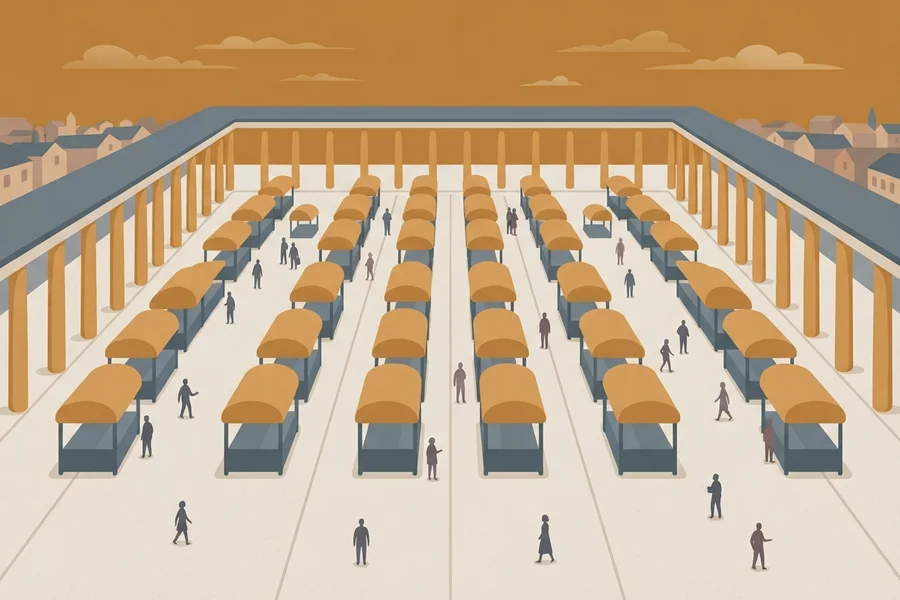
The Straight Row. You lean toward letting market outcomes stand in how the economy should be run, and toward the community setting shared standards of conduct in how far authority reaches into personal life.
Two dials, two answers: let the market's outcomes stand, and let the community set one shared standard of conduct. Neither reading usually sits at the extreme end — a blended result, near the middle of one or both scales, is the normal shape here too, not a lesser one.
You're not especially troubled by outcomes landing unevenly on their own, but you still expect the people around you to hold to one common, recognizable standard of behavior day to day.
A steady, predictable group is what you help build — outcomes aren't actively reshuffled, and everyone plays along by roughly the same well-understood, unspoken rules.
That's the flip side of the same restraint. Little gets actively corrected when an outcome lands badly for reasons nobody chose, and a shared standard holding the group together can also mean less room for whoever's choices don't fit it.
Whether that steadiness is worth more than the give a person who doesn't fit deserves is exactly what the rest of your answers keep testing.
Your results are no accident
The classic 16-type personality test rooted in Jung's typology has been rebuilt from the ground up: a new CoreTypes methodology, and a far higher level of accuracy. These might be the most useful ten minutes you'll ever spend on yourself: you walk away with the key to your decisions, your relationships and your results — and it's yours for good.
Take the free testFrequently Asked Questions
How accurate is a test like this?
As accurate as any short self-report quiz can be: it gives you a rough placement based on your own answers, not a scientific verdict on your politics. The two-axis idea behind it comes out of decades of research into how people's political attitudes tend to cluster, but 24 questions can only sketch a lean, not measure it down to the decimal.
Has this test been scientifically validated?
Not in the way a clinical diagnostic tool is validated, no — and that's true of every quiz in this space, not just this one. What does have real backing is the underlying idea: political scientists have run the numbers on how people's attitudes cluster and kept landing on two separate factors rather than one, using different data sets and different statistical approaches across several decades. None of them, though, published anything like the reliability and validity testing a licensed psychological scale goes through, and neither has this test. Read your result as an informed sketch, not a lab-grade measurement.
What's the difference between a two-axis compass and a single left-right scale?
Think of the difference between one grade for a two-part exam and two separate grades. Folding economics and authority into one left-right figure means two people who land in exactly the same spot might actually disagree on almost everything, just in opposite directions on each part, with the average happening to cancel out. Studies that measured both parts separately found only a weak link between them, which is exactly why averaging them into one score throws away information a two-axis result keeps.
Does this test work the same way in every country?
Not automatically, and that's a real measurement problem rather than just a wording one — even a word as basic as "liberal" points to close to opposite ends of the spectrum depending on where you are, and the economic axis on its own has only reliably sorted people's actual views in a handful of the countries studied so far. That's exactly why none of the 24 questions here name a party, a politician, or a specific policy: they stick to general values, which travel better across borders than any one country's debates do.
What's the difference between "liberal" and "left," or "conservative" and "right"?
Pick up a newspaper from two different countries and "liberal" can describe almost opposite politics — in one it signals someone left-leaning, in the other it signals someone who wants less government involvement in the economy, a position usually filed under "conservative" back home. "Left" and "right" wobble the same way once you cross a border. That mismatch is exactly why this test never uses any of those four words: each axis here just gets named for the actual preference behind it, not for a label whose meaning changes depending on where the reader is standing.
Methodology
Picture two separate dials rather than one. This test turns one toward however you think an economy ought to be run, and the other toward how much say a community or government should have over the way people live day to day. Where one dial lands says nothing about the other, so each is read on its own, and only combined at the end into one of four end results.
Most people don't push either dial all the way to one end. A result sitting closer to the middle of one axis, or both, is exactly what research into this kind of measurement would predict — not a sign the test couldn't get a clear read on you.
One thing this test skips on purpose: the usual shorthand. Calling someone "liberal" points to a different place on the map depending on the country, and "left" and "right" wobble the same way once you cross a border. So instead of that vocabulary — or any specific party, politician, or policy — the 24 questions stay at the level of general values, the kind that hold their meaning no matter where you're reading this from. Nothing here sorts you into a party, ranks one combination of leanings above another, passes judgment on anyone's character, or claims a tie to any other named quiz in this space.
For background on why a single axis leaves things out, see the left-right political spectrum and the wider political spectrum.
References
- Eysenck, H. J. (1954). The Psychology of Politics. London: Routledge & Kegan Paul.
- Treier, S., & Hillygus, D. S. (2009). The Nature of Political Ideology in the Contemporary Electorate. Public Opinion Quarterly, 73(4), 679–703.
- Feldman, S., & Johnston, C. D. (2014). Understanding the Determinants of Political Ideology: Implications of Structural Complexity. Political Psychology, 35(3), 337–358. doi:10.1111/pops.12055.