Relationship Pattern Quiz
This is a free, independent attachment style quiz — not created by, or affiliated with, any single author, coach, or program. Answer 24 short questions about how you handle closeness in your relationships generally, and get a result built from two separate scales that combine into one of the four standard attachment styles. About 6 minutes.

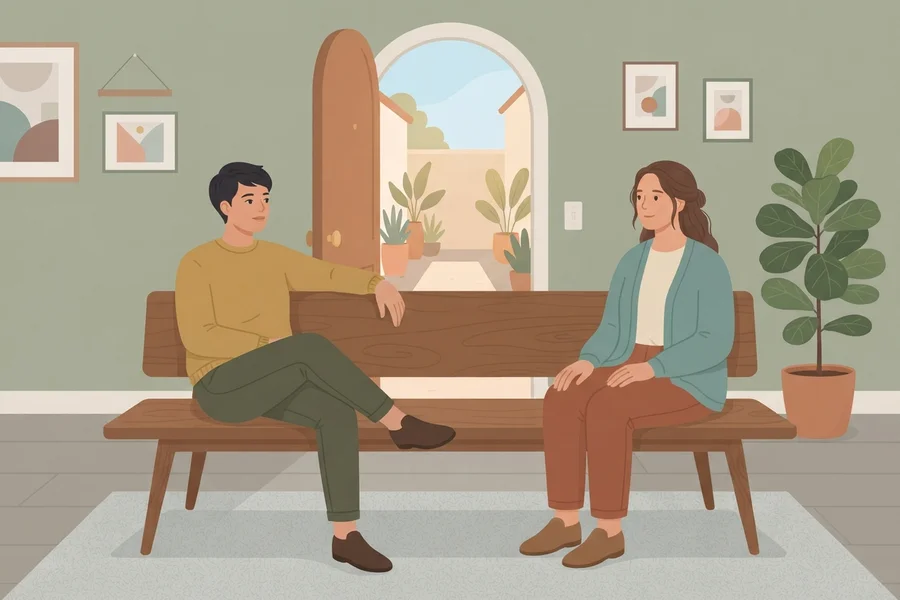
Secure: The Unlocked Door
This pattern doesn't spend much energy wondering whether closeness will hold, and it doesn't treat leaning on someone — or being leaned on — as something to weigh first. That goes for whichever close relationships are actually part of your life right now: a partner, family, friends, or some mix of the three.
It shows up in ordinary moments — a plan falls through at the last minute and it just doesn't read as a threat. Most people land somewhere in the middle of both scales rather than at a pure extreme, and that blended reading is the ordinary shape of this result, not a weaker one.
You don't hold the door shut, and you rarely need someone to knock twice. The cost is easy to miss: when connection takes so little effort, it's easy to under-read how much someone whose pattern runs differently needs a signal spelled out in actual words rather than assumed.
None of this predicts how any one relationship will go, and it says nothing about your gender, your history, or whether you currently have a partner, close family, or close friends to call on at all.

Anxious-Preoccupied: The Live Wire
This combination stays genuinely alert to small signs that closeness might be slipping, and meets that alertness by reaching toward people rather than pulling away from them — asking, checking, wanting the reassurance said out loud, whether that's with a partner, a family member, or a close friend.
A slower reply or a quieter stretch than usual can be enough to set off a real chain of concern, and the instinct that follows is to close the gap fast rather than sit with the uncertainty. Most people carry this pattern in a blended form, somewhere off the extreme on one or both scales, and that's the ordinary shape of this result, not a diluted version of it.
The same watchfulness that catches an actual problem early can also read an ordinary quiet moment as more meaningful than it turns out to be. That isn't a flaw in the people you're close to, and it isn't "being too much" — it's a pattern with its own logic.
It says nothing about whether any specific relationship is actually in trouble, and it isn't a verdict on your childhood or on anyone who raised you.

Dismissive-Avoidant: The Solo Carry
This combination doesn't carry much background worry about where things stand, and it treats managing things alone as the safer bet — even when a partner, a family member, or a friend is genuinely offering to help or get closer.
It shows up as a quiet instinct to handle a hard week solo rather than say much about it. Most people carry this in a blended form rather than at the far edge of either scale, and that's the ordinary shape of this result, not a sign of something unresolved.
The strength here is real — a personal problem rarely turns into someone else's burden, and independence holds up under pressure. The cost is quieter: a real need, including your own, can go unspoken, not from indifference but from reaching for "I've got this" before asking even crosses your mind.
None of this is coldness, and it isn't evidence of not caring — it describes how this pattern tends to run, not a verdict on your capacity to care, your gender, or your history.
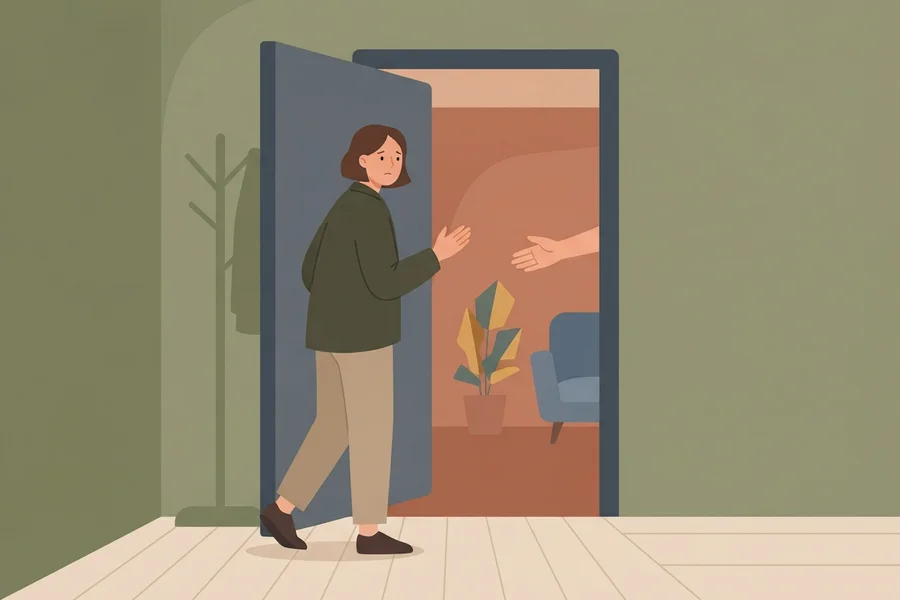
Fearful-Avoidant / Disorganized: The Half-Open Door
This combination wants closeness and guards against it in close to the same breath — real worry about whether it will hold, paired with a pull to manage alone and hold back even while wanting the closeness. It isn't limited to one kind of relationship; the same push-pull can show up with a partner, with family, or with a close friend.
Comfort that's genuinely wanted can be met with hesitation right as it arrives. Most people land somewhere blended between the two scales rather than at a pure corner of either, and that's the ordinary shape of this result, not a sign that it's unclear.
That push-pull isn't indecision for its own sake — it's two real pulls, toward and away, landing at close to the same time.
This general-population, self-report combination is a separate, milder thing from the clinical attachment disorders that sit near this construct — those are diagnoses made only by a clinician. This result doesn't diagnose or rule out either of them, isn't evidence of a childhood-trauma history, and isn't a verdict on anyone who raised you.
Your results are no accident
The classic 16-type personality test rooted in Jung's typology has been rebuilt from the ground up: a new CoreTypes methodology, and a far higher level of accuracy. These might be the most useful ten minutes you'll ever spend on yourself: you walk away with the key to your decisions, your relationships and your results — and it's yours for good.
Take the free testFrequently Asked Questions
How accurate is an attachment style quiz like this?
This is meant as a mirror for your own answers, not a clinical measurement — it shows you the pattern in what you picked, nothing about a single relationship's condition. Treat it as a useful starting point for noticing your own tendencies, not as something a licensed professional would sign off on.
How many attachment styles are there?
Early research grouped people into three attachment patterns. A fourth, blended pattern got pulled out and given its own name later, which is why four is now the standard count, and this quiz follows that four-part breakdown. You'll still run into sources that use the older three-way version; it isn't outdated so much as an earlier stage of the same research.
Can your attachment style change?
What you get here is a snapshot of how you'd describe yourself right now, not something stamped on you permanently. It can genuinely differ depending on whether you're thinking about a partner, family, or a friend, and real experience over the years can shift it further. Take today's result as current, not as a life sentence.
What's the difference between anxious and avoidant attachment?
These measure two different things, not two ends of the same line. One tracks the background worry over whether closeness will hold up; a separate measure tracks how comfortable it actually feels to depend on someone. Someone can rate high on one and low on the other at the same time — that's the whole reason this quiz keeps them as separate scores instead of merging them into a single number.
Can you have more than one attachment style?
Both measures run on a spectrum rather than sorting you into a strict box, so most people end up somewhere in between rather than at either extreme. It's also common for the pattern to shift a bit depending on who you're with — part of the reason this quiz covers your romantic life, your family, and your friendships instead of picking just one of them.
Methodology
This quiz works from two separate, continuous measures behind adult attachment — how much background worry tends to shadow closeness, and how comfortable it feels to lean on someone you're close to. Each measure gets its own set of questions about a romantic partner, about family, and about friendship, since a pattern like this tends to show up in more than one of those relationships.
Combine the two measures, and the result maps onto one of four standard attachment-style names used in this field. Both run on a continuum, so landing near the middle of one or both is the typical, expected outcome, not a vague result. The quiz reads the same whether you currently have someone in mind for any of those three roles or not — a partner, someone in your family, or a friend.
For more background, see the APA's definition of attachment style and an overview of how the four categories are built from these two dimensions.
This is meant for personal reflection using only what you reported about yourself, not a diagnostic tool and not a stand-in for a clinician. It doesn't evaluate your childhood or pass judgment on whoever raised you, and pairing the two highest readings together is specifically not the same as either of the two clinical attachment disorders near this territory, nor proof of past trauma. Real concerns about how you connect with people close to you are better brought to an actual professional than left to a quiz result.
References
- Ainsworth, M. D. S., Blehar, M. C., Waters, E., & Wall, S. (1978). Patterns of Attachment: A Psychological Study of the Strange Situation. Hillsdale, NJ: Erlbaum.
- Hazan, C., & Shaver, P. (1987). Romantic love conceptualized as an attachment process. Journal of Personality and Social Psychology, 52(3), 511–524. doi:10.1037/0022-3514.52.3.511.
- Bartholomew, K., & Horowitz, L. M. (1991). Attachment styles among young adults: A test of a four-category model. Journal of Personality and Social Psychology, 61(2), 226–244. doi:10.1037/0022-3514.61.2.226.
- Fraley, R. C., Waller, N. G., & Brennan, K. A. (2000). An item response theory analysis of self-report measures of adult attachment. Journal of Personality and Social Psychology, 78(2), 350–365. doi:10.1037/0022-3514.78.2.350.