What Grade Should I Teach Quiz
Answer 16 quick questions about how you naturally respond to a room full of students, plan your time, and want to be remembered, then see which age band — from the very youngest learners to older teens — best fits your instincts. Takes about 4 minutes.

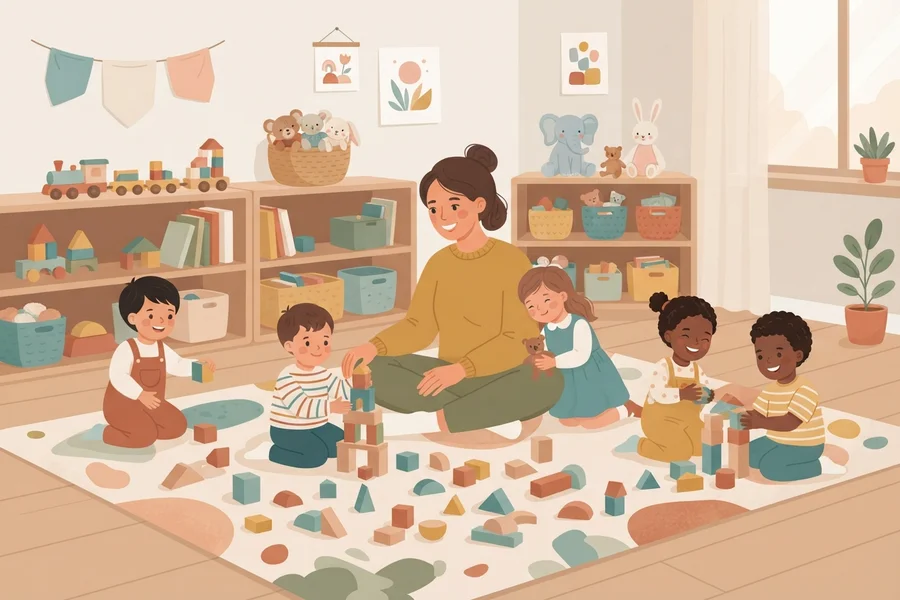
The Gentle Anchor — a natural fit for the very youngest learners, still discovering the world through play
The very youngest learners are where you're most yourself. You hold several different threads of a child's day at once — movement and play, first words and numbers, the small emotional weather that blows through every hour — never boxed into just one of them.
A spilled cup. A sudden tantrum. A shy child hovering at the edge of the group. None of it rattles you. You move through it steadily, soothing and redirecting, and the room settles around you without a raised voice.
That patience is the real strength here, rarer than it looks, and it's what makes very young children feel safe enough to try things. The cost sits right next to it: less depth in any one subject, and an authority that comes from routine and warmth, earned slowly.
What's it like to lose a real argument to someone who's about to become an adult? You'll have to imagine it from the outside, for now.

The Steady Compass — a natural fit for children old enough to run with structure, still eager to learn
You're most at home with children who are still generalists but can already carry a structure once someone's set it up for them. Several subjects, several routines, all moving through the same day — and you're the one keeping it all running.
The best part of your day isn't the lesson itself. It's watching a child run with it: the schedule clicks, everyone knows what's next, and a kind of quiet order takes over the room.
That steadiness is your real strength — a rhythm children can set their clock by. What it costs you is some of the raw, hands-on nurture of the youngest classrooms, and the subject depth and identity-work that come later, neither of which you're quite doing yet.
One open-ended question fills somebody's whole year.

The Grounded Spark — a natural fit for early adolescents in the middle of rapid change
You're the adult a young person can lean on right when everything is changing at once — their body, their thinking, their friendships, all moving at the same time, loudly and unevenly.
A friendship blows up at lunch and is somehow patched together again by the next class; somewhere in the middle of that, someone tests a rule just to see what happens, and none of it throws you off balance. You hold a line that's firm without ever turning into a fight.
That kind of flux tolerance is rare. It's exactly what keeps a young person steady through a stretch most adults find exhausting. The cost is real, too: small, constant friction that still asks for more assertiveness than the youngest classrooms ever do.
Somewhere else entirely: a subject followed to its very edges, or a morning that never once wobbles.

The Sparring Partner — a natural fit for older teens ready to think and argue for themselves
You're most fulfilled going deep in one field and treating the people in front of you as near-adults — capable of forming a real opinion and standing behind it under pushback.
A hand goes up with a genuine counterargument, not a request for the answer, and you meet it head-on, handing over an open prompt more often than a script so the rest is theirs to work out.
That directness is your strength, and you can hold a position under real pushback without flinching — exactly what near-adults need from you. The cost comes from the same place: less of the patient, imaginative, nurture-first quality that anchors the youngest rooms, and when something does go wrong here, it tends to land harder than it would with a younger group. That's the price of it.
A small child, scissors in hand for the first time, concentrating hard on getting it right — that's a scene from a room you don't teach in.
Your results are no accident
The classic 16-type personality test rooted in Jung's typology has been rebuilt from the ground up: a new CoreTypes methodology, and a far higher level of accuracy. These might be the most useful ten minutes you'll ever spend on yourself: you walk away with the key to your decisions, your relationships and your results — and it's yours for good.
Take the free testFrequently Asked Questions
What grade is the best to teach?
None of the four bands ranks above the others — early years, primary years, middle years and senior years each come with their own real pull, not a lesser version of one "true" best age to teach. What this quiz actually does is point at the band whose temperament and rhythm line up with yours, which is a very different question from which one is objectively best.
How do you choose what grade level you want to teach?
Pay attention to which picture keeps grabbing your attention: mentoring older, near-adult students by going deep into one subject alongside them; being the steady, even-keeled adult a younger teenager can lean on while their whole identity is in flux; keeping a calm, structured routine running for children who can already manage a fair amount on their own; or getting to nurture the very youngest learners across a wide spread of small, everyday skills. Whichever picture you keep returning to is the real answer.
Should I teach elementary, middle, or high school?
Subject knowledge and credentials turn out to matter less here than people expect. What the underlying research keeps pointing back to instead is temperament — are you naturally even-keeled and patient, or do you lean into pushing back and being direct — plus how much rope you're comfortable giving students to work things out on their own. Every one of the four bands shows up as a genuine, well-supported fit for somebody; none of them ranks as the harder or more legitimate choice.
Do I prefer the energy of little kids or the idea of working with teenagers?
You don't actually have to force yourself into just one of two camps. This quiz treats hands-on, nurture-heavy days with small children and deep, mentorship-style conversations with almost-adults as the two far edges of one spectrum, with two more distinct bands sitting in between. Your answers can land anywhere along that whole range, not just at one end or the other.
Methodology
Four professional frameworks for describing childhood and adolescence sit behind the four bands here, chosen because they group students by how that age actually behaves and learns, not by whatever number or label a given country's school system happens to assign it. Layered on top is research comparing the traits of people who already teach younger students against people who already teach older ones.
What actually gets measured: which role you naturally slide into as the adult in the room, how much independence you're comfortable handing students before stepping in, whether you'd rather range across several subjects or go deep into one, and how you hold up when a room gets loud or unpredictable. None of that produces a single score — it sorts your answers into one of four developmental bands instead.
Where you land here isn't a verdict on how good a teacher you'd be, and it's not a life sentence — people drift between these bands more than once over a career. What you're getting instead is a read on which age group's rhythm currently suits you best, built by cross-referencing how educators of different ages actually differ as people against the way specialists describe each stage of childhood. No single test or checklist produced these categories on its own. See the APA's overview of child development and the Cleveland Clinic's summary of developmental stages for more on how professionals define these stages.
References
- Baldwin, B., Slaton, E., Head, M., & Burns, J. (1990). Personality Factors of Elementary and Secondary Pre-Service Teachers. Paper presented at the Annual Meeting of the Mid-South Educational Research Association, New Orleans, LA. ERIC ED326522.
- UNESCO Institute for Statistics. International Standard Classification of Education (ISCED) 2011.
- National Association for the Education of Young Children (NAEYC). Developmentally Appropriate Practice (DAP) Position Statement, 4th edition (2022).
- Association for Middle Level Education (AMLE). Developmental Characteristics of Young Adolescents.