Relationship Quiz
Answer 24 quick questions about the relationship you’re actually in right now, how it feels day to day, how disagreements go, how much trust and closeness are there. It takes about 5 minutes, and you’ll get one clear read on where things stand today.


The Uphill Stretch. Right now, more of this relationship feels hard than good.
Across the six areas this test measures, satisfaction, conflict handling, trust, everyday agreement, shared time, confidence in the future, your answers land closer to absent than present in most of them. That's not a read on one rough week; it's what twenty-four separate answers add up to.
A disagreement is more likely to curdle into old grievances than settle into understanding. Plans for something as ordinary as the weekend take real negotiating, and an evening together can end up feeling more like coexisting than connecting.
There's something worth having here anyway: naming a pattern this low accurately is a real signal across most of what this test measures, not noise from an unlucky stretch.
One thing this result never claims: that anything unsafe is going on. This test only asks about ordinary relationship strain as you experience it, and it has no way to detect coercive control, threats, or violence. Any concern along those lines deserves dedicated resources, not this result.
The total says nothing about your partner, who was never surveyed here, or about which of the six areas weighs heaviest, two people at this same score can be struggling in very different ways.

Patchy Skies. Day to day, the hard stretches outnumber the easy ones, even though the easy ones are real.
More days than not, this relationship takes real effort before it feels easy. Disagreements tend to drift toward criticism before they settle into real understanding, the everyday stuff, money, plans, chores, usually needs active negotiating, and trust or closeness come with some real hesitation built in.
None of that erases the good stretches. They're actually there, not manufactured for the sake of balance, and that's exactly what separates this result from something closer to the floor: real ease exists here, it's just outnumbered right now.
The tricky part is how easy this pattern is to undersell. Someone at this level might describe the relationship as basically fine, while their own twenty-four answers, taken together, actually describe more hard days than easy ones.
The same total here can be built from very different mixtures, thin trust for one person, thin everyday coordination for another. It says nothing about how your partner sees things, or whether the harder areas are already being worked on.
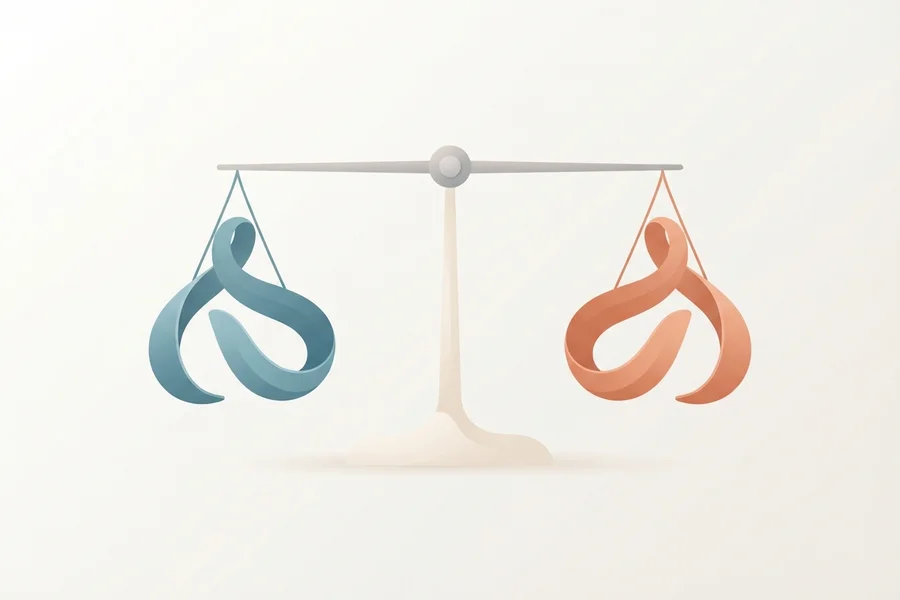
Right at the Midpoint. This relationship could honestly go either way right now, with good moments and hard moments landing about evenly.
Across the six areas this test covers, your answers land almost exactly on the line between leaning toward ease and leaning toward strain. That's rare enough to be worth naming precisely: this is a real, tightly centered reading, not a rounded-off average.
A single close call, on any one of the twenty-four questions, could have tipped this either toward the harder side or the easier one instead. Standing exactly at that line is its own kind of answer.
Balance this exact usually means neither side has quite enough weight to be the clear story, which can itself feel less like a stable footing and more like standing right on a seam.
This narrow result doesn't say which three of the six areas lean toward ease for you and which three lean toward strain, only that, added up, they land almost even. It says nothing about your partner, and nothing about which way things are moving from here.

Solid Ground. Day to day, more of this relationship feels good than hard.
Across the six areas this test measures, your answers lean toward ease, a real and recurring lean spread across most of what this test covers at once, stronger than any single strong area could produce on its own. Disagreements mostly resolve into actual understanding, trust holds up, and the everyday stuff mostly gets sorted without a fight.
This is a broad pattern across most of what this test measures at once, not a single good habit doing all the work.
The honest description is a lean, not a guarantee. The same six areas that mostly land well can still have a thinner stretch tucked inside them, and it's worth knowing which one, rather than filing the whole thing under great and moving on.
This result doesn't say which specific area lags behind the rest for you, and it says nothing about your partner's own sense of things. It's a read on how this currently feels, not a promise that it holds exactly this way going forward.

Firing on All Cylinders. This relationship consistently feels like one of the best parts of an ordinary day.
Across essentially all six areas this test covers, satisfaction, how conflict gets handled, trust, everyday coordination, shared time, and confidence in the future, your answers sit near the top of what this scale can register. That holds on an ordinary day just as much as on a good one.
Little here reads as taken for granted. Affection shows up as a matter of course, disagreements tend to end in real understanding, and the sense of building toward the same future together comes through clearly.
None of that makes this a flawless result, or a win over anyone else's. Future strain can still reach a relationship at this level the same as any other, and every one of this test's five results describes a real, legitimate way of experiencing a relationship, this one included.
A pattern this consistently good can make ordinary strain, the kind that eventually touches most relationships, harder to expect when it does show up. And this result says nothing about your partner's own experience, which may or may not read the same way.
Your results are no accident
The classic 16-type personality test rooted in Jung's typology has been rebuilt from the ground up: a new CoreTypes methodology, and a far higher level of accuracy. These might be the most useful ten minutes you'll ever spend on yourself: you walk away with the key to your decisions, your relationships and your results — and it's yours for good.
Take the free testFrequently Asked Questions
How do I know if my relationship is healthy?
There's no single checklist for that, but this test gives you one grounded way to look: it reflects your own reported experience across six aspects that research on relationships keeps coming back to, satisfaction, communication, trust, everyday coordination, closeness, and commitment. What comes back is a level, not a verdict, a description of how things currently feel to you, not a diagnosis of the relationship itself.
How accurate is a relationship quiz like this one?
The structure draws on established methods researchers use to study relationship quality, so the six aspects and the scoring aren't arbitrary. But this particular test is a self-report reflection tool, not a validated clinical or predictive instrument, and it can't hand you a number about how you compare to other people. What it gives you is a considered look at your own answers, nothing more.
Does a low score mean I should end my relationship?
No. Every result here describes how the relationship currently feels to you, never advice about its future. A decision that size deserves more than a quiz result, this one included, and this test isn't built to make that call for you or anyone else.
Is this a relationship style or relationship personality test?
No, it doesn't sort you into a style or a personality type. It measures how one specific, current relationship is functioning right now, on a single scale running from more strained to more thriving. If you're looking for a type or style label, that's a different kind of test than this one.
How many questions are in this relationship test?
Twenty-four, four for each of the six aspects this test covers. That's enough to cover the ground evenly without turning into a long survey, it takes about five minutes.
Methodology
This test adds up self-reported signals across six separately grounded aspects of how a relationship functions, satisfaction, communication and conflict, trust, everyday coordination, shared time, and commitment, into one overall reading of how things currently stand. It doesn't sort anyone into a type or a style.
Twenty-four short, first-person items cover those six aspects evenly, four each, on one shared five-step scale, and about a quarter are worded so that agreement actually pulls the total down, keeping the score from simply rewarding agreeable answers. The lowest of the five results is deliberately the narrowest band: real relationship strain shows up as a documented minority pattern among typical respondents, not an even half. The boundaries between all five levels sit at the scale's own natural break points, not sliced into equal fifths.
A few honest limits. This only reflects what you notice and are willing to say about your own relationship, your partner was never part of it. It's a read on how things currently feel, never a prediction or advice about whether to stay or go, and a single total can hide very different mixtures underneath it. One boundary is worth stating directly: this test doesn't ask about, and can't detect, coercive control, threats, or physical safety, the NHS's guide to relationships and wellbeing is a better place to start for concerns like that. For how communication patterns shape a relationship over time, see the APA's overview of healthy relationships.
Nothing here is split by gender, and none of it replaces couples counseling or professional guidance. This is a self-report reflection tool, not a diagnostic instrument.
References
- Hlynsson, J. I., Ívarsson, Í. Ö., Andersson, G., & Carlbring, P. (2025). To be or not to be satisfied in your romantic relationship: Evaluating the reliability and validity of the Valentine scale. Cognitive Behaviour Therapy.
- Rempel, J. K., Holmes, J. G., & Zanna, M. P. (1985). Trust in close relationships. Journal of Personality and Social Psychology, 49(1), 95–112.
- Spanier, G. B. (1976). Measuring dyadic adjustment: New scales for assessing the quality of marriage and similar dyads. Journal of Marriage and the Family, 38(1), 15–28.
- Karney, B. R., & Bradbury, T. N. (1995). The longitudinal course of marital quality and stability: A review of theory, method, and research. Psychological Bulletin, 118(1), 3–34.