Panic Disorder Test
You’ll answer 15 short questions about sudden waves of fear, how your body and mind react to them, and what you’ve started avoiding because of them. It takes about four minutes, and at the end you’ll get a plain-language read on how present that pattern is in your life right now.

This test is for informational purposes only and is not a substitute for a professional diagnosis. Consult a qualified professional for medical or psychological advice.

The Open Room. Minimal Signs of Panic Attacks
If a wave of sudden fear has ever caught you off guard, your answers say it hasn't become a habit. The handful of patterns this test is built to catch — misread bodily signals, lingering worry between episodes, an avoided place — just aren't showing up here in any real way.
A single intense scare somewhere in a life is common on its own and doesn't automatically add up to a pattern. What your answers describe is closer to steady ground: most days pass without your body or your plans being reorganized around what might happen next.
You're not spending energy monitoring your pulse or rehearsing an exit before you've even arrived somewhere, and that costs you nothing to maintain. If there's a trade-off, it's that a genuinely rare bad afternoon can still catch you off guard precisely because you don't expect it.
This result doesn't rule out something happening earlier in life that never repeated — this test only asks about now, and it isn't built to look backward.
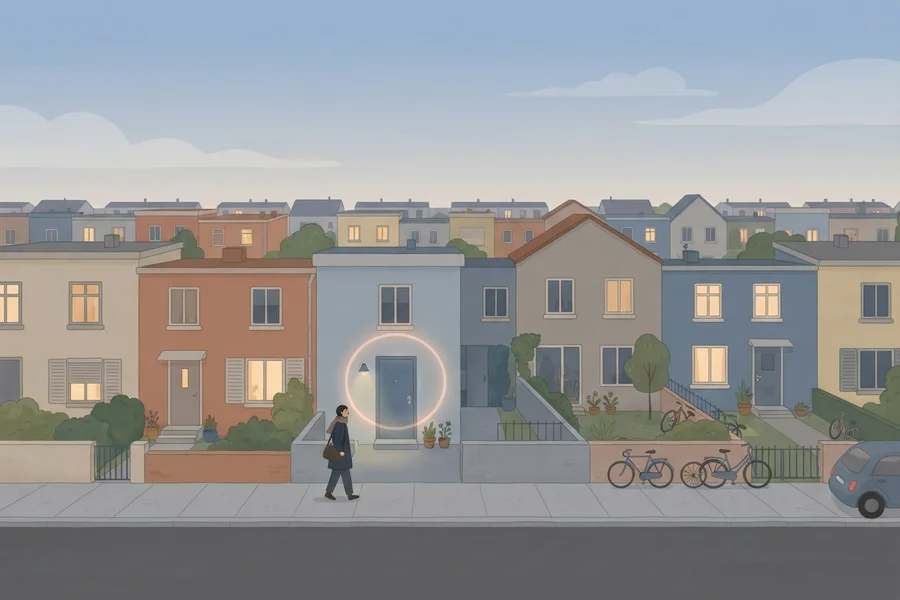
The Marked Door. Occasional Signs of Panic Attacks
Somewhere in your answers, the wave shows up — not as a constant companion, but as something that surfaces in a recognizable handful of situations. A specific place, a specific kind of morning: it has a shape, and the shape is narrow.
Most of your days still run without this pattern touching them. You're not restructuring your week around it, and it hasn't become the lens you view your plans through. But in the situations where it does show up, it costs more than it looks like from outside — an extra minute of bracing, a route picked with it half in mind.
The strength is real: this hasn't taken over the map of your life, only a corner of it. The cost sits quietly in that corner, easy to underestimate because the rest of the week looks completely ordinary.
What one sitting like this can't tell you is whether that corner is shrinking, holding steady, or slowly growing — that's something only time, not a single self-report, can show.

The Fork in the Path. Noticeable Signs of Panic Attacks
Your answers land squarely in the middle of this scale, and that's a genuinely mixed picture rather than an unclear one. In some situations the wave, the racing interpretation of a sensation, or the urge to avoid something shows up; in others, closely resembling the first, it doesn't.
That inconsistency is the actual finding here, not a hedge. Depending on the day or the place, this pattern is either present and noticeable or barely there at all — which can make it hard to predict, for you as much as for anyone watching from outside.
The upside is that this hasn't settled into a fixed routine you have to work around every time. The harder part is the unpredictability itself: not knowing in advance which version of a familiar situation you'll get.
That unevenness is worth paying attention to on its own terms, whatever you decide to do about it next.

The Rerouted Map. Frequent Signs of Panic Attacks
Across most of what this test asks about, the pattern is active: the wave comes often enough to feel like a regular feature of your weeks, a racing heart gets read as an emergency more often than not, and specific places or kinds of exertion have started getting sidestepped rather than faced.
You can see it in the small planning decisions — leaving early "just in case," picking a seat near the door, cutting a workout short at the first sign of it. None of these choices are dramatic on their own, but together they've started to reroute how you move through an ordinary week.
Work still happens, plans mostly get kept, life continues — that persistence is real and worth naming. But keeping all of that going now takes ongoing effort it didn't used to, and that effort is the cost showing up underneath the persistence.
At this level, it's a good time to mention this to a doctor or therapist — an ordinary check-in, much like raising any other recurring physical pattern, and a chance to get a second, trained read on what's going on.

The Window Seat. Pronounced Signs of Panic Attacks
Nearly every part of this pattern shows up strongly in your answers: the wave arrives close to automatically, a racing heart reads as danger almost every time, and the worry about the next one rarely fully lets up between episodes.
The avoidance has real reach now — specific places, specific kinds of exertion, specific situations get sidestepped as a matter of course, and staying close to an exit or a particular person has become part of how you get through the ones you don't avoid.
You're still finding ways through your days, and that persistence counts for something. But the amount of quiet engineering behind an ordinary afternoon has grown, and it's reasonable to assume it's costing you more than it shows from the outside.
A conversation with a doctor or therapist is a sensible next step here — not an emergency, not a verdict, just a practical way to get support for a pattern this present in your daily life.
Your results are no accident
The classic 16-type personality test rooted in Jung's typology has been rebuilt from the ground up: a new CoreTypes methodology, and a far higher level of accuracy. These might be the most useful ten minutes you'll ever spend on yourself: you walk away with the key to your decisions, your relationships and your results — and it's yours for good.
Take the free testFrequently Asked Questions
Can this test diagnose panic disorder?
No. A diagnosis is made by a clinician — a primary care doctor, psychiatrist, psychologist, or clinical social worker — who looks at when your symptoms started, how often they happen, how they affect your life, and rules out physical causes with an exam and bloodwork. A single self-report sitting like this one can't do any of that; it can only describe the pattern you're reporting right now.
What's the difference between a panic attack and panic disorder?
A panic attack is a common experience — a sudden wave of intense fear that can happen to almost anyone, often just once. Panic disorder is a much rarer clinical diagnosis: it requires repeated, unexpected attacks plus at least a month of ongoing worry about the next one, or a real change in behavior because of that worry, and it's something a clinician establishes over time, not from one attack alone.
How accurate is this panic disorder test?
It's an honest snapshot of how you're describing your own current pattern — how often the wave hits, how you interpret bodily sensations, how much you worry between episodes, and what you've started avoiding. That's as far as any single sitting can go. It doesn't replace the exam, bloodwork, and time a clinical evaluation uses to reach an actual diagnosis.
What should I do with my result?
Treat it as information about a current pattern, not a verdict on who you are. If your result named frequent or pronounced signs, that's a reasonable, ordinary reason to bring the pattern up with a doctor or therapist — there's no need to wait for a crisis to have that conversation.
Methodology
This test is built around five patterns commonly described in the panic-attack literature: how often a sudden wave of fear or discomfort shows up, how a bodily sensation in the moment gets read as an emergency, the background worry about the next episode, avoidance of specific places, and avoidance of specific physical sensations or triggers. It draws on that body of work rather than reproducing any single published screening instrument.
What it measures is your own, present-day report of how often and how strongly these patterns show up for you — not a clinical diagnosis, not a severity score, and not the length-of-time criterion a clinician uses to distinguish an isolated scare from an ongoing disorder.
A short self-report has real limits. It can't rule out a physical cause behind a racing heart, the way an exam and bloodwork can. It can't track how long a pattern has actually lasted, and it can't tell your experience apart from a different condition that happens to look similar from the outside.
This test is not a diagnostic tool and isn't a substitute for an evaluation by a doctor or mental health professional. For general background, see the National Institute of Mental Health; if you're wondering where to start a conversation about what you're experiencing, the NHS overview of panic disorder is a reasonable, non-alarmist place to look.
References
- Clark, D. M. (1986). A cognitive approach to panic. Behaviour Research and Therapy, 24(4), 461–470. doi:10.1016/0005-7967(86)90011-2
- White, K. S., Brown, T. A., Somers, T. J., & Barlow, D. H. (2006). Avoidance behavior in panic disorder: The moderating influence of perceived control. Behaviour Research and Therapy, 44(1), 147–157. doi:10.1016/j.brat.2005.07.009
- de Jonge, P., Roest, A. M., Lim, C. C. W., et al. (2016). Cross-national epidemiology of panic disorder and panic attacks in the World Mental Health Surveys. Depression and Anxiety, 33(12), 1155–1177. doi:10.1002/da.22572.