Soulmate Quiz
Answer 24 quick questions about how you read a new connection — no memorized facts, just what actually feels true to you. At the end you’ll get one of four results built from two separate beliefs about what makes two people a good fit. Takes about 6 minutes.

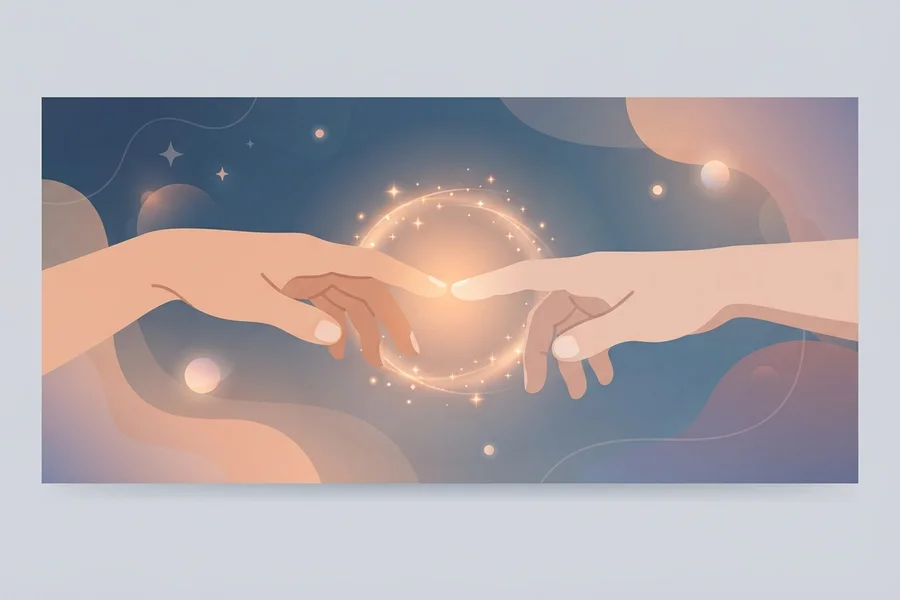
Both Hands In — an early spark feels like real evidence, and you keep working to make it hold
You read an early, strong sense that something fits as real information, not proof beyond doubt but a signal worth trusting. At the same time you don't treat that feeling as the finish line: a disagreement, some distance, or an awkward stretch doesn't shake your sense that this is worth staying in, and you keep showing up to work through it.
That combination — trusting the spark and still doing the work — tends to hold up best specifically when the person across from you actually turns out to be close to what that early read promised. When the fit really is good, both halves of what you believe point the same direction, and that alignment is a real, documented advantage, not a coincidence.
The tradeoff is quieter. Because the early signal carries real weight for you, a partner who doesn't quite match that first impression can leave you working harder than the situation calls for, propping up a read that was never confirmed. What that first spark actually promised is something only time with an actual person can answer — this pattern can't answer it for you.

The Instant Verdict — a strong early feeling does most of the deciding, and friction reads more like a verdict than something to work through
A strong early feeling of rightness carries a lot of weight for you. Once it's there, doubt tends to register as a sign the fit itself might be wrong, rather than as an ordinary bump along the way — you're quick to size up a connection from how it starts, and slower to reach for the idea that friction is simply something to work through.
That pattern is linked to real conflict and to pulling back sooner, specifically in situations where the actual person doesn't match the early read as closely as hoped. The same early trust that feels so clarifying when the fit is genuinely good can just as easily read an ordinary rough patch as a verdict on the whole thing.
None of that makes the instinct wrong. It just means the early read is doing more work in your relationships than the friction itself usually deserves — worth remembering, since an early impression, however strong, is still only one impression.

Built, Not Born — you're not counting on an early sign, but effort is where your trust goes
An early this-feels-right moment doesn't carry much weight for you on its own — you'd rather watch what actually happens over the weeks and months that follow. Effort is where your real trust goes: a disagreement worked through, a difficult stretch gotten past together, small ongoing investment quietly adding up to something.
That pattern is specifically linked to relationships holding up better under strain and to satisfaction that lasts rather than fades. Staying engaged through friction, instead of either taking it at face value or leaning on an early sign to explain it away, is a documented strength of this way of reading a connection.
The quieter cost is patience. Because you're not leaning on an early signal to reassure you, the payoff can take longer to show up, and a new connection can feel less certain early on than it might for someone who trusts a first impression more. What you're building has to actually get built before it shows its value — there's no early shortcut for that reassurance, and you tend to be fine with that.

Plain Sight — neither belief does much of the filtering, so you go by what's actually there
Neither of the two lenses this quiz measures does much of the filtering for you. An early this-feels-right moment doesn't carry outsized weight, and friction doesn't automatically get read as something to actively work through either — you're simply less likely to reach for either framework than most people are.
That doesn't mean nothing is happening; it means what does happen tends to be read more directly. A disagreement mostly registers as a disagreement. A partner's actual qualities register as exactly that, largely unfiltered by a meant-to-be glow or a we-can-build-this determination pulling in either direction.
This combination isn't a leftover where the other three results have something and you don't — it's its own real position, reasoned out from what the other two beliefs are each independently known to do, rather than a group studied on its own terms. Without either lens turned up high, what actually happens between two people carries the most weight for you, plainly, on its own.
Your results are no accident
The classic 16-type personality test rooted in Jung's typology has been rebuilt from the ground up: a new CoreTypes methodology, and a far higher level of accuracy. These might be the most useful ten minutes you'll ever spend on yourself: you walk away with the key to your decisions, your relationships and your results — and it's yours for good.
Take the free testFrequently Asked Questions
Can a soulmate quiz actually tell me who my soulmate is?
No — this quiz reads your own belief pattern about why a connection ends up feeling right, not a way to identify or predict a specific person. Nothing about the questions or the result points at anyone in particular; it points back at you.
What if I already have a partner — does that change my result?
No. This isn't an evaluation of any specific relationship or the partner in it; it's a read on the general belief pattern you carry, and that pattern applies whether you currently have a partner, used to, or don't right now.
Is there actually such a thing as a soulmate?
Not as a scientific concept — "soulmate" is a cultural idea, not something researchers can measure directly. What is real and measurable is a person's belief style about how two people end up being right for each other, which is exactly what this quiz scores.
How do you know if someone is your soulmate?
There's no external checklist for that in the research this quiz draws on. What this quiz can tell you is your own belief style about relationship fit — not a verdict about any specific person you have in mind.
Is this based on real psychology, or is it just for fun?
It's built on a real, decades-old research tradition measuring two independent beliefs about what pulls a relationship together. Each belief is common and normal to hold at any level. That said, it's a self-report tool describing a belief pattern — not a diagnostic instrument, and not a predictor of how any one relationship will turn out.
Methodology
This quiz is built on the approach of relationship research that treats "the right fit" as shaped by two separate beliefs, not one. One belief is about whether an early, strong sense that something clicks should be trusted as a fixed signal about where things are headed. The other is about whether closeness is something two people build through ordinary effort, not something simply present from the start. Each belief is scored on its own, and where the two land together becomes your result.
Because the two beliefs are measured independently, landing high — or low — on one says nothing about where you'll land on the other. Both are common, ordinary positions to hold at any level; neither is treated here as the healthier one, and documented patterns tied to each are described honestly, never as a verdict on your character.
A few honest limits are worth naming. "Soulmate" itself is a cultural idea more than a scientific one — nothing in the research behind this quiz treats it as a measurable thing. What is measurable, and what this quiz actually scores, is your belief style about what actually makes two people suited to each other. Your result doesn't forecast what will happen in any relationship, and it isn't a verdict on a partner who never answered a single question here. It's a self-report snapshot of a belief pattern, not a diagnostic tool and not evidence about how any real relationship of yours is actually going.
References
- Knee, C. R. (1998). Implicit theories of relationships: Assessment and prediction of romantic relationship initiation, coping, and longevity. Journal of Personality and Social Psychology, 74(2), 360–370.
- Knee, C. R., Patrick, H., & Lonsbary, C. (2003). Implicit theories of relationships: Orientations toward evaluation and cultivation. Personality and Social Psychology Review, 7(1), 41–55.
- Franiuk, R., Cohen, D., & Shaver, P. R. (2002). Implicit theories of relationships: Implications for relationship satisfaction and longevity. Personal Relationships, 9(4), 345–367.