Sensory Processing Disorder Test
You’ll answer 18 short questions about how touch, sound, light, smell, movement, and your body’s own signals show up in daily life. It takes about four minutes, and at the end you’ll get a plain-language read on how much these patterns affect your everyday life right now.

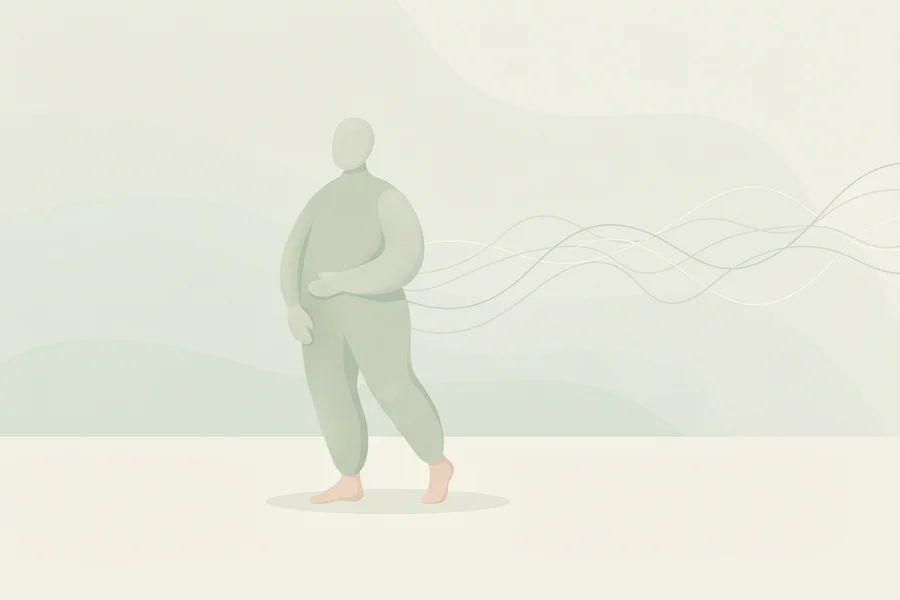
The Quiet Baseline. Your Senses Barely Raise Their Voice.
Across touch, sound, sight, smell, movement, and body signals, your answers land close to how things seem to register for the people around you. A loud room, a scratchy sweater, a bright hallway — none of it asks for special handling from you.
You put on whatever's in the drawer without checking the tag first, sit through a fluorescent-lit meeting without noticing the flicker, and get through a task in whatever kind of room you happen to be in that day.
That's a real strength, even if it doesn't feel like one: your routines, your wardrobe, your commute don't need to be built around what your senses can tolerate. Whatever energy that would take is free for other things.
None of this means a strong, isolated reaction has never caught you off guard — a genuinely awful smell, one impossibly itchy tag. A one-off like that is common on its own and doesn't say anything about a repeating pattern; it's simply not what today's answers describe.
What today's answers can't say is whether that one memory means more than it seems to — this test only asked about the pattern as it stands right now.
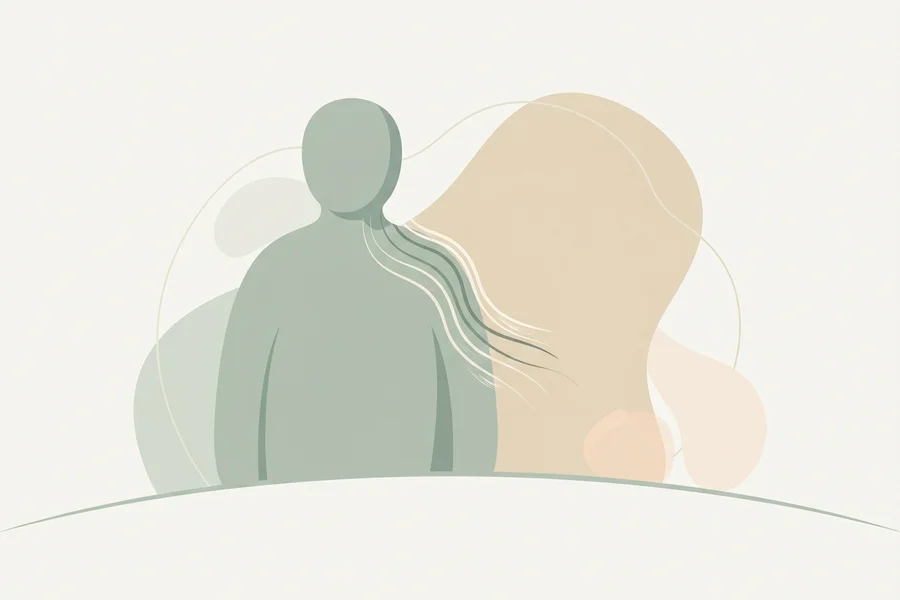
The Occasional Snag. A Few Spots Still Catch You Off Guard.
A narrow, specific set of situations still catches you — not the whole day, not every day, but ones you could point to by name. Outside of those, touch, sound, sight, smell, and movement register close to how they seem to for the people around you.
A particular fluorescent light in one hallway gets you every single time you walk under it; the nearly identical fixture two doors down never has.
Nothing about your day gets planned around your senses by default — the wardrobe, the commute, the weekly routine all hold up fine without adjustment, day after day.
But the situations that do catch you cost more than they look like from outside — a bit of avoidance here, some quiet preparation there, attention spent on something nobody else in the room seems to notice.
One sitting like this can't tell you whether this particular pattern has held steady for years or belongs to this one stretch of life — that part stays open.

The Mixed Signal. Your Senses Can't Agree From One Day to the Next.
Your answers land in a genuinely mixed spot — not a clear yes, not a clear no, but a real pattern that depends on which situation and which sense is involved.
A certain sound might catch you every time while a similar one never does; a texture that derails one afternoon barely registers the next. The inconsistency itself is the honest finding here, not a sign the test came up short.
That variability is workable. You're not carrying a constant weight, and plenty of days go by without any of it coming up at all.
The cost shows up unevenly too: some weeks nothing about touch, sound, sight, smell, or movement asks anything of you, and then a single afternoon needs real recovery time for reasons that aren't always obvious in the moment.
What decides which days land which way — the setting, the specific stimulus, something else entirely — isn't something eighteen questions can pin down on their own.
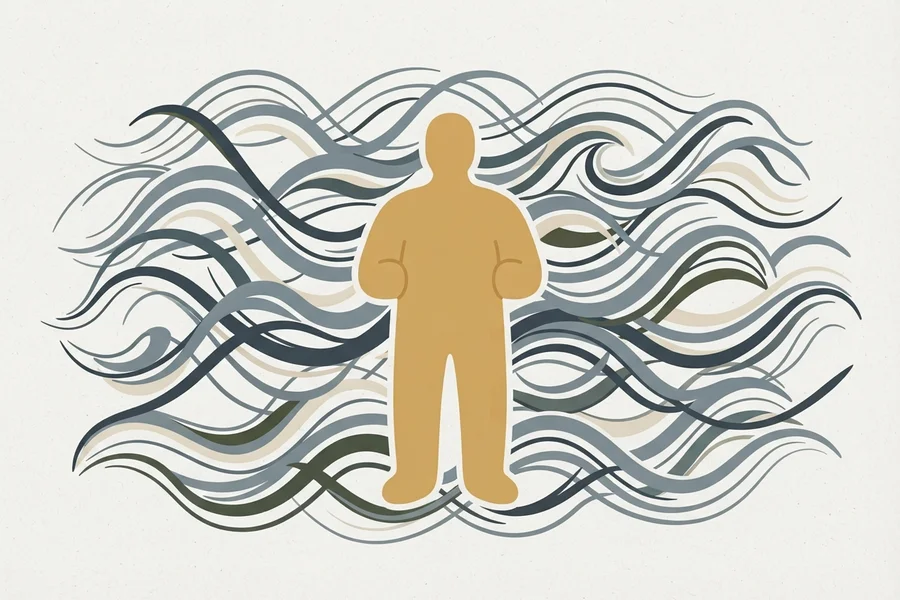
The Rerouted Day. Your Senses Are Steering More Than You'd Guess.
Sensory-processing differences show up often for you, across five or six of the areas this test covers, and they've started to shape choices you make before you've fully thought about why.
What's worn gets chosen partly for the fabric, not just the look. Meals get picked around texture as much as taste. A day's plans quietly route around the loudest room, the brightest aisle, the crowd that would otherwise mean noise from every direction.
You've built real workarounds, and the day still gets managed, one adjustment at a time — that takes a kind of practical skill that doesn't get much credit.
The cost of that skill is visible, though: the rerouting, the substitutions, the mental math before a plan gets made are real weight, even when the day still comes together fine on the other side.
Talking this over with an occupational therapist — the professional this field turns to for exactly this kind of pattern — is a reasonable next step from here, not an emergency one. What that conversation would actually surface about your own six areas is still an open question.

The Full Current. Your Senses Are Running the Show Right Now.
Sensory-processing differences are strongly present across five or six of the six areas this test covers, and they're already reshaping day-to-day life rather than sitting in the background.
Routines get built around them from the start now — where you sit, what you eat, which stores you avoid, how a room gets scanned for the exit before you've even sat down. It's less a series of one-off reactions than a running condition your day gets planned inside of.
Managing at this level, day after day, takes real, ongoing effort — effort that's easy for people outside it to miss entirely.
That effort has a cost that compounds: fewer places feel easy to be in, and more of each day gets spent adjusting around what your senses are doing.
An occupational therapist can look at a pattern like this directly and help build a plan around it — a reasonable, ordinary step from here, not a last resort. What that would change about your own routines is the part only that conversation can answer.
Your results are no accident
The classic 16-type personality test rooted in Jung's typology has been rebuilt from the ground up: a new CoreTypes methodology, and a far higher level of accuracy. These might be the most useful ten minutes you'll ever spend on yourself: you walk away with the key to your decisions, your relationships and your results — and it's yours for good.
Take the free testFrequently Asked Questions
Does this quiz actually diagnose sensory processing disorder?
No test you take on your own can settle that, this one included — there isn't a single, agreed-upon checklist for this pattern for anything here to be measured against. An occupational therapist can offer something different: a hands-on evaluation with standardized tools, and even then the field talks about "recognizing" the pattern rather than handing down a diagnosis in the usual sense. A strong result here is a reasonable prompt to book that conversation, not a verdict on its own.
Do doctors officially recognize sensory processing disorder as its own diagnosis?
The patterns themselves are well established — researchers have studied how adults over- or under-respond to touch, sound, and light for years. What doesn't exist is agreement among clinicians to treat it as its own separate diagnosis; right now it mainly shows up as one thread inside how autism gets diagnosed, not as a free-standing category with criteria of its own.
Does this apply to adults, or is it strictly a childhood thing?
Plenty of adults describe exactly this — a fabric that won't sit right, a room too loud to think in — and this test was written with that adult experience in mind from the start, not scaled down from something meant for children.
Does a high score mean I'm autistic?
Not on its own. There's a real overlap between these sensory patterns and autistic traits across the population, but it runs loosely, not as a rule — plenty of people report strong sensory reactions with nothing autistic about them at all. This test isn't built to say anything about autism one way or the other.
How is this different from just being a highly sensitive person?
The two get used interchangeably in casual conversation, but they're not measuring the same thing. A highly sensitive person is a broader description of how someone takes in stimulation and emotion generally; this test stays narrower, asking only about six specific channels — touch, sound, sight, taste and smell, movement, and the body's own internal signals.
Methodology
This test looks at eighteen specific patterns tied to how the senses handle everyday input: touch, sound, sight, smell and taste, movement and balance, and how the body flags things like hunger or the need to move. It draws on research into how these patterns show up in adults, not on any single published questionnaire.
What you get back is your own present-day account of how often and how strongly these six areas show up for you — not a diagnosis, and not a rung on any official severity ladder. Clinicians don't currently treat sensory processing disorder as its own free-standing diagnosis, so there's simply no clinical scale to place a self-report tool on; what this can honestly hand you instead is how much these patterns are shaping your life right now.
These sensory patterns turn up on their own plenty of the time, with no autism involved, even though the two loosely overlap across the population — this test isn't built to say anything about autism either way. They're also their own thing apart from everyday stress or anxiety, only lightly connected to either, not a stand-in for measuring them.
A short self-report has real ceilings: it can't substitute for the kind of in-person, standardized evaluation an occupational therapist would run, and it can't say whether what you're reporting today has held steady for years or belongs to a rough patch.
This isn't a diagnostic tool, and it doesn't replace an evaluation by a qualified professional. For a plain-language overview of the condition, the Cleveland Clinic's overview is a solid starting point; for how the concept has been classified and measured over time, see its entry on Wikipedia.
References
- Tavassoli, T., Hoekstra, R. A., & Baron-Cohen, S. (2014). The Sensory Perception Quotient (SPQ): development and validation of a new sensory questionnaire for adults with and without autism. Molecular Autism, 5, 29. doi:10.1186/2040-2392-5-29.
- Metz, A. E., Boling, D., DeVore, A., Holladay, H., Liao, J. F., & Vander Vlutch, K. (2019). Dunn's Model of Sensory Processing: An Investigation of the Axes of the Four-Quadrant Model in Healthy Adults. Brain Sciences, 9(2), 35. doi:10.3390/brainsci9020035.
- Chang, M., Liu, C.-J., & Blanche, E. (2022). Sensory processing correlates with depression and perceived stress in older adults. Innovation in Aging, 6(Suppl 1), 691. doi:10.1093/geroni/igac059.2534.