Aphantasia Apple Test
This short test asks you to picture five familiar things — an apple, a face, your front door, a favorite piece of clothing, a route you know well — across fifteen quick questions, and tells you how vivid your mental pictures tend to be. Takes about 4 minutes.


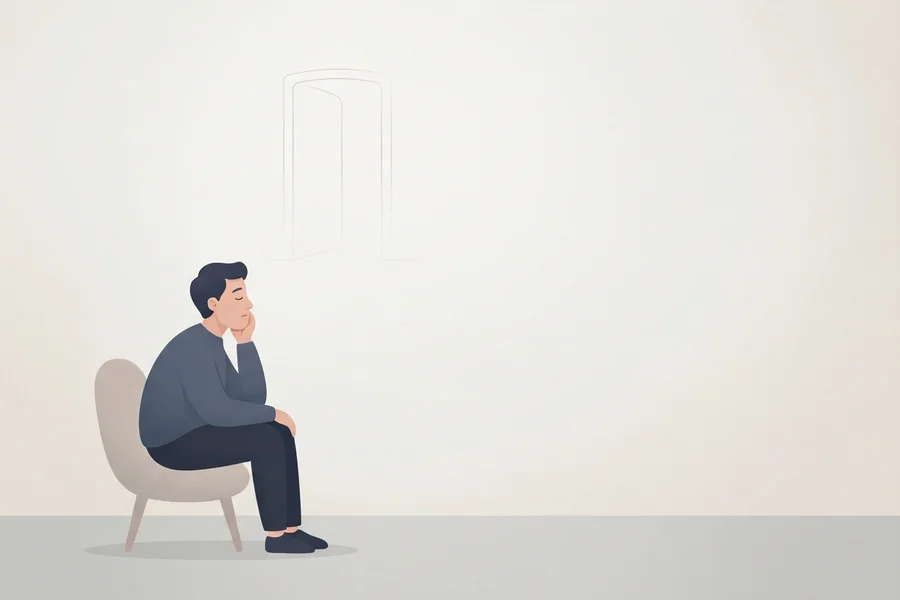
The Wordkeeper. You picture in facts, not images.
When you try to call up something familiar — an apple, a doorway, a face — nothing visual arrives. You land on the fact of the thing straight away: its color, its shape, where it sits. No picture rides along with that knowledge.
Someone can describe a room in loving detail and you’ll follow every word, but nothing renders behind your eyes while they talk. Told to ‘just picture it,’ you find there’s nothing to look at — only accurate, complete knowledge of what’s being described.
This is one real, ordinary end of how people experience their own thinking, not a deficiency — closer to being left-handed than to anything broken. Your mind runs on words, structure, and the other senses instead of pictures, and manages fine without needing one.
The cost shows up in moments built around picturing on purpose — a guided visualization, someone’s ‘close your eyes and imagine’ — which can land flat, since there’s no image there to meet the invitation.
What’s left unanswered is whether this has always been true for you or started at some point, and whether it reaches past pictures into imagined sound or touch.
The Faint Trace. Your mental pictures are little more than flickers.
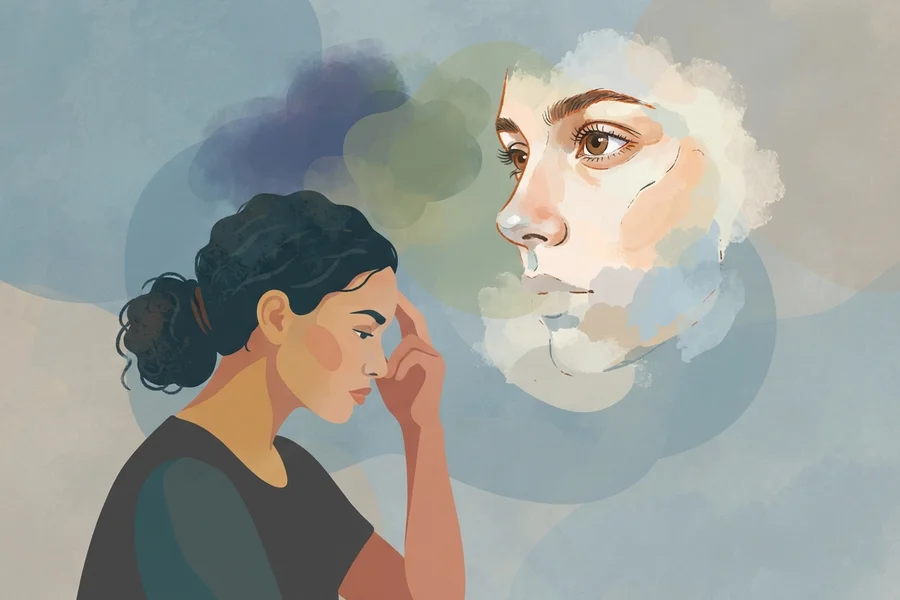
Across what you just pictured — an apple, a face, the walk you know by heart — the pattern was closer to a trace than to a picture: a flicker of color or shape, gone before there was much to look at.
Someone hands you a photo for a minute and takes it away, then asks what you remember, and what surfaces feels a lot like this: a passing impression rather than a picture you could still study.
The upside is the one minimal imagery gets too: little of your thinking depends on holding a picture steady, so you’re not left stuck when nothing forms in the first place.
The trace itself is hard to lean on. It rarely holds long enough to check a detail against it or add anything new, so you’re left going on a flash rather than a proper look.
Whether that flicker would grow sturdier with deliberate practice is a question no one has a proven answer to yet, and this isn’t the place to promise one.
The Steady Sketch. Your mental pictures are real, if quiet.
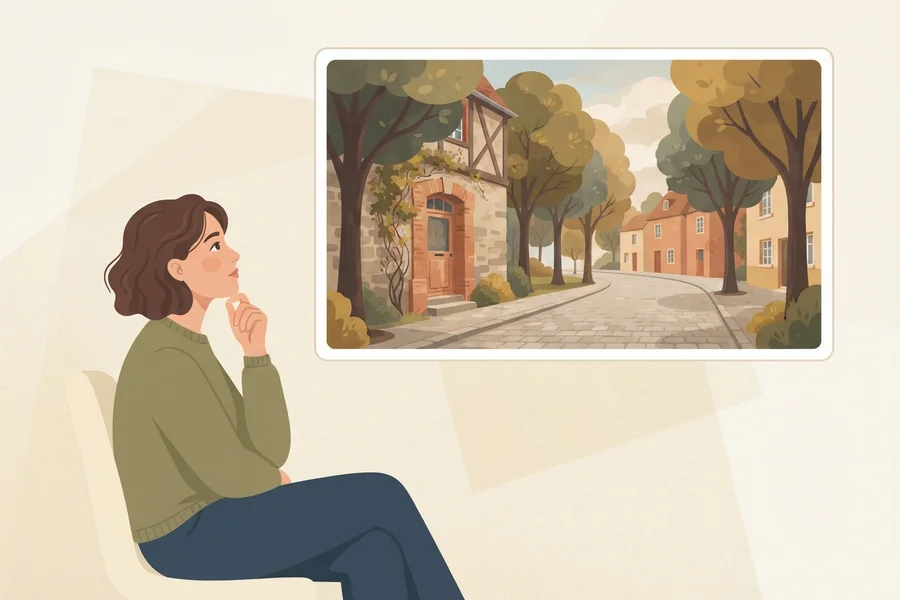
A picture shows up for most of what you tried to call to mind — an apple, a face, a place you know — with real color and shape, if not sharp ones. It’s recognizably a picture, not just a flicker or a bare fact.
It takes a bit of doing to keep in place. Told to hold an image steady and look it over, you can, but you notice the effort — it’s not the kind of picture that just sits there waiting.
The strength is that pictures are available to you without much fuss to summon in the first place — a real, working tool, not something you have to fight for out of nothing.
The trade-off is precision: a modest picture isn’t always detailed or steady enough to lean on for something that genuinely needs sharp visual accuracy, like matching a color exactly from memory.
This sits in the wide, ordinary middle most people land in — common ground, not a borderline or unclear reading of anything.
The Clear View. Your mental pictures come through bright and steady.
A picture forms readily for nearly everything you tried to call to mind, and it holds — real color, real shape, close enough to feel like you’re actually looking rather than remembering.
Ask yourself to check a detail — which way the light falls, what shade something is — and you don’t have to guess. The picture is steady enough to look over rather than just recall.
The strength is reliability: pictures are a ready tool, easy to call up and to study once they’re there, whether you’re navigating somewhere new or just trying to place a face.
The same ease cuts the other way. An unwanted or upsetting picture is exactly as easy to summon and just as hard to put down once it’s arrived — vividness doesn’t come with a filter for which pictures you’d rather not have.
This sits in the wide, ordinary middle most people land in too — the richer half of it, not an exceptional or rare result on its own.

The Living Picture. Your mental pictures arrive almost like sight itself.
Nearly everything you tried to picture came through richly detailed and steady — real color, real shape, and a felt sense that’s close to actually seeing the thing rather than imagining it.
There’s little gap between deciding to picture something and having it fully there: an apple, a face, a doorway arrives whole, ready to be looked over rather than pieced together bit by bit.
This sits at the other end of the same ordinary, balanced spread minimal imagery sits at — a real variation, not a superior state, with its own advantages and its own costs, same as the other end has.
The cost mirrors the strength exactly: a picture this ready to form is just as ready to form uninvited. An unwelcome image can arrive with the same ease and vividness as a wanted one, and be just as hard to set aside.
What’s left unanswered is whether this vividness reaches into imagined sound or touch too, and whether it ever competes for attention with whatever else you’re doing — two questions this set of fifteen didn’t ask.
Your results are no accident
The classic 16-type personality test rooted in Jung's typology has been rebuilt from the ground up: a new CoreTypes methodology, and a far higher level of accuracy. These might be the most useful ten minutes you'll ever spend on yourself: you walk away with the key to your decisions, your relationships and your results — and it's yours for good.
Take the free testFrequently Asked Questions
Is the aphantasia apple test actually accurate?
One single mental image is genuinely too thin to say much on its own — that’s true even in the research the original viral image is based on. This test spreads the same question across fifteen prompts and five different pictures instead of one, for a steadier read than a single glance at a drawing can give. It’s still a self-report reflection, not a lab-validated diagnostic tool.
How is this different from the real aphantasia questionnaire researchers use?
Same basic idea — asking about several different pictures you deliberately call to mind — but this is its own short, self-report version, not a substitute for the longer, validated questionnaire researchers use in studies. Think of it as a quick reflection, not the scientific instrument itself.
What does it mean if I get a very low, “no image” result?
It means pictures register faintly or not at all for you when you deliberately try to call one up. That’s a real, well-documented pattern and far from rare — not a sign that anything is wrong with how you think.
Is aphantasia a disorder or a disability?
No. Both the researcher who named the phenomenon and major health-information sources are clear that neither end of this spectrum — no images or extremely vivid ones — is a medical condition, disorder, or disability. It’s a documented, ordinary variation in how people experience their own thinking.
Can this change over time, or is it something you’re born with?
It’s usually lifelong and present from early on, though it can also start later in life for some people. There’s no proven method that reliably trains it away or brings it on in either direction, as far as current research shows.
Methodology
This test is built around the same real skill aphantasia research studies: how clearly you can deliberately call up a familiar picture in your mind — an apple, a face, a doorway, a piece of clothing, a walk you know well. Fifteen questions, spread across five everyday things, cover three angles: how much detail shows up, whether it feels like seeing or just knowing, and how long a picture holds once it forms.
There’s a well-known image people use to compare their own mental picture of an apple against a printed reference. Nothing here can show you that reference, time your answer, or grade your picture against a right one — so instead of one glance at a single image, this test asks in words, across several different pictures. That trade is a strength, not a shortfall: worded questions about several things give a steadier read than one glance at one image ever could.
Neither end of the result — no pictures at all, or pictures as vivid as looking — is a medical condition, a disorder, or a disability. It’s a real, documented, ordinary variation in how people experience their own thinking, in the same category as being left- or right-handed. The APA’s definition of imagery and the Cleveland Clinic’s overview of aphantasia both make this point directly.
A short self-report reflection like this isn’t the same as a full, validated questionnaire run under controlled conditions, and it doesn’t diagnose or certify anything about you.
References
- Marks, D.F. (1973). Visual imagery differences in the recall of pictures. British Journal of Psychology, 64(1), 17–24. doi:10.1111/j.2044-8295.1973.tb01322.x
- Zeman, A., Dewar, M., & Della Sala, S. (2015). Lives without imagery — congenital aphantasia. Cortex, 73, 378–380. doi:10.1016/j.cortex.2015.05.019
- Wright, D.J. et al. (2024). An international estimate of the prevalence of differing visual imagery abilities. Frontiers in Psychology, 15, 1454107. doi:10.3389/fpsyg.2024.1454107