
Depression Signs Test
Questions: 24Time: ≈ 5 min
Answer 24 short questions about the last two weeks, picking the scene that sounds most like yours. This is not the PHQ-9 questionnaire itself but a separate test on the same topic. It takes ≈5 minutes, and at the end you see the level of signs of depression that fits your answers right now.


Depression Signs Test: your result
Right now, your signs of depression are at a minimal level.
Across the eight areas this test looks at, little of what it asks about showed up in your last two weeks. Mood, sleep, energy, appetite and focus have kept their usual shape, and where something did flicker, it never called for effort to get through a day.
That doesn't make for a life without weather. Everyone has a low afternoon, a rough night, a stretch when the mind won't stay put, and a minimal result doesn't claim that none of those happened to you. It says only that these patterns are not a standing feature of the last two weeks.
And it says only that. The result covers a two-week window and nothing beyond it, so it can't tell you whether things looked different earlier or will look different later. If your mood shifts, the test will be here to take again.

Depression Signs Test: your result
Right now, your signs of depression are at a mild level.
A handful of the eight areas made themselves felt over the last two weeks. When they do, they're unpleasant, but you've kept going: work gets done, plans get kept, and the people around you meet the usual you.
Your strength here is that much of the two weeks carried no extra load. Long stretches of your days run clean, and you can tell those apart from the heavier ones.
The cost sits in the details. Certain days or situations take more effort, more time or more catching up than anyone watching would guess, and the things that used to reward you may pay out a little less.
One snapshot of two weeks can't say whether this is a passing patch or something that has settled in. What it does give you is a clear picture of where things stand right now.

Depression Signs Test: your result
Right now, your signs of depression are at a moderate level.
More of the eight areas are speaking up together than at a mild level. Mood, sleep and focus may all be registering at the same time instead of one by one, and that combination is what places you here.
The friction sits between manageable and marked. Your routines and your relationships can feel it, though neither is run by it yet: you get through the day, and you notice what the getting-through costs.
Nothing in this result asks you to play that down. A day that takes extra effort is a real day with a real price, even when from outside it looks like any other.
What you're reading describes the last two weeks, a snapshot rather than a verdict. It's a fair reason to watch how these areas move over the coming weeks.
Depression Signs Test: your result
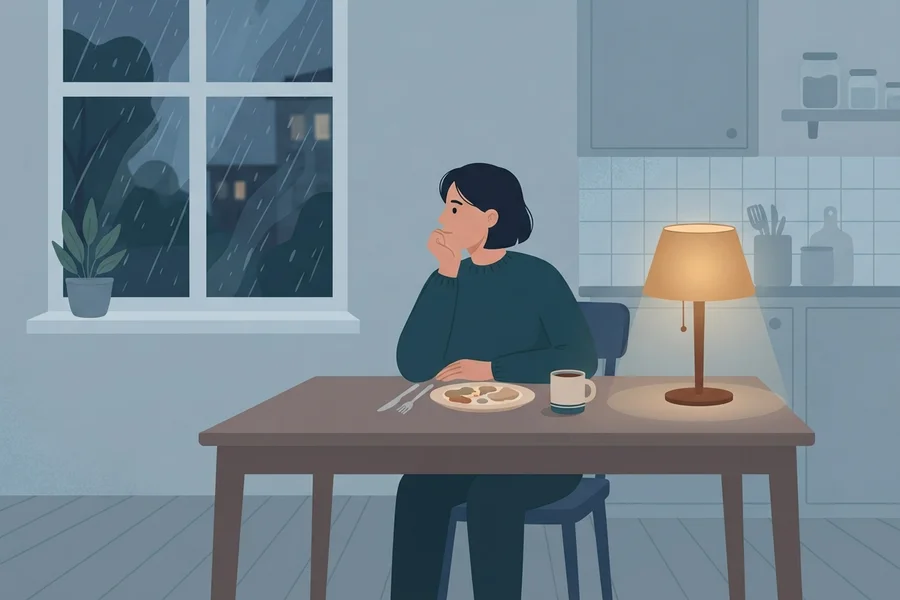
Right now, your signs of depression are at an elevated level.
Most of the eight areas were involved over the last two weeks, and they stayed with you through the days rather than turning up for an hour here and there. Getting through ordinary routines is taking noticeably more active effort than at a moderate level.
You may have been doing much of that work quietly, so it's worth saying out loud. Talking this over with a doctor or another health professional is an ordinary, reasonable next step, and there's no clock on it.
A result like this can't say what lies behind it. A demanding stretch of life, grief or another health condition can produce a similar pattern of answers, and sorting that out is what a conversation with a professional is for.
None of this is a judgement of you. It describes two weeks.

Depression Signs Test: your result
Right now, your signs of depression are at a pronounced level.
Nearly all of the eight areas were present together through the whole of the last two weeks. At this level the strain is serious, and daily routines, work and relationships are likely to be feeling it.
Talking this through with a doctor or a mental health professional is an ordinary, sensible step, and it deserves a place on your list whatever else is crowding it. No deadline attaches to it; you can choose a moment that suits you.
This result describes what you reported about two weeks. It isn't a diagnosis, and it can't say whether these patterns come from depression itself or partly from something else that overlaps with it.
Answering these questions put into words something that can be hard to say. A conversation can start from exactly there.
Your results are no accident
The classic 16-type personality test rooted in Jung's typology has been rebuilt from the ground up: a new CoreTypes methodology, and a far higher level of accuracy. These might be the most useful ten minutes you'll ever spend on yourself: you walk away with the key to your decisions, your relationships and your results — and it's yours for good.
Take the free testYour result card
More tests like this
 Paranoia Test
A 15-question self-report test on how often suspicion, mistrust, and guardedness show up for you. Not a diagnosis, just your own patterns reflected back.
 Panic Disorder Test
See how often sudden waves of fear catch you off guard, and how far they've started to shape your choices. A private panic disorder test, about 4 minutes.
 Mental Illness Test
A 21-question self-report test matching which of seven patterns — depression to ADHD — fits what you've noticed in yourself lately. Not a diagnosis.
How this test works
Methodology
The result here is a self-report and nothing more: your own account of the last two weeks, turned into a level. The same answers can come from a hard period in life, from grief or from another condition, and no questionnaire can sort those apart. To see how screening tools of this kind are meant to be read, try MedlinePlus on depression screening.
The five result levels use score ranges set by us. Studies of screening questionnaires have not found one sharp line that separates people cleanly, so the borders between our levels are soft, too.
The test is based on the approach of openly published research on depression in everyday life, with the last two weeks as the window. Eight areas are covered: focus, sleep, appetite, mood, energy, the pull of things you enjoy, self-worth, and how quickly and expressively you move.
It is not the PHQ-9 questionnaire and doesn't pretend to be. Questions, answer steps and score ranges were all written for this site, and one area from the original questionnaire has been left out on purpose.
This is not a diagnostic tool, and it doesn't replace a doctor or a therapist. Depression can only be assessed by a trained professional, in a conversation that takes in your whole history. If the result concerns you, or you would simply like to talk it over, the NIMH page on finding help is a good place to start.
Frequently Asked Questions
Is this the real PHQ-9?
No. It is a separate test on a similar subject, written from scratch, with its own number of questions and its own result levels. It doesn't hand out the well-known questionnaire's score, so a result here shouldn't be quoted as that score to a doctor or anyone else.
Can an online depression test diagnose depression?
No. A diagnosis comes from a qualified professional who talks with you, asks about your history and weighs your symptoms; a single online questionnaire can't do that. What you get here is a snapshot of how the last two weeks felt, in your own words. If you'd like to talk to someone, the NIMH guide to finding help lists where to turn.
How accurate is a depression screening test?
Treat the result as a starting point for thinking, not as a measured figure. This test hasn't been through formal validation. In the studied versions of checklists like it, answers line up well with a clinician's interview but not perfectly, and researchers don't agree on one exact cutoff.
Can I take a depression test on my own?
You can, and it's meant to be taken that way: nobody has to read the questions to you, and it takes about five minutes. Afterwards, whatever level appears, a conversation with a health professional about how you've been is a fair next step if you want one.
Is a depression test the same as an anxiety test?
Worry and low mood often turn up together, which is why people mix the two up, but they are separate subjects. Everything this test asks belongs to the depression side, and it doesn't try to stand in for an anxiety questionnaire or any other.
References
- Kroenke K, Spitzer RL, Williams JBW. "The PHQ-9: validity of a brief depression severity measure." J Gen Intern Med. 2001;16(9):606-13. doi:10.1046/j.1525-1497.2001.016009606.x.
- Levis B, Benedetti A, Thombs BD, on behalf of the DEPRESsion Screening Data (DEPRESSD) Collaboration. "Accuracy of Patient Health Questionnaire-9 (PHQ-9) for screening to detect major depression: individual participant data meta-analysis." BMJ. 2019;365:l1476. doi:10.1136/bmj.l1476.
- Bennabi D, et al. "Psychomotor Retardation in Depression: A Systematic Review of Diagnostic, Pathophysiologic, and Therapeutic Implications." Biomed Res Int. 2013;2013:158746. doi:10.1155/2013/158746.
- The Open University. OpenLearn. "Exploring depression: the diagnosis of depression."