
Dermatillomania Signs Test
Questions: 15Time: ≈ 4 min
Answer 15 short questions by choosing the option closest to your own day; none of the options is a right or wrong one. It takes about 4 minutes, and at the end you see your level of skin-picking signs, from minimal to pronounced, with a short reading.


Dermatillomania Signs Test: your result
Barely a ripple Your signs of dermatillomania are minimal.
Your answers show minimal signs of dermatillomania. Skin is something you touch, smooth and rub absentmindedly like anyone else, and that touching stays in the background of your day.
When an urge does appear, it passes. Your attention stays on whatever you were doing, the time you set aside for things stays yours, and nobody around you has to be managed or avoided.
Your strength is how little room this takes up. You get on with what you chose to do, and a habit like this has never asked to run your schedule.
The cost is close to nothing. A short test only records how things stand today, so if your days change, taking it again later will show you.

Dermatillomania Signs Test: your result
A quiet habit Your signs of dermatillomania are mild and limited.
Your answers show mild signs of dermatillomania: a real habit, but a contained one.
You know it is there. A rough patch draws your attention, you pick for a little while, and then you get on with the day. Someone sitting beside you would most likely never see it.
You have kept it in proportion. It takes a slice of your attention and a few minutes, while work, friends and evenings carry on without being rearranged around it.
The price is small but real: those minutes, and a half-formed wish that you did it less. A score cannot say where the pull comes from or whether it will grow or fade. That part you can watch for yourself.

Dermatillomania Signs Test: your result
Common ground Your signs of dermatillomania are in the ordinary middle for this test.
Your answers land in the ordinary middle of what this test measures. That is a normal place to land, and nothing in it says something has gone wrong.
Part of your picking runs on autopilot and part of it is deliberate. You have tried to rein it in with some success, it costs you some time, and you feel a little exposed when someone notices.
The strength here is that you see the pattern and have already tried to steer it. The cost is a steady trickle of minutes and a bit of self-consciousness, enough to be felt without taking over.
Which part pulls hardest cannot be read from one total. Your own days will show you better than any number.

Dermatillomania Signs Test: your result
A steady pull Your signs of dermatillomania are elevated, clearly above the ordinary middle.
Your answers show elevated signs of dermatillomania, clearly above the ordinary middle of this test.
The pull has become something you feel. Urges can take real effort to let pass, episodes carry you away from what you meant to do, and small arrangements of clothes or seating keep other people from noticing.
A lot is being handled here, and you are handling it quietly. That takes skill and stamina, and it deserves to be seen as such.
The cost is the space this management occupies: attention held in reserve, minutes that go elsewhere, a background hum of watching yourself.
A single total cannot show which of these leads for you. Going back through your own answers, one by one, may tell you more than the number does.
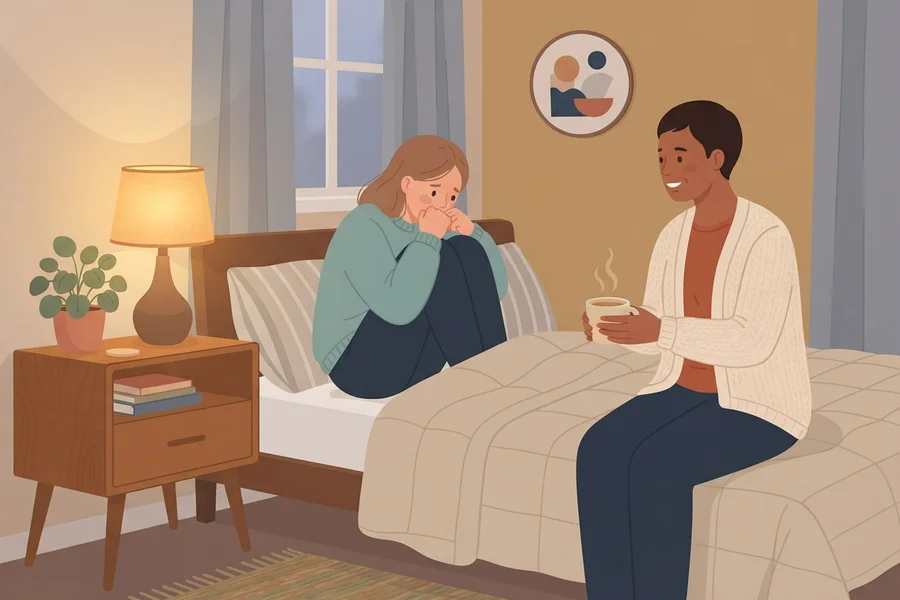
Dermatillomania Signs Test: your result
A lot carried alone Your signs of dermatillomania are pronounced, at the high end of this scale.
Your answers show pronounced signs of dermatillomania, at the high end of this scale.
At this level, urges tend to run strong, stopping is hard, picking takes a large share of the day, and keeping it unseen turns into work of its own. A total cannot show which of these leads for you.
You have held all of this together, largely by yourself, and that took persistence.
The cost is how much of your day, and how much hiding, it has taken.
Speaking with a professional is one option you could consider, and the choice is entirely yours. The methodology section below has a link to a page about where people look for that kind of support, whenever you want it.
Your results are no accident
The classic 16-type personality test rooted in Jung's typology has been rebuilt from the ground up: a new CoreTypes methodology, and a far higher level of accuracy. These might be the most useful ten minutes you'll ever spend on yourself: you walk away with the key to your decisions, your relationships and your results — and it's yours for good.
Take the free testYour result card
More tests like this
 Alexithymia Test
Take the alexithymia test: 22 short situations about naming and describing feelings. See your level of signs, from minimal to marked, in about 5 minutes.
 Teenage Anger Issues Test
Answer 16 short questions about your own anger and see whether it sits within what's typical for your age, at its upper edge, or beyond it. About 4 minutes.
 Panic Disorder Test
See how often sudden waves of fear catch you off guard, and how far they've started to shape your choices. A private panic disorder test, about 4 minutes.
How this test works
Methodology
This test is built on the approach of established self-report research into skin picking: how strong the habit is, how much it gets in the way of daily life, and whether it runs on autopilot or with full attention. Fifteen questions cover five areas, three each: how urges build, automatic versus deliberate picking, efforts to cut back, time lost, and the discomfort and hiding that come with it.
Your answers add up to one level of signs, shown on a single scale and placed in one of five bands. The number rests entirely on how you describe your own behaviour, so it carries no outside observation and no clinical rating. For general information on symptoms, self-help and where to look for support, see the NHS page on skin picking.
This is not a diagnostic instrument, and it cannot stand in for an assessment by a qualified professional. If anything here concerns you, that is the person to talk to.
Frequently Asked Questions
Can this test tell me if I have dermatillomania?
No. Only a qualified clinician can make that call, through a conversation that goes into your history and your daily life. What you get here is a level of signs, described by you, and nothing beyond it. If you want a clear answer, a GP or a mental health professional is the right person to ask.
Is dermatillomania a recognized condition?
Yes. Major systems of clinical classification list it as a distinct pattern, and health services describe it under the name skin picking disorder.
How many questions are in this test, and how long does it take?
There are 15 questions, and most people need about 4 minutes. Each has five answers, you choose the one closest to your own life, and there is nothing to prepare.
Can a habit like this be worked on?
Yes. Support exists, and there are professionals who work with habits of this kind. A clinician can talk through what might suit you. This test does not recommend any particular approach.
References
- Snorrason, I., Ólafsson, R. P., Flessner, C. A., Keuthen, N. J., Franklin, M. E., & Woods, D. W. (2012). The Skin Picking Scale-Revised: Factor structure and psychometric properties. Journal of Obsessive-Compulsive and Related Disorders, 1(2), 133–137. doi:10.1016/j.jocrd.2012.03.001
- Keuthen, N. J., Deckersbach, T., Wilhelm, S., Engelhard, I., Forker, A., O'Sullivan, R. L., Jenike, M. A., & Baer, L. (2001). The Skin Picking Impact Scale (SPIS): scale development and psychometric analyses. Psychosomatics, 42(5), 397–403. doi:10.1176/appi.psy.42.5.397
- Walther, M. R., Flessner, C. A., Conelea, C. A., & Woods, D. W. (2009). The Milwaukee Inventory for the Dimensions of Adult Skin Picking (MIDAS): Initial development and psychometric properties. Journal of Behavior Therapy and Experimental Psychiatry, 40(1), 127–135. doi:10.1016/j.jbtep.2008.07.002