
Religious Trauma Self-Test
Questions: 18Time: ≈ 4 min
Read each of the 18 questions and choose the answer that matches your life today, not how it was back then. There are no right or wrong answers, and it takes about 4 minutes. At the end you’ll see how much your religious past weighs on your daily life now, with a short explanation.


Religious Trauma Self-Test: your result
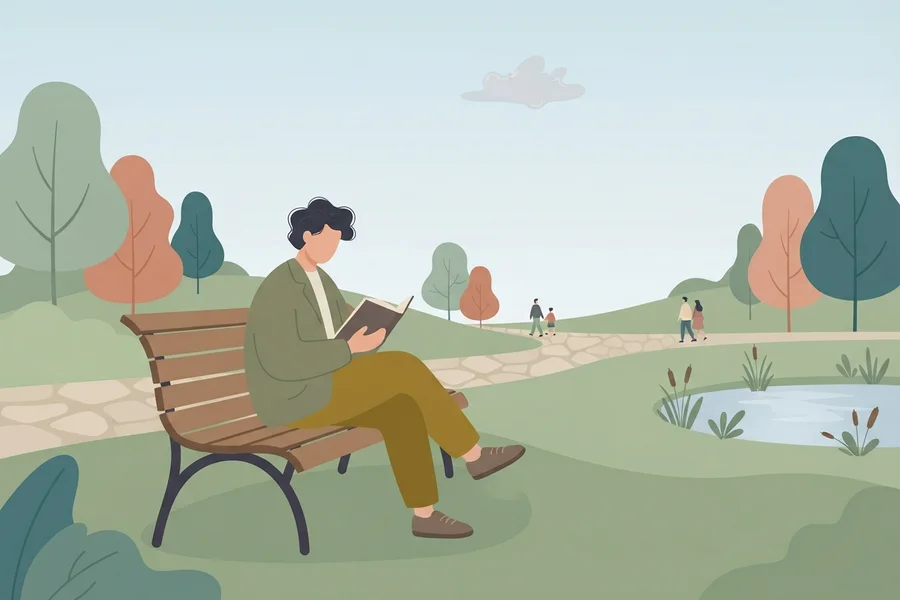
Your religious past is barely a presence in your day-to-day life.
Across all six areas this test looks at, your answers sit closer to absence than to even a faint trace. Your religious past hardly registers in your days now: your choices feel like yours, and ordinary mistakes stay ordinary.
That describes today, not what came before. A result this low doesn't mean your surroundings were simple or that nothing hard ever happened, and you don't need an easy history to land here. It means the old material isn't pulling on you at the moment.
A working sense of safety and self-direction is no small thing. It lets you spend your attention on what's in front of you instead of on what's behind.
If one answer made you pause while you were clicking through, that single question is worth a second look in a few months.
Religious Trauma Self-Test: your result
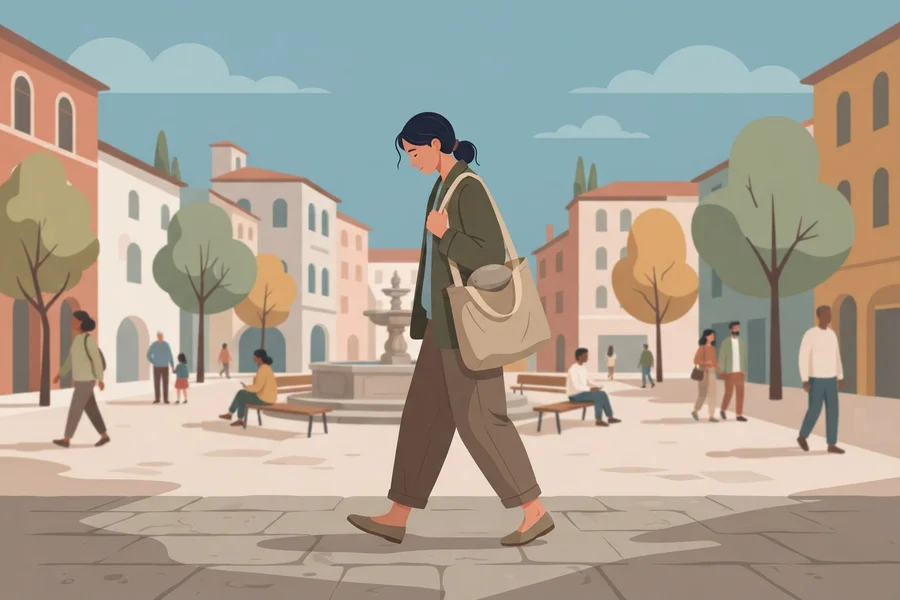
Your religious past surfaces in your day-to-day life in small, passing ways.
Your answers lean toward absence more than presence, though not all the way to the floor. In daily life that tends to look like an echo: a flicker of "would they approve?" before a decision, a brief sting over a small mistake, a phrase that catches for a moment and lets go.
Your decisions and relationships mostly run on your own terms, and that is the strength of this result. The echoes are real all the same. They are no reason for alarm, and they are not nothing either; small things you can name are easier to handle than ones you can't.
The cost is quiet. Low-grade patterns get waved off precisely because they never shout, and a flicker repeated for years can still shape what you say, what you skip, and what you keep to yourself.
Go back to the questions where your answer climbed above the bottom step. Those are the places where the weight, however light, has an address.

Religious Trauma Self-Test: your result
Your religious past is split down the middle in your day-to-day life, leaning neither light nor heavy.
Your answers land at the exact middle of this scale, and one answer going the other way could have put you on either side. There's no clear lean here, and that makes it an honest result rather than a shrug.
In practice it can mean that some parts of life feel settled while others still carry a charge: you speak freely with friends and tighten up with family, or sleep well and still wince at a certain phrase. The pattern across the six areas says more than the total does.
The strength of this middle ground is that you can name what's there without stretching it into a bigger story than your answers support. Holding both sides at once takes steadiness.
The cost is that an uneven weight is easy to dismiss as not that bad, and it can still matter to the person carrying it. Which of the six areas felt heaviest as you answered? Start looking there.
Religious Trauma Self-Test: your result
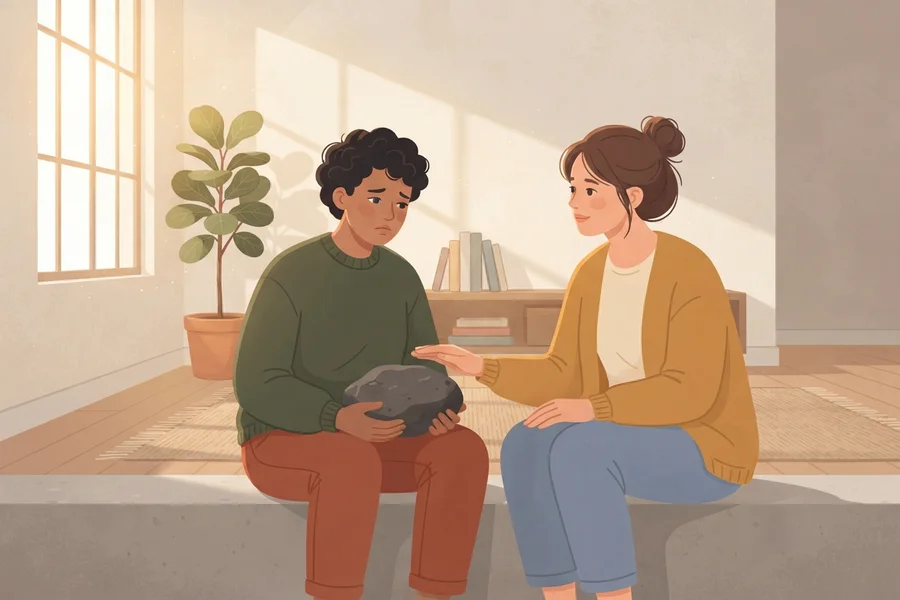
Your religious past is a regular companion in several parts of your day-to-day life.
Your answers lean toward presence more than absence. Your religious past shows up in how you make decisions, how you relate to people, how safe you feel, and what your mood does when nothing is going wrong.
Even when it stays under the surface, a share of your energy goes into managing it: rehearsing what to say, softening what you show, steadying yourself after a reminder. That upkeep is the cost of this result, and it helps to be honest about how much it adds up to.
The strength here is clarity. You recognized something specific across most of the areas this test touches, and the patterns behind these questions are described in research on adverse religious experience. What you're carrying is not a vague feeling.
What this result leaves open is the why and the how long. A score can't answer either one, and this test doesn't pretend to.
Religious Trauma Self-Test: your result
Your religious past is a heavy load across nearly all of your day-to-day life.
Your answers sit at the top of this scale across nearly every area it covers, including the questions about safety, freedom, and acceptance. Right now your religious past is a heavy load on almost everything you do in a day.
At this level the weight is likely to reach the practical side of life: how you decide things, who gets to see the real you, how you sleep, how your mood runs. It's a lot to carry, and being tired of carrying it makes sense.
Your answers also show something steady. You described a real, well-documented set of patterns accurately and in detail, and that precision is a strength in itself.
If this gets in the way of living today, it may help to talk with a counselor or therapist who knows this territory well. There's no deadline in that and nothing urgent; it's a door you can open whenever you choose.
Your results are no accident
The classic 16-type personality test rooted in Jung's typology has been rebuilt from the ground up: a new CoreTypes methodology, and a far higher level of accuracy. These might be the most useful ten minutes you'll ever spend on yourself: you walk away with the key to your decisions, your relationships and your results — and it's yours for good.
Take the free testYour result card
More tests like this
 Phobia Test
See how strongly fear, dread, and avoidance show up around whatever you're afraid of with this free 5-minute phobia test — no need to say what it is.
 Moral Scrupulosity OCD Test
Take the moral scrupulosity OCD test: 18 short questions on nagging doubts about your honesty and kindness, with your level of signs in about 4 minutes.
 Alexithymia Test
Take the alexithymia test: 22 short situations about naming and describing feelings. See your level of signs, from minimal to marked, in about 5 minutes.
How this test works
Methodology
These questions follow the way researchers now study adverse religious experience. They ask not what happened but what still weighs on you now. You rate how heavy six kinds of burden feel today: pressure to conform, teaching that worked through fear, shame and a shaky sense of worth, having part of yourself rejected, strained relationships, and anxiety or low mood tied to your own religious experience.
The test passes no judgment on any faith tradition or system of belief. Two people from the same background can land far apart, and someone who never belonged to a religious group can still answer every question. The result reflects the individual, whatever the tradition behind them.
Questioning what you believe, or changing your mind about it, is ordinary life and doesn't register here on its own; only lasting weight does. PTSD is a separate matter: certain experiences can fit its clinical criteria, but a clinician is the one who makes that call, and this test casts a wider, looser net than a screen for it.
No official diagnosis matches this territory, so your result describes how much it weighs on you now, nothing more clinical than that. If your religious experience still sits heavily on you, this psychology-magazine feature is a good thing to read next.
Treat the test as an aid to reflection. It is not a diagnostic tool, and it doesn't stand in for a conversation with a licensed professional.
Frequently Asked Questions
Is religious trauma real?
Yes, in the way that matters to most readers: people live with it, researchers study it, and its effects can be measured. No official diagnosis carries this name, so no manual can confirm or rule it out as a medical category. But a missing label and an unreal experience are different claims. Scholars have agreed on a working definition of the term, and more than one questionnaire for it has been tested independently.
Can this test diagnose religious trauma?
No. A clinician couldn't diagnose it either, since there is no diagnosis by that name to give. What you get here is a self-reported picture of how much of it weighs on you today. For anything beyond that, the right conversation is with a licensed therapist, ideally one who has worked with people from this background.
Do I have to give up my faith if I have religious trauma?
No. The test looks at how heavy certain experiences still feel, not at belief. Some people keep their faith and carry this weight alongside it; others set one down and hold on to the other; others change both. Your result favors none of those paths.
What is the difference between spiritual abuse and religious trauma?
Spiritual abuse points at what was done: a particular act, teaching, or relationship. Religious trauma points at what lasted, the effect that remains in a person. This test deals only with the second. It asks about today and never asks you to name or describe an event.
Is questioning or deconstructing my beliefs the same as religious trauma?
No. Doubting, rethinking, or changing what you believe is a normal part of a thinking life and proves nothing by itself. The test asks something different: whether specific patterns have left a lasting weight on you now. You can question everything and score low, or hold your beliefs unchanged and score high.
References
- Slade, D. M., Smell, A., Wilson, E., & Drumsta, R. (2023). "Percentage of U.S. Adults Suffering from Religious Trauma: A Sociological Study." Socio-Historical Examination of Religion and Ministry (SHERM), 5(1), 1–28. doi:10.33929/sherm.2023.vol5.no1.01.
- Koch, D., & Edstrom, L. (2022). "Development of the Spiritual Harm and Abuse Scale." Journal for the Scientific Study of Religion, 61(2), 476–506.
- Winell, M. (2011). "Religious Trauma Syndrome." Cognitive Behaviour Therapy Today, British Association for Behavioural and Cognitive Psychotherapies.