Multiple Intelligence Test
Answer 32 short questions about how you naturally think, work, and connect with people and ideas. It takes about 7 minutes, and at the end you’ll see which of eight domains your answers lean toward most, along with your full profile across all eight.


The Storyteller. You Lead with Linguistic.
Words are where you go first — not because you've been taught to, but because whatever the question is, an answer starts assembling itself as a sentence before it does as anything else.
You'll write out a plan nobody asked for, just to see it clearly — and it's usually your draft that ends up getting passed around.
That precision earns real trust: people take the version of events you give as the clear one. It costs something too — a sentence rewritten four times before it's sent, or a feeling that needed quiet instead of narration.
None of this makes language the only thing you're capable of — it's simply where today's answers leaned hardest, not a proven, separate kind of intelligence, and not a measure of how smart you are next to anyone else. The other seven domains are sitting right there on their own scales, and what a sentence looks like under real pressure is something this test was never going to show you.
The Systems Thinker. You Lead with Logical-Mathematical.
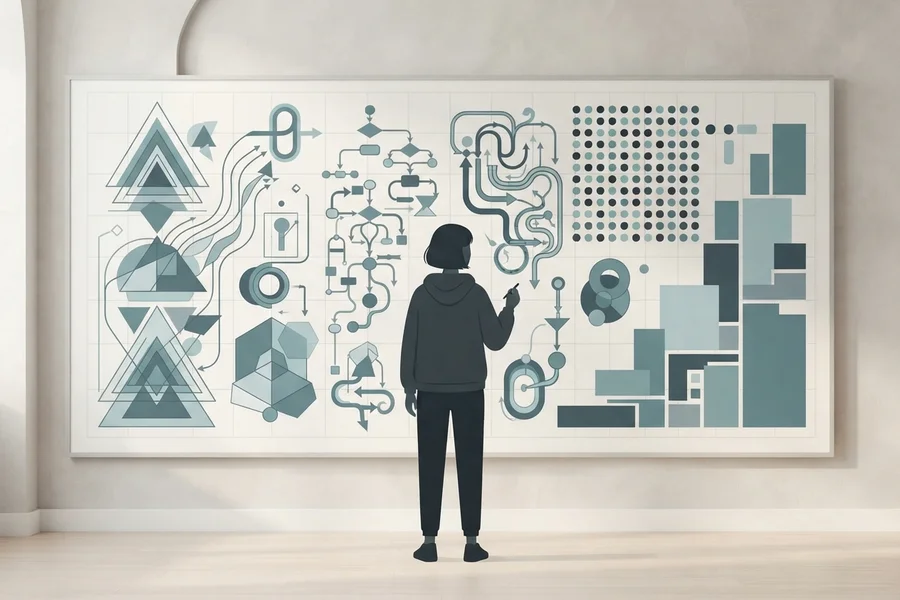
A problem with a clear shape is where you do your best thinking, and something that doesn't add up rarely gets left alone until it does.
Something not adding up is enough to keep you circling it until the actual cause turns up, and colleagues learn fast that you're the one who'll find the flaw in a plan before it ships.
That habit of digging until the real cause surfaces is genuinely useful when something's broken, though a good-enough answer rarely feels good enough, and letting a loose thread stay loose takes real, deliberate effort.
This isn't proof of a separate, independently wired kind of intelligence, and it says nothing about your intelligence level next to anyone else's — it's where today's answers leaned, with seven other domains still visible right alongside it. What a genuinely hard problem does to that instinct, under real pressure, is left for you to find out.

The Visual Builder. You Lead with Spatial.
The picture comes before the explanation, almost every time — how something looks, fits together, or would appear from another angle.
Handed a set of directions, you've usually already redrawn them in your head before finishing the sentence, and friends stop bothering with verbal instructions and just ask for a sketch.
A picture that won't quite let go can keep replaying and rearranging long after a decision's already made — the flip side of seeing, before almost anyone else does, exactly how the pieces of a plan or a room are going to fit.
This is a lean, not a verdict — a self-reported strength from today's answers, not a scientifically settled, separate ability, and not a ranking against anyone else's mind. The other seven scales are still right there next to this one. What happens when the picture in your head turns out to be wrong is something this test can't tell you.

The Rhythm Keeper. You Lead with Musical.
Rhythm gets under your skin before you've decided to pay attention to it, and a melody rarely passes by unnoticed.
A tune from years ago can still pull a whole afternoon back with it, and it's usually your opinion the room waits on before deciding what it thought of a song.
That responsiveness to sound makes you the person whose reaction to a piece of music actually means something. It can also mean a bad mix or a jarring noise lodges itself far longer than it should.
This says how today's answers leaned, not that sound is a proven, independent kind of smart, and not how musical you are compared with anyone else. Seven other domains sit on their own scales beside this one, just as real. What this doesn't touch is what you'd actually do with that ear, given the chance.

The Hands-On Maker. You Lead with Bodily-Kinesthetic.
Your hands work things out that your head is still catching up to — movement, physical skill, and hands-on craft come before overthinking does.
A new physical skill gets tried, not studied — adjusting by feel while everyone else is still reading the instructions, and it's your name that comes up when something breaks.
Learning by feel gets you moving while everyone else is still reading the manual. Sitting still with something unsolved is another matter — that's when the restlessness shows up, a foot tapping or a room getting paced that didn't need pacing.
This is today's lean, built from self-reported answers — not a scientifically demonstrated, separate intelligence, and not a ranking of how capable you are next to anyone else. The other seven domains are visible right alongside it. Whether that instinct turns into a craft you actually build is left open here.
The Connector. You Lead with Interpersonal.
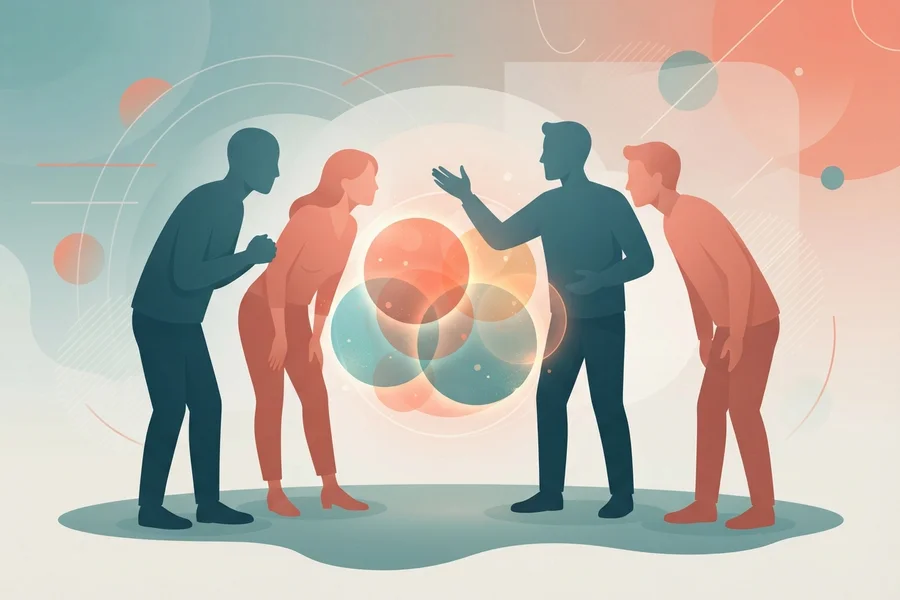
A room full of strangers doesn't stay unreadable for long once you're in it — the mood, the tension, the person running things all come into focus fast.
Before anyone explains what's wrong, you've usually already clocked who's upset and who's the reason why, and friends bring you the fight they haven't told anyone else about yet.
Reading a room that fast is a genuine gift when something needs smoothing over. It also means someone else's mood can end up steering your evening before you've noticed it happening.
This names where today's answers leaned, not a proven separate ability and not a claim about how emotionally sharp you are compared with other people. All eight scales, including the other seven, sit right there together. What this doesn't cover is how that instinct holds up in the relationship that matters most to you.

The Quiet Compass. You Lead with Intrapersonal.
You've usually named the reason behind a reaction before anyone else has finished reacting to it — your own motives rarely stay a mystery for long.
A values check runs quietly in the background of most decisions, even small ones, and the people close to you have started introducing you as the grounded one.
That clarity about your own motives shows in how steady your decisions look from the outside, even though the habit of working through everything alone means some of it would go easier if it were shared.
Nothing here claims to be an independently proven trait, or a statement about how much insight you have relative to anyone else — just where today's answers leaned. Seven other domains are visible on their own scales alongside it. Whether that clarity holds under a genuinely hard year is something no test can answer.

The Pattern Reader. You Lead with Naturalistic.
A hillside, a weed, a change in the weather — something in it always catches, when it passes other people by entirely.
A walk turns into an inventory without meaning to — what's new, what's changed, what doesn't belong — and it's your phone that gets the photo of an unfamiliar plant, with a question attached.
That eye for pattern doesn't switch off just because the outing was supposed to be relaxing — leaves get counted, changes get logged, and letting a detail go unexamined takes real effort.
This reflects where today's answers leaned, not a scientifically confirmed, separate intelligence, and not a comparison to how observant anyone else is. The other seven domains are sitting right there too, on their own scales. What's left open is what that eye for pattern would notice somewhere entirely unfamiliar.
Your results are no accident
The classic 16-type personality test rooted in Jung's typology has been rebuilt from the ground up: a new CoreTypes methodology, and a far higher level of accuracy. These might be the most useful ten minutes you'll ever spend on yourself: you walk away with the key to your decisions, your relationships and your results — and it's yours for good.
Take the free testFrequently Asked Questions
How does the scoring actually work?
It adds together how you answered across all eight areas and shows which one came out on top. That's a snapshot of where your responses leaned today — not a score, and not a measurement of how intelligent you are.
Is it seven types, eight, or nine?
The original version counted seven. An eighth — the naturalistic one, tied to noticing patterns in nature — got added a few years later, and that's the count used here. A ninth has been floated in discussion since, but it's never cleared the bar the rest had to clear, so it isn't included.
Does real science back this up?
Part of it, yes. People clearly gravitate toward certain areas, feeling more capable and interested there than elsewhere — that much isn't in dispute. The bigger, shakier claim is that eight of those areas function as fully independent, hard-wired abilities, and the data doesn't really back that up: study after study finds the domains blending into each other and into overall ability, instead of forming eight clean, standalone systems. What you get here is where your own answers pointed, not a lab-certified verdict on your mind.
Is this basically a learning-styles quiz?
Different question entirely. A learning-styles quiz is about the channel that helps new information stick — pictures, sound, text, doing it yourself. This one is about which broad area — words, numbers, movement, people, and so on — you already lean toward, confidence and curiosity included. The person who originally proposed this framework has been explicit that the two ideas shouldn't be mixed up.
What sets this apart from an IQ test?
An IQ test puts a single number on general mental ability. This one skips that entirely — it won't tell you how bright or capable you are, only which of eight areas your answers gravitated toward. A fair number of those eight, rhythm and sound or physical coordination among them, aren't things a standard IQ test even attempts to touch.
Methodology
This is a self-report quiz: 32 short scenes, and your reactions to them get sorted into eight labeled buckets — language, logic, images, sound, movement, working with people, working with yourself, and reading the natural world. Whichever bucket collects the strongest pull from your answers becomes your result, shown alongside all eight so you can see the full spread.
The premise underneath it is old and fairly uncontroversial: people differ in what they're naturally drawn to and good at. Shakier is the next step — treating those eight areas as fully separate, hard-wired abilities working independently of each other and of general intelligence. Studies that have tested this tend to find the opposite: performance overlaps quite a bit, both between the domains and with broader measures of ability, rather than splitting cleanly apart.
Treat your result as a snapshot of where your answers pointed today, not a diagnosis of raw ability. It doesn't rate how sharp or generally capable you are, and no official, standardized version of this quiz exists — every version out there, this one included, is a homemade attempt at the same underlying idea. It's also a different question entirely from a quiz about how new information sticks best for you, through pictures, sound, text, or hands-on practice.
Two starting points if you want to dig further: a look back at how this idea was first proposed and later expanded, and an overview of all eight areas plus the case researchers make against treating them as standalone.
References
- Gardner, H. (1983). Frames of Mind: The Theory of Multiple Intelligences. New York: Basic Books. "A biopsychological potential to process information that can be activated in a cultural setting to solve problems or fashion products that are of value in a culture."
- Visser, B. A., Ashton, M. C., & Vernon, P. A. (2006). Beyond g: Putting multiple intelligences theory to the test. Intelligence, 34(5), 487–502. doi:10.1016/j.intell.2006.02.004.
- Visser, B. A., Ashton, M. C., & Vernon, P. A. (2006). g and the measurement of Multiple Intelligences: A response to Gardner. Intelligence, 34(5), 507–510. doi:10.1016/j.intell.2006.04.006. "Each of the domains proposed by Gardner appears to involve a blend of g, of cognitive abilities other than g (group factors), and, in some cases, of non-cognitive abilities or of personality characteristics."
- Waterhouse, L. (2023). Why multiple intelligences theory is a neuromyth. Frontiers in Psychology, 14, 1217288. doi:10.3389/fpsyg.2023.1217288. "At present there are no standard measures of the intelligences, thus individual researchers have to create their own measures."