Internal Monologue Test
Answer 15 quick questions about everyday moments — reading, deciding, remembering — and see which of three channels, words, pictures, or a wordless sense of knowing, your thinking leans on most. It takes about 4 minutes.


The Narrator. In your mind, thinking mostly shows up as words — a running inner voice.
Across these fifteen scenarios, words came out ahead of pictures or a wordless sense of knowing, with a voice narrating, rehearsing, or repeating things back to you as thinking happens. This result names that pattern: The Narrator.
The sentences get tested before you say them out loud. The grocery list gets said under your breath on the way there. Thinking, for you, tends to arrive already dressed in language.
That gives you a rehearsal space for a hard conversation before you're actually in it, and a short step from a thought straight into speech. Whatever crosses your mind, you generally already have the words for it.
A mind this talkative can feel loud or constant from the inside. That's not a flaw in itself — this test only counted how often words showed up, not their tone. A busy inner voice, on its own, says nothing about how calm you are.
A strong verbal channel doesn't mean the visual or wordless ones are missing; most people carry some of each. This is simply the one that came out on top across these fifteen moments.
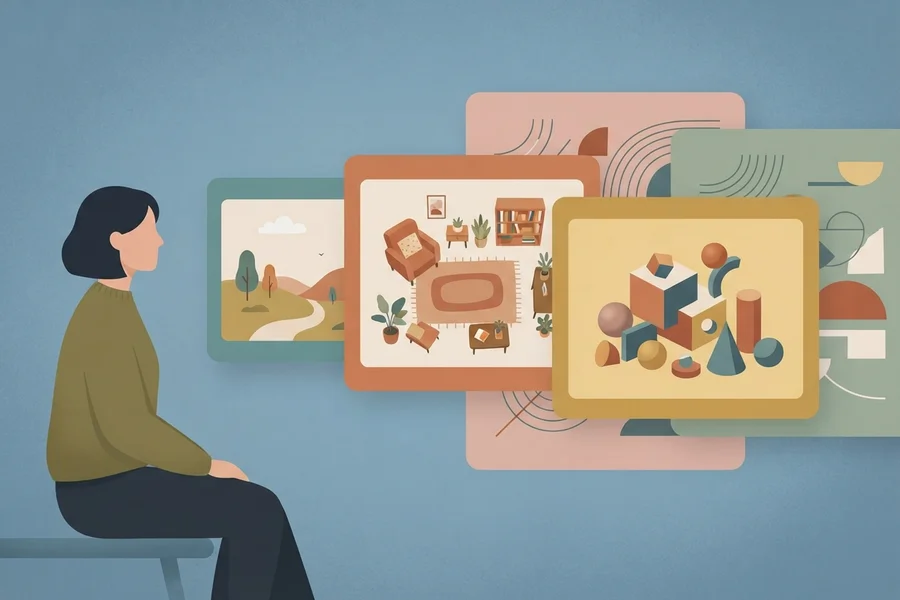
The Inner Screen. In your mind, thinking mostly shows up as pictures — mental images more than words.
Across these fifteen scenarios, pictures came out ahead. A scene or an image did the work more often than a running commentary or a wordless sense of things. This result names that pattern: The Inner Screen.
It shows up as a to-do list seen at a glance instead of recited, or a plan for a room played out as an image before a word gets said about it. Thinking, for you, tends to arrive already pictured.
That gives you a fast, private way to settle a lot at once — a spatial problem turned over as a picture rather than talked through step by step, a decision that resolves the moment you can actually see it.
The trade-off is that the same speed can make an image harder to put into words on the spot, for someone waiting on an explanation. What's clear to you in a picture can take a beat longer to become a sentence someone else can follow.
A strong pull toward pictures doesn't mean words are missing. Neither does it mean the wordless channel is. Most people carry some of each, and this is simply the one that came out on top here.

The Quiet Knowing. In your mind, thinking mostly shows up as neither words nor pictures — answers that just arrive.
Across these fifteen scenarios, an answer or a sense of things arrived on its own more often than in words or pictures. This result names that pattern: The Quiet Knowing.
A word you're reaching for can feel close before any letters form. A sense of what a room needs can arrive before you've pictured the furniture in it at all. Thinking, for you, tends to arrive already finished.
That gives you a direct route from noticing something to knowing it. The sense of it arrives whole, rather than being pieced together first in words or in an image.
Because this mode leaves nothing behind in words or pictures, it can also be the hardest of the three to hold onto afterward, or to explain to someone asking how you got there. It isn't that it happens less often than the other two — there's nothing left over afterward to point back to.
Arriving at something without words or images isn't a gap where a monologue should be. It's its own channel, as ordinary as the other two, and across these fifteen moments, it's simply the one that showed up most for you.
Your results are no accident
The classic 16-type personality test rooted in Jung's typology has been rebuilt from the ground up: a new CoreTypes methodology, and a far higher level of accuracy. These might be the most useful ten minutes you'll ever spend on yourself: you walk away with the key to your decisions, your relationships and your results — and it's yours for good.
Take the free testFrequently Asked Questions
Does everyone have an internal monologue?
No. Research on this finds meaningfully different habitual patterns among people, and not having a strong verbal channel isn't rare or a deficiency. Verbal, visual, and wordless thinking are three separate channels, and each one is a normal way for a mind to work.
Is it normal to not have an inner monologue?
Yes. The research on this describes the pattern as highly variable from person to person, not as a hierarchy with a "better" way of thinking at the top. Leaning on pictures or a wordless sense of knowing more than words is just as ordinary as leaning on words.
How do I know if I have an inner monologue?
Notice what happens the next few times you catch yourself mid-thought: does it show up mostly as words running through your mind, mostly as pictures, or mostly as a sense of knowing with no words or pictures attached? That everyday noticing — not a diagnosis — is exactly what this test's fifteen questions sample.
How common is an inner monologue?
Self-report studies of large samples show wide variation from person to person, and even the closest available frequency figures describe one channel at a time rather than a single "how much monologue" number. Self-report on this topic also tends to run higher than what moment-to-moment observation of the same people finds.
What functions does an internal monologue serve?
Documented functions include planning or sequencing a task before doing it, working through emotion during a stressful moment, rehearsing what to say before a difficult conversation, and supporting verbal memory — all uses this test's questions draw on directly.
Methodology
This test is based on the self-report tradition of classifying a person's habitual pattern of inner experience into distinct channels — verbal narration, visual imagery, and wordless, unsymbolized thinking — rather than treating "how much inner monologue" someone has as a single intensity scale. Each of the fifteen questions offers one everyday scenario with three equally common ways of experiencing it, and your result reflects whichever channel your answers matched most often.
What it measures is your own self-described, habitual pattern: how your thinking tends to register — as words, as pictures, or as something that arrives without either — across everyday situations like reading a sentence or making a snap decision. For more on how people talk to themselves internally, see healthdirect's overview of self-talk, and Wikipedia's entry on intrapersonal communication for the wider research on this.
A caution worth keeping in mind: self-report reflects how you perceive and recall your own thinking, and research shows this can diverge from what real-time observation of the same person would find. Treat your result as how you'd describe your own thinking, not a precise measurement of it. The three channels also commonly overlap in the same person — a result here names a leaning, not an exclusive category, and this is not a mental-health assessment of any kind.
References
- Alderson-Day, B., & Fernyhough, C. (2015). "Inner speech: Development, cognitive functions, phenomenology, and neurobiology." Psychological Bulletin, 141(5), 931–965. doi:10.1037/bul0000021.
- Hurlburt, R. T., & Akhter, S. A. (2006). "The Descriptive Experience Sampling method." Phenomenology and the Cognitive Sciences, 5(3-4), 271–301.
- Heavey, C. L., Moynihan, S. A., Brouwers, V. P., Lapping-Carr, L., Krumm, A. E., Kelsey, J. M., Turner, D. K., & Hurlburt, R. T. (2019). "Measuring the Frequency of Inner-Experience Characteristics by Self-Report: The Nevada Inner Experience Questionnaire." Frontiers in Psychology, 9:2615. doi:10.3389/fpsyg.2018.02615.
- Hurlburt, R. T., Heavey, C. L., Lapping-Carr, L., Krumm, A. E., Moynihan, S. A., Kaneshiro, C., Brouwers, V. P., Turner, D. K., & Kelsey, J. M. (2022). "Measuring the Frequency of Inner-Experience Characteristics." Perspectives on Psychological Science (advance online 2021). doi:10.1177/1745691621990379.