Learning Style Quiz
Answer twenty quick questions about how you naturally take in new information, and in about four minutes you’ll see which of four channels – hands-on, listening, reading and writing, or visual – your own answers leaned toward most.

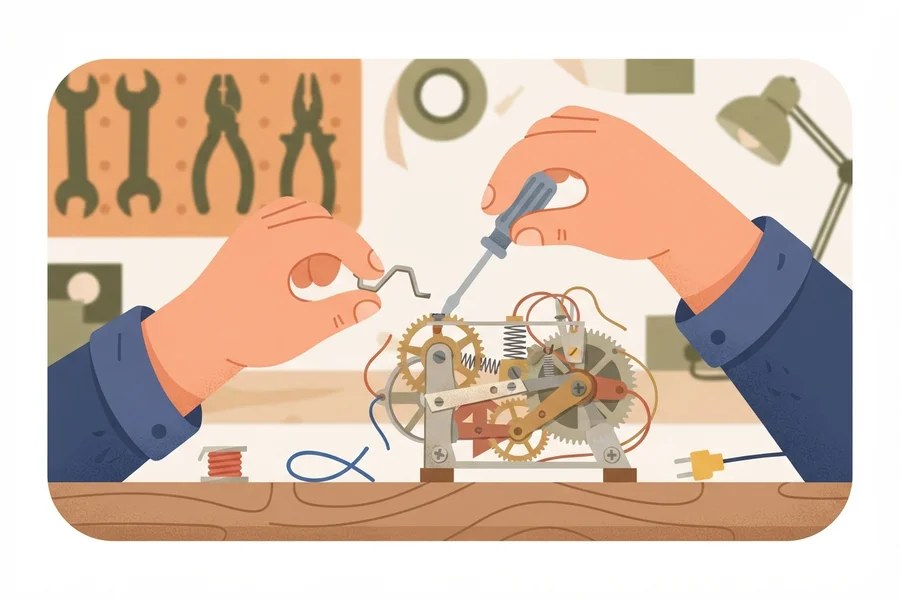
Kinesthetic — The Tinkerer
Hands-on, learn-by-doing practice is what you reach for first - that's the lean your answers took across this test's twenty questions, the pattern in this particular run through the test, not a permanent label.
All four channels are drawn from the same pool of twenty answers, so this lead might have been wide, or the four channels might have landed close enough together that another pass could tip differently - either way, this is what this set of answers pointed to.
That pattern usually belongs to someone who gets moving on something directly - trying it, adjusting by feel - before reaching for a manual, a diagram, or someone explaining it out loud.
It's a preference for how information arrives, not a measure of skill, and no research has shown that studying or teaching to match it actually improves how well anyone learns.

Auditory — The Conversationalist
Listening and talking things through is what you reach for first - that's what your answers pointed to across this test's twenty questions, a reading of this specific run through the test, not a fixed trait you're stuck with.
Because hands-on, auditory, reading, and visual answers all draw from the same set of twenty, the gap between them could have been wide or the four could have sat close together; this is simply where your answers landed this time.
People who lean this way tend to take in something new best by hearing it explained or talked through, and hold onto it best by saying it back out loud — more so than by writing it down or looking at a diagram.
That's a preference for how material comes in, not a mark of ability, and no study has shown that teaching or studying to match it makes anyone learn faster or better.

Reading & Writing — The Notetaker
Reading and writing things out is what you reach for first - that's the lean your answers took across this test's twenty questions, what this particular set of answers pointed to, not a verdict on who you are.
All four channels share the same pool of twenty, so the margin here could have been wide, or the channels could have come out nearly even; either way, this is the shape your answers took this time.
This pattern usually fits someone who takes in new material best as written text - a list, a set of instructions, a clear definition - and holds onto it by writing it out or rereading it, ahead of watching a demonstration or listening to an explanation.
It describes how information is received, not how capable you are, and studying or teaching to match it hasn't been shown by research to actually improve learning.

Visual — The Sketcher
Diagrams and visuals are what you reach for first - that's what your answers leaned toward across this test's twenty questions, a read on this particular set of responses, not a label stuck to you afterward.
Since hands-on, auditory, reading, and visual all draw from the same twenty answers, that lead could have been wide, or the four could have ended up close together; this is simply where this pass through the test landed.
That pattern tends to belong to someone who takes in new material best as a diagram, chart, map, or spatial layout, and holds onto it by picturing or sketching it — reading prose, hearing an explanation, or trying it hands-on tend to stick less by comparison.
It's a preference for how information shows up, not a measure of ability, and no research backs the idea that studying or teaching to match it makes learning any better.
Your results are no accident
The classic 16-type personality test rooted in Jung's typology has been rebuilt from the ground up: a new CoreTypes methodology, and a far higher level of accuracy. These might be the most useful ten minutes you'll ever spend on yourself: you walk away with the key to your decisions, your relationships and your results — and it's yours for good.
Take the free testFrequently Asked Questions
How do I find out my learning style?
This test infers a leaning from the pattern of your choices across twenty everyday situations, not from a single question. It reports which of four channels - hands-on, listening, reading and writing, or visual - your own answers pointed to most, and it's a preference for how information is presented, not an ability or a fixed diagnosis.
What are the four learning styles measured here?
This test measures four channels: hands-on/kinesthetic (learning by doing), auditory (listening and talking things through), reading & writing (working with written text), and visual (diagrams, charts, and images). Each one describes a preference for how information is presented - none is ranked above the others.
Can your learning style be a mix of more than one channel?
Yes. Every question offers all four channels as answers, and the total is split across just twenty of them, so it's entirely possible for two or more channels to land close together instead of showing one clear leader. Your result names whichever channel this particular set of answers leaned toward most - it isn't an exclusive label that rules the other three out.
Does studying in my learning style actually help me learn better?
The preference itself is real and tends to hold up fairly well if you retake a test like this later, but research testing whether teaching or studying to match that preference actually improves learning has not backed up the idea - no solid evidence base has been found for building instruction around this kind of result. This test tells you what your answers leaned toward, not a study method proven to work better than any other.
Are learning styles scientifically real, and how accurate is this test?
The underlying preferences are measurable and reasonably stable when retested, but the wider claim that people learn better when taught to their preferred channel isn't well supported by the available research. This test is built to be upfront about that distinction: it tells you where your own answers leaned, without implying that matching your learning to it will make you learn faster or better.
Methodology
This test is based on the general, widely used idea that people differ in which format of information - hands-on practice, listening, reading and writing, or seeing something visually - they find easiest to work with. Twenty everyday situations ask what you'd actually do or prefer, and the channel that comes up most in your answers becomes your result.
What it measures is a preference for how information is presented, not an ability, an intelligence measure, or a screening tool for any learning disability or processing condition - how something arrives is a genuinely different question from how well you'd handle it once it does.
A stated preference like this tends to hold up reasonably well when someone is asked again later, but that stability describes the preference itself, not aptitude: a stated preference has shown little to no relationship to how well someone actually performs on the same material. Research testing whether teaching or studying in a person's preferred channel improves learning outcomes has not supported that idea, and this test makes no such claim anywhere in its results. It is not equivalent to, and does not claim to be, any specific branded assessment, and it does not diagnose, and is not evidence for, any learning disability or processing condition.
For more on where this idea comes from and how the evidence around it is debated, see the APA's overview of the topic's origins and Wikipedia's summary of the ongoing scientific debate.
References
- Pashler, H., McDaniel, M., Rohrer, D., & Bjork, R. (2009). Learning styles: Concepts and evidence. Psychological Science in the Public Interest, 9(3), 105–119. doi:10.1111/j.1539-6053.2009.01038.x. "We conclude therefore, that at present, there is no adequate evidence base to justify incorporating learning-styles assessments into general educational practice."
- Coffield, F., Moseley, D., Hall, E., & Ecclestone, K. (2004). Learning styles and pedagogy in post-16 learning: A systematic and critical review. Learning and Skills Research Centre. ISBN 1-85338-918-8. "We therefore advise against pedagogical intervention based solely on any of the learning style instruments."
- Fleming, N. D. (2012). Facts, Fallacies and Myths: VARK and Learning Preferences. "VARK results are indicative not diagnostic."
- American Psychological Association (2023). Where did the visual, auditory, and kinesthetic learning style typology come from? Psychological Science Spotlight, Issue 277. "The case for the VAK learning style typology had been conceptually problematic since its origins, and the empirical research supporting the idea has always been weak... some of the earliest literature reviews of the effectiveness of VAK-specific teaching techniques consistently found the method to be ineffective."