Photographic Memory Test
Answer 14 quick questions about what actually happens when you try to picture something, and get a plain read on how vivid your mental imagery is. Takes about 3 minutes.


The Word Keeper. Your mind holds this in facts, not in pictures.
Ask you to picture your kitchen and what comes first is a list: the fridge on the left, the window facing the street. No image rides along with it. Your mind runs this whole test in words and facts, not in pictures.
You can describe a friend's face down to the last detail from memory and still not "see" it while you do it. Reading a novel, you follow the plot without a single scene playing behind your eyes.
None of this makes you worse at remembering or imagining anything. Recalling names, following directions, working through a problem in your head all still run at full strength, just on facts and logic instead of a picture. This has an actual name in the research literature, aphantasia, and it's a documented, ordinary point on the same spectrum everyone else is on — just a different set of tools doing the same job.
Where it does show up is in moments other people lean on a picture without noticing, like getting lost in old photos. You reach the same place by a different route, and the more interesting question is how far your own route actually takes you.
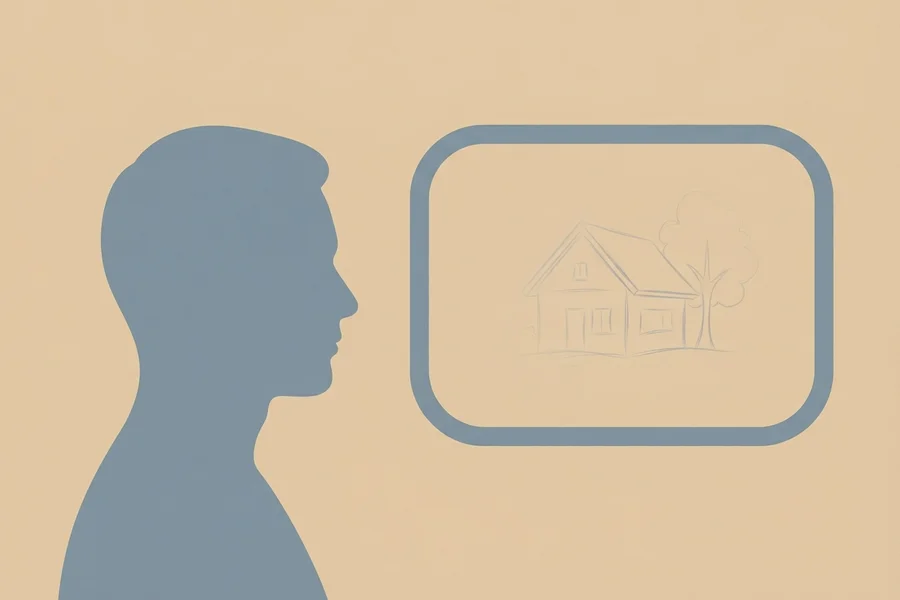
The Quick Fade. A picture flickers for you, then fades before it settles.
A picture does show up when you reach for one. It's just not the first thing that arrives, and it doesn't stay long. Facts get there first, the colour, the shape, what something is for, and the image trails in after, if it comes at all.
Picture an old apartment and you might catch the outline of a room before it slips away, more felt than actually seen. Hold a friend's face in mind past the first second and it softens into an impression rather than a photo.
The upside is a mind that doesn't get hijacked by a stray image when the task calls for plain facts. You're not the one picturing the meeting room instead of listening to what's being said in it.
What's left open is how much sharper things might get if you gave an image more than a second to arrive. Most people in this range have never actually tested that.
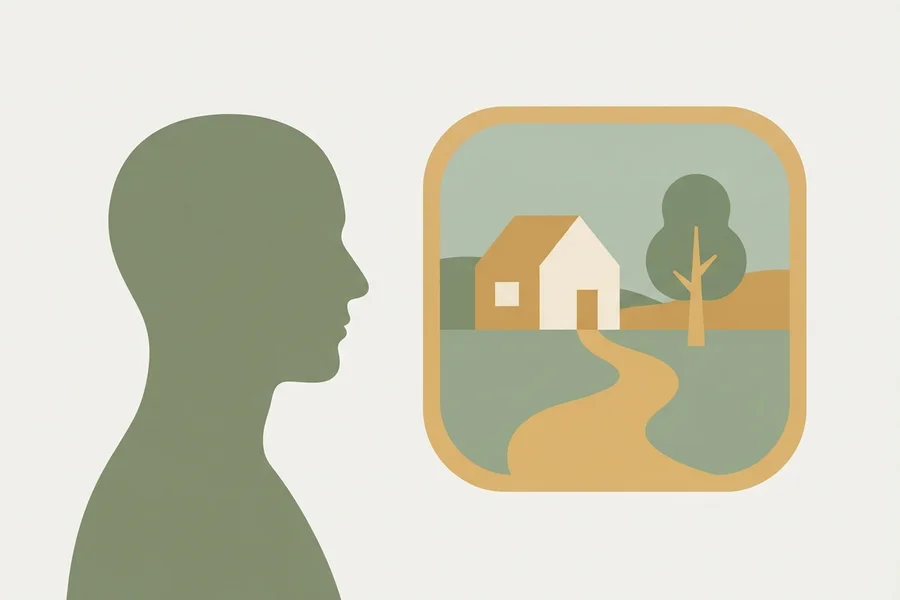
The Working Picture. An ordinary picture forms for you, without much effort.
Picture your front door and it shows up: ordinary, complete enough to be useful, nothing about it especially sharp or especially thin. This is the shape a mental picture takes for most people who actually sit down and try this.
Call up a friend's face, a familiar street, the layout of your kitchen, and each one arrives without a fight, present and functional in the unremarkable way a light switch is unremarkable until it stops working.
The strength here is reliability. The picture is there when you reach for it, dependable enough to plan furniture in a room or picture a route before driving it, without needing to force anything.
None of this is a consolation prize; it's the honest, ordinary answer for the people who actually take a test like this. What's left is a smaller question worth sitting with: what you'd notice if you paid closer attention to a picture you already trust to show up.

The Vivid Eye. A clearly detailed picture forms for you, sharper than most people get.
Close your eyes and a picture arrives readily, carrying detail most people don't get: the exact pattern on a shirt, the specific angle of a familiar face, present without much work on your part.
You're the one who clocks that a book got moved two inches on the shelf, or that a coworker changed their haircut, before anyone points it out. The picture in your head is detailed enough to catch the difference against it.
That same vividness has a cost. An image this present doesn't always know when to leave, and it can crowd out plain thinking the way a loud room crowds out a quiet conversation.
Still short of the rarest end of this, where a picture stops needing any effort at all. Worth noticing what changes for you on the days it arrives even faster than usual.
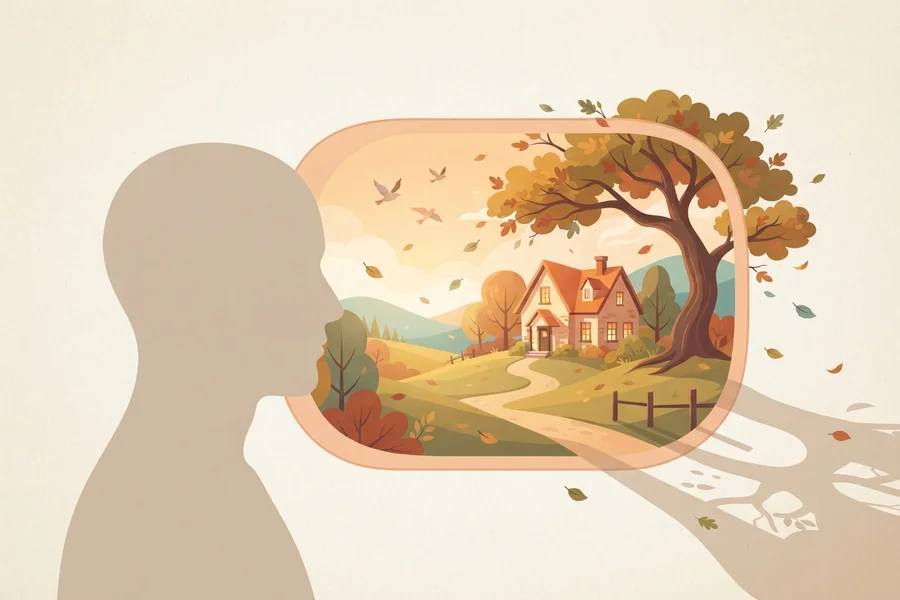
The Full Scene. An almost real, richly detailed picture forms for you, every single time.
A picture arrives instantly and whole, close enough to the real thing that recalling a room can feel like standing back in it, detail and colour included, without building any of it up piece by piece.
You're the one who notices a single rearranged object in a familiar room on the way through the door, and who can describe a scene from months ago the way someone else would describe a photo they're holding.
This is real, and rare enough to sit at the genuine high end of the same spectrum everyone else is on. But it's still imagination, not proof of the popular idea of a mind that files away every page it's ever seen. No adult has ever passed a controlled test built to catch that ability, and even the vivid imagery some children show didn't leave them with a measurably better memory once they grew out of it.
What a picture this vivid doesn't do is guarantee accuracy. A detailed image and a correct one aren't the same claim, and that gap is worth sitting with the next time this vividness feels like proof of something more.
Your results are no accident
The classic 16-type personality test rooted in Jung's typology has been rebuilt from the ground up: a new CoreTypes methodology, and a far higher level of accuracy. These might be the most useful ten minutes you'll ever spend on yourself: you walk away with the key to your decisions, your relationships and your results — and it's yours for good.
Take the free testFrequently Asked Questions
How can you actually tell if you have a photographic memory?
Nobody has managed to demonstrate it under real testing conditions. No adult, in a rigorous setup designed on purpose to catch exactly this ability, has ever recalled material with total, lasting accuracy. So there's no reliable sign to look for, because the ability itself hasn't been confirmed to exist in the first place. What genuinely differs from person to person, and what a quiz like this one can pick up on, comes down to just how present the pictures feel that you form in your head on purpose.
Is eidetic memory the same thing as photographic memory?
Not really, even though the two names get swapped for each other constantly. Eidetic imagery turns up in a small number of children, where a picture seems to hang in front of their eyes for a short stretch right after they've looked away, and it's gone by the time they're teenagers. It didn't leave those kids with sharper memories once they grew up, either. Treating that childhood quirk as proof of an adult who can flawlessly recall anything they've ever seen is a leap the evidence simply doesn't support.
How rare is photographic memory?
Eidetic imagery in children is already uncommon, and it fades out before adulthood in essentially every case. Confirmed adult-level photographic recall is rarer still, in fact testing aimed squarely at catching it in grown-ups has never turned up a single case. Everyday differences in how vividly people picture things, on the other hand, are common, and straightforward to gauge, and it's only a small slice of that group who land at the genuinely vivid end.
Can you train yourself to have a photographic memory?
No study with proper controls has ever shown that to be teachable. What genuinely can be built up through practice is a set of memorisation habits, the sort competitive memorisers rely on to lock in long number strings or a shuffled card deck within minutes. Ask any of them, and they'll usually tell you outright that they aren't working from some built-in photographic ability; they've simply drilled a method most people never bother learning.
What's the difference between a strong visual memory and photographic memory?
A vivid, detailed way of picturing things day to day counts as a genuine, fairly common trait, and it genuinely pays off in small ways, like catching a detail or holding onto how a place looked. That's worlds apart from the claim behind "photographic memory": flawless, indefinite recall of exactly what was in front of you, image for image. The second claim has never actually been backed up by controlled testing in adults; the first one has been, many times over.
Methodology
This test grew out of an older habit in psychology: instead of showing someone material and checking afterward what stuck, researchers simply ask people to rate their own mental pictures, in their own words, on how present and lifelike those pictures feel. Nobody here is shown anything to memorise, and no answer gets marked right or wrong.
What gets measured is narrower than the name suggests. It's whether a picture you deliberately call up, a face, a room, a place you've stood in, feels close to actually looking at the thing, or stays thin, more like a fact you're aware of than something you can see. A handful of questions also check whether that same habit shows up unprompted, in things like spotting a rearranged shelf or holding onto a detail from a photo you only glanced at.
None of this adds up to a check on photographic memory the way most people mean the phrase, a mind that captures a page and keeps it whole and correct, indefinitely. Nobody has ever pulled that off under a proper testing setup, so a short quiz couldn't confirm it either way. This also isn't a gauge of how much you remember or how accurate that memory turns out to be, and it settles nothing about anyone's health.
One mix-up is worth untangling here: "eidetic image" often gets treated as another name for photographic memory. It isn't. That childhood phenomenon is genuine, if uncommon, mostly seen in young children, and it fades out on its own well before adulthood; even the kids who had it didn't end up remembering better later in life because of it. What this quiz actually tracks, ordinary visual imagery in grown adults, sits on its own well-mapped continuum, running from almost no picture at all up to something vivid enough to feel real, which is still a different claim from flawless recall, however far up that continuum a person lands.
References
- Marks, D.F. (1973). Visual imagery differences in the recall of pictures. British Journal of Psychology, 64(1), 17-24.
- Zeman, A., Dewar, M., & Della Sala, S. (2015). Lives without imagery – congenital aphantasia. Cortex, 73, 378-380.
- Wright, D.J. et al. (2024). An international estimate of the prevalence of differing visual imagery abilities. Frontiers in Psychology, 15, 1454107 doi:10.3389/fpsyg.2024.1454107