Attachment Style Test
This is an independent test, not affiliated with any commercial attachment-style quiz — 24 quick questions about how you handle closeness generally, no partner required. Answer with your first instinct, and in about six minutes you’ll get one of four attachment patterns, plus what that pattern tends to look like day to day.

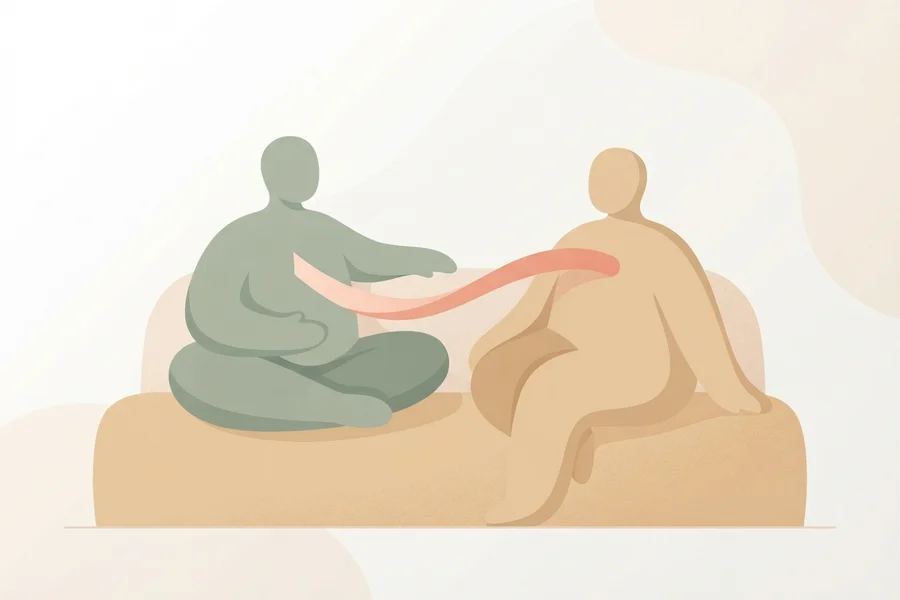
The Open Hand. Secure — you don't brace for distance, and leaning on someone close comes easily to you.
You don't spend much energy wondering where you stand with people who matter to you. A friend goes quiet for a day, and it barely registers as a question; when a partner offers to help carry something heavy, you take the offer instead of managing around it.
Closeness and independence sit together for you without much friction — you ask for support about as easily as you give it, and neither feels like a debt. If you land closer to the middle of both scales than to either edge, that's the ordinary outcome here, not a weaker one — most people land somewhere in that blend.
The quiet cost of needing so little reassurance yourself is that it's easy for you to under-read someone whose wiring runs differently — someone who does need the signal spelled out, twice, in plain words, before they'll believe it. What comes easily to you doesn't automatically come easily to whoever is standing across from you.
None of this promises that a particular relationship of yours is thriving right now, or that it will keep going the way it has. It describes a habit of mind you carry, not a guarantee.
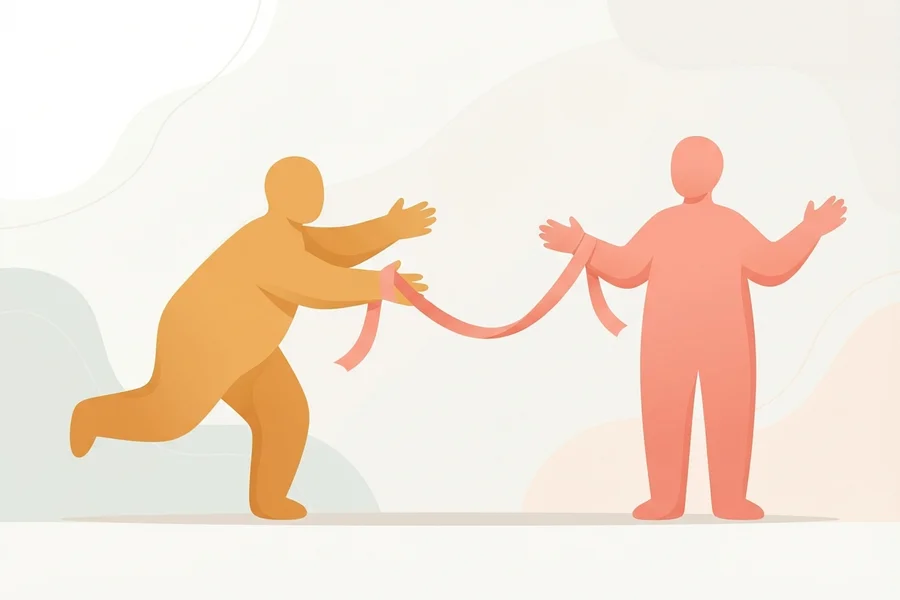
The Watchful Reach. Anxious-preoccupied — you stay alert to the smallest sign someone might be pulling away, and you reach for closeness rather than retreat from it.
Your attention snags on the small stuff — a reply that lands an hour later than usual, a message that reads a little shorter than the last one. Your mind doesn't let it go quietly; it runs through the possibilities, and quite a few of the ones it lands on aren't good.
What sets you apart from someone who simply pulls away is the direction you move in: toward the person, not away from them. You ask for reassurance, you follow up on plans, you say what you feel instead of swallowing it. If your result blends both scales rather than sitting at either edge, that's the ordinary shape this takes for most people here, not a softer or less real version of it.
The same watchfulness that helps you catch a real problem early can also turn a genuinely unremarkable evening into three hours of quiet rehearsal in your head, so your checking-in can start running ahead of anything the situation is actually asking for.
This isn't you "being too much," and it isn't a verdict on whether any specific relationship of yours is in trouble. It's a habit of attention, and habits of attention can loosen with practice.
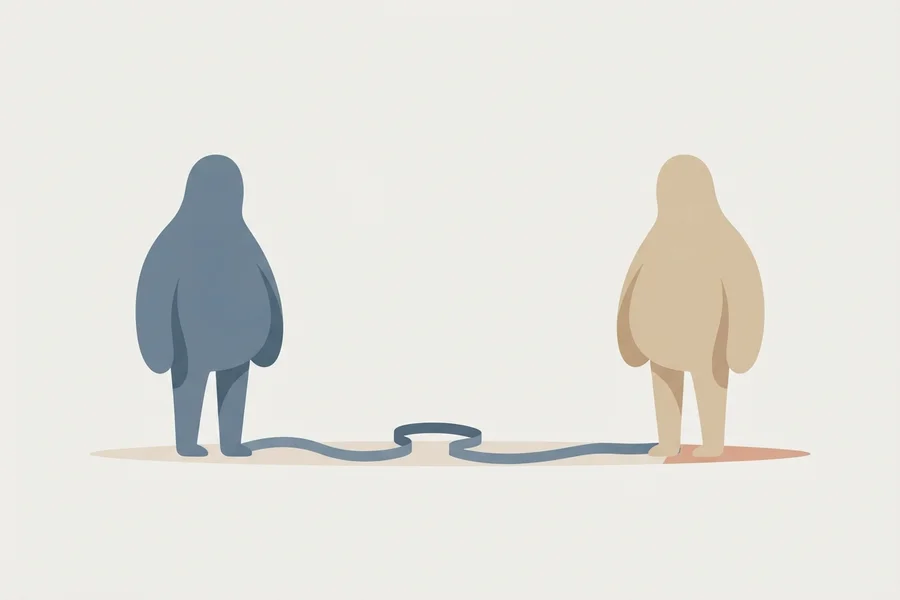
The Calm Fortress. Avoidant-dismissive — little worry crosses your mind about where you stand, and you'd rather handle things solo than lean on someone close.
You rarely lie awake wondering whether the people close to you still care — and you'd rather sort out a hard week alone than hand any of it over, even when a hand is right there, offered freely.
It shows up in small refusals more than dramatic ones: the offer to help you turn down out of habit, the long feelings-talk you quietly steer somewhere shorter. If you land in the middle of both scales rather than at a hard extreme, that's by far the more common outcome, and it describes you just as accurately as a sharper result would.
Your strength is real: very little gets dumped on anyone else, and self-sufficiency this steady carries you through a lot on its own. The cost sits next to it — your needs go unspoken, not from indifference but from an instinct to handle things solo first, and someone's bid to get nearer can land as pressure before it lands as care.
None of this is coldness on your part, or proof that you don't care. It's a setting, not a sentence — and it can shift once you notice the instinct to go it alone for what it is.
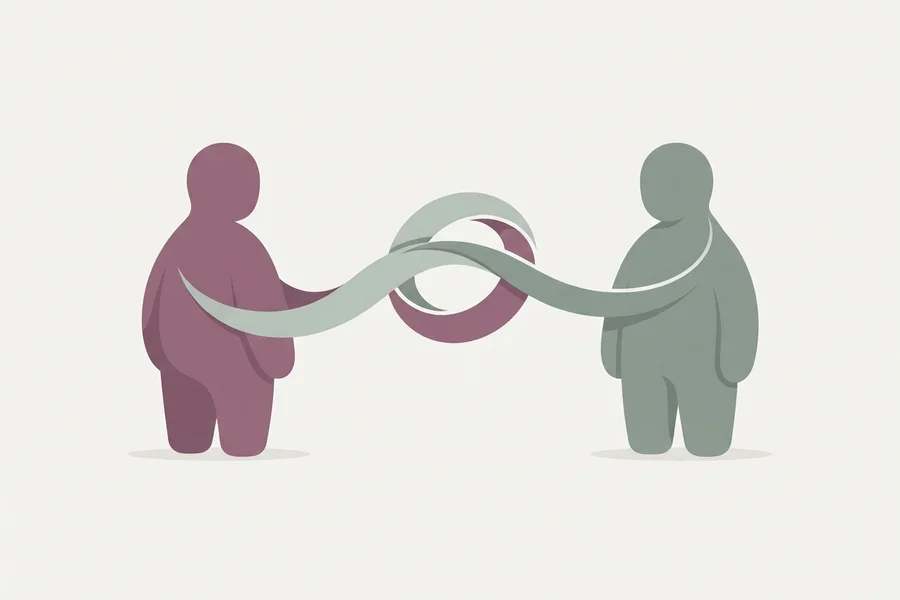
The Tangled Thread. Disorganized / fearful-avoidant — you want closeness and guard against it in the same stretch.
You can want closeness and brace against it in the very same breath — noticing a slower reply with real unease, and then, when someone actually leans in close, pulling back half a step before you decide whether to let them in.
It isn't indecision on your part, and it isn't a contradiction to be embarrassed about. Reaching and guarding simply happen on the same stretch of ground for you, sometimes inside the same conversation, so comfort you genuinely wanted can be met with your own hesitation right as it arrives.
If your result blends both scales rather than sitting at either extreme, that's the typical shape this takes — most people who land here are closer to the middle of one or both scales than to a hard corner.
One thing is worth saying to you plainly: this general-pattern combination is a different, much milder thing than the clinical term used in the child-development literature for a specific infant-caregiver pattern. It isn't evidence of a childhood-trauma history in your case, it isn't a diagnosis, and it doesn't describe a fixed, unchangeable state for you — just a pattern worth noticing.
Your results are no accident
The classic 16-type personality test rooted in Jung's typology has been rebuilt from the ground up: a new CoreTypes methodology, and a far higher level of accuracy. These might be the most useful ten minutes you'll ever spend on yourself: you walk away with the key to your decisions, your relationships and your results — and it's yours for good.
Take the free testFrequently asked questions
Can an attachment style quiz actually diagnose your attachment style?
No. What you're taking is a set of self-report questions, not a clinical evaluation — it reflects back the choices you made about your own habits, not a professional's judgment call. The result names a pattern that shows up across your answers here; it isn't a ruling on how any one relationship is actually going. Use it to notice something about yourself first, and for anything more than that, a licensed professional is the one qualified to give it.
What are the four attachment styles?
Researchers in this area generally describe four broad adult patterns: secure, anxious-preoccupied, avoidant-dismissive, and disorganized, also called fearful-avoidant. They aren't four separate boxes measured on their own — each comes from crossing two underlying, continuous dimensions: how much worry shows up about a close other's availability, and how comfortable it feels to rely on someone. The four labels are simply the four ways those two dimensions can combine.
How many questions does this test have, and how long does it take?
This test runs 24 questions split evenly across the two dimensions it measures, all set in the context of close relationships in general rather than one specific person. It's built to take about six minutes at an unhurried pace.
Can your attachment style change over time?
Yes. What you get here is a read on your current habits, not a label stamped on for good. These patterns move — a difficult relationship can pull someone toward more watchfulness, a steady one can loosen old guardedness, and plain time changes things too. Whatever you land on today is a description of now, nothing more fixed than that.
Methodology
This test scores two separate, independent dimensions of how people handle closeness: how much worry and watchfulness come up around a close other's availability, and how comfortable it feels to lean on and open up to someone close. Each dimension is scored on its own — your position on one doesn't move the other. The combination of where you land on both gives one of four broad patterns that show up across decades of adult-attachment research, an approach built on the idea of two crossed dimensions rather than one single scale (learn more about the underlying attachment style concept).
The questions are written around close relationships in general — a partner, a close friend, a family member — not one specific person, so the test works whether or not you currently have a partner, and it doesn't assume anything about your gender.
This describes a pattern; it isn't a clinical tool and it isn't a diagnosis, and it says nothing about one relationship's health or future. It also isn't a stand-in for any commercial questionnaire you might have come across elsewhere. Both dimensions run on a continuum, so ending up somewhere in the middle is the statistically ordinary outcome, not a weaker one. The fourth pattern shares its name with a term from child-development research, but the two aren't the same thing — this result says nothing about what happened in anyone's childhood. For an actual clinical read, that's a conversation for a licensed professional, not a quiz.
References
- Fraley, R. C., Waller, N. G., & Brennan, K. A. (2000). An item response theory analysis of self-report measures of adult attachment. Journal of Personality and Social Psychology, 78(2), 350–365.
- Bartholomew, K., & Horowitz, L. M. (1991). Attachment styles among young adults: A test of a four-category model. Journal of Personality and Social Psychology, 61(2), 226–244.
- Hazan, C., & Shaver, P. (1987). Romantic love conceptualized as an attachment process. Journal of Personality and Social Psychology, 52(3), 511–524. doi:10.1037/0022-3514.52.3.511.
- Ainsworth, M. D. S., Blehar, M. C., Waters, E., & Wall, S. (1978). Patterns of Attachment: A Psychological Study of the Strange Situation. Hillsdale, NJ: Erlbaum.