
Remote Associates Style Test
Questions: 14Time: ≈ 3 min
Read each of the 14 everyday situations and choose the answer that sounds most like you; it takes about 3 minutes. This is not the three-word puzzle from the original Remote Associates Test but a separate test of how you arrive at solutions. At the end you will see where your style sits, from step by step to all at once.

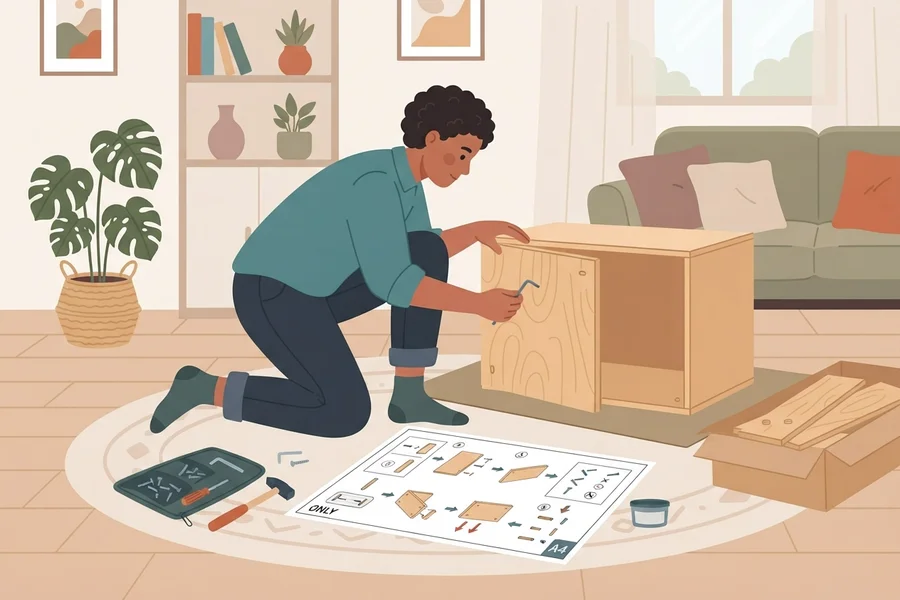
Remote Associates Style Test: your result
The Trail Marker Your solutions almost always come step by step, and the whole path stays in view.
Look behind most of what you work out and you will find a trail: a first step, a second, a check, a conclusion. When someone asks how you got there, you can tell them, and you would rather hand over a route than a hunch.
Your answers can be retraced and explained, whether the problem is a stubborn gadget, a long list or a quarrel with a friend. People lean on what you say because they can see where it comes from, and that is where this style is strong.
A quick read that arrives complete and cannot yet be explained gets little room with you, so you may pass it over even when it would have been the shorter road. Trusting a route sometimes costs more time than the answer already sitting in your head.
Whether answers found this way are better or worse than anyone else’s is not something this describes. It describes how they reach you, and for you they arrive with a map attached.

Remote Associates Style Test: your result
The Map Reader Your solutions mostly come step by step, with a sudden click now and then.
Most of the time you get where you are going by doing the work in order. You check, you compare, you watch the answer take shape. And now and then, with no warning, a click cuts in and does the job in a moment.
What you gain is a method you do not have to wait on. When no flash of insight turns up, you still have somewhere to start, so a problem seldom leaves you sitting still.
The other side is reaching for the slow, safe check when a quick read would have done just as well: you re-add a sum you already trusted, or retrace a route you could have walked blind. Which problems invite the click, this test cannot say. It only shows that both ways of arriving turn up in your answers, one more than the other, and that neither ranks above the other.
The click, when it comes, is a guest rather than the host, and a welcome one.

Remote Associates Style Test: your result
The Weathervane Your solutions come both ways, step by step and whole, with no lean to either side.
Some of your answers arrive step by step and others arrive whole, and neither habit has taken over. Which one turns up seems to depend on the problem in front of you rather than on a fixed way you work.
That is a finding in its own right. You have two working routes and you switch between them, often without noticing: a plan built list by list on Monday, a stuck argument cracked by a sudden new angle on Tuesday.
Range is what you get out of it. When the first route stalls, the second is within reach, so you are seldom out of options. The price is that neither route is worn smooth: you may not trust a hunch fully, you may not trust a method fully, and now and then you stop to wonder which of the two to use.
Mixed here means complete, not undecided. Your style changes with the problem, and that is a plain description of how answers get to you.

Remote Associates Style Test: your result
The Rock Hopper Your solutions mostly arrive as a click, with step-by-step checking now and then.
When a problem rewards it, the answer shows up whole, and you recognize it before you can say why. Stuck on something, you are more likely to change the angle than to push harder along the same road. Every so often you slow down and check it step by step, too.
You get unstuck fast, and you do not have to retrace every step to feel you have arrived; a lot of your answers come from the sidelong glance rather than the grind. Whether they turn out right more or less often than slow ones is not what this describes.
Where it costs you is the walk-through. A good share of your answers show up complete, not built piece by piece, so explaining one to a person who wants the steps can take real effort and may mean reconstructing a route you never walked.
Mostly a click, with a careful check on the side: that is how answers come to you.

Remote Associates Style Test: your result
The Glider Your solutions almost always arrive whole, and the path behind them is hard to retrace.
Answers reach you in one piece, and the way there is rarely something you can trace afterward. You look at a problem, set it down, and later the finished solution is simply sitting there, along with a small, distinct pleasure that it arrived that way.
Speed to something workable is what you get. You are not kept waiting for a method to pay off, and a stuck problem does not hold you for long, because you change the angle easily instead of repeating the same approach.
Explaining how you got there is often hard after the fact, and a step-by-step version of the same answer may not exist, even when someone asks you to produce one. ‘It just came to me’ is true, and it is not much help to the person across the table.
This describes how a solution reaches you, and for you it comes whole. It tells nothing about whether your answers are more often correct or more original than slow ones, or whether you are sharper or more creative.
Your results are no accident
The classic 16-type personality test rooted in Jung's typology has been rebuilt from the ground up: a new CoreTypes methodology, and a far higher level of accuracy. These might be the most useful ten minutes you'll ever spend on yourself: you walk away with the key to your decisions, your relationships and your results — and it's yours for good.
Take the free testYour result card
More tests like this
 Everyday Attention Test
Not the timed classic: an 18-question self-report check on everyday attention — how much of it stays with the task when something else is pulling.
 Multiple Intelligence Test
Answer 32 quick questions to see which of eight domains — from words and logic to movement and nature — your own answers lean toward most. Free, about 7 minutes.
 Aphantasia Apple Test
Picture an apple in your mind — does it actually appear, or do you just know it’s there? Take this quick test to find out how vivid your mental pictures really are.
How this test works
Methodology
Start with what this is not. The Remote Associates Test that gave this page its name is a word puzzle: you are shown three words and have to find a fourth that links all of them, and only one answer counts. Nothing like that is in here, because you are not solving anything; you are telling us how you work things out. Nor does the result rate creativity, intelligence or IQ. The way a solution feels when it arrives and how good that solution is turn out to be separate questions, so what you get describes a habit, not a talent.
What it does look at is how answers tend to come to you in everyday life. Some arrive as a path you could walk back through, one stage after another. Others show up whole, with no visible working, a moment psychologists call insight. The situations range from a puzzle you are alone with to an argument going in circles, and they also ask how easily you change tack when something stalls.
Nobody comes out ahead on this scale; both ends are everyday routes to an answer. Because the test rests on your own account, it reflects how you see your habits rather than a timed performance, and your style may well shift from one kind of problem to the next.
Frequently Asked Questions
Is this the test where you get three words and have to find a fourth?
No, and many people arrive expecting it. Here you read 14 everyday situations and pick the answer that sounds most like you, and the result describes how solutions usually reach you. The three-word task asks for one word produced from memory, which this site has no way to check, so its items are not copied or imitated. Nothing is marked right or wrong, and no creativity, intelligence or IQ figure comes out of it, either.
Is a sudden click better than working it out step by step?
No. Both are everyday ways for an answer to turn up, and plenty of people use both in a single day. Each comes with a strength and a price, and the result lays out both without ranking one above the other.
Does my result mean I am more creative or more intelligent?
No. It reports a style, meaning the route your solutions describe taking, and not a verdict on how inventive or clever you are. Even for the word-puzzle test this page is named after, saying that an answer came in a flash tells you little about how well that person does on ability measures.
Is this the same as an IQ test?
No. Nothing here is scored as correct or incorrect, and no figure about your intelligence comes out of it. You describe what you do, and the result mirrors it back.
How many questions are there, and is that the same as the original test?
This test asks about a different idea: how you arrive at solutions, not whether you can find a target word. It has 14 questions and takes about 3 minutes. Longer item counts you may have read about belong to the original test; this one is its own short set of questions about your habits.
References
- Mednick, S. A. (1962). The associative basis of the creative process. Psychological Review, 69(3), 220–232.
- Ovington, L. A., Saliba, A. J., & Goldring, J. (2016). Dispositional Insight Scale: Development and validation of a tool that measures propensity toward insight in problem solving. Creativity Research Journal, 28(3), 342–347. doi:10.1080/10400419.2016.1195641
- Cunningham, J. B., & MacGregor, J. N. (2019). A self-report measure of productive thinking in solving insight problems. Journal of Creative Behavior, 53(1), 97–108. doi:10.1002/jocb.169