
Vanderbilt ADHD Assessment
Questions: 26Time: ≈ 6 min
This test is about a child aged 6 to 12 and is filled in by a parent or another adult who knows the child well. It is an independent test, not the official Vanderbilt scale and not a copy of it. Think back over the last few months, pick the scene that fits the child best in each of the 26 questions (about 6 minutes), and at the end you will see how strong the signs of ADHD look from where you stand.


Vanderbilt ADHD Assessment: your result
Quiet Harbor you see minimal signs of ADHD in the child.
Over the last few months you have described a child whose behavior sits comfortably within what is expected for the age. On this scale that is a minimal level of ADHD signs.
Restless, distracted or hasty moments turn up in your answers, as they do in any childhood, but they pass quickly and never gather into a pattern. School, home, friendships and clubs run smoothly, and nobody around the child seems to be working harder than usual to keep things on track.
That smooth running is the strength of this picture. A child who can focus, wait and settle when the day asks for it has plenty of room left for curiosity and play.
The result rests on one adult's view of recent months, so it shows how things look from where you stand and no further. Another season, or another room of the child's life, might add detail.

Vanderbilt ADHD Assessment: your result
Light Breeze you see mild signs of ADHD in the child.
Your answers point to mild signs of ADHD in the child. A little drifting, fidgeting or hasty acting appears when a situation asks for effort or stillness, such as long homework or a wait in line.
An attentive adult like you notices these moments, but the child copes. A reminder or a short break brings the child back on course, and school, home, friends and activities feel the effect only slightly.
The strength here is recovery: the child slips, picks up again and keeps going. The cost is that you can see the effort at times, and you may hand out a nudge you would not need to give another child.
Mild signs are a position on a scale. They are not a pattern of difficulty and not a label, and they describe the recent months as you have seen them.

Vanderbilt ADHD Assessment: your result
Steady Wind you see moderate signs of ADHD in the child.
The middle of the scale is a real level in its own right, and your answers land there: moderate signs of ADHD. The child is neither calm nor strongly affected.
Inattention, restlessness and quick, unplanned acting are present in a steady measure. They have started to show up in more than one place and to touch school, family life or friendships, without taking any of them over.
Daily life still gets done, with some adult help along the way. The price is effort, both for the child who is working to keep up and for the adults who guide, remind and smooth things over.
Teachers and relatives may read the same days differently from you, and their view is worth hearing. What you have here is a level of signs from your own seat, with no reason attached to it.
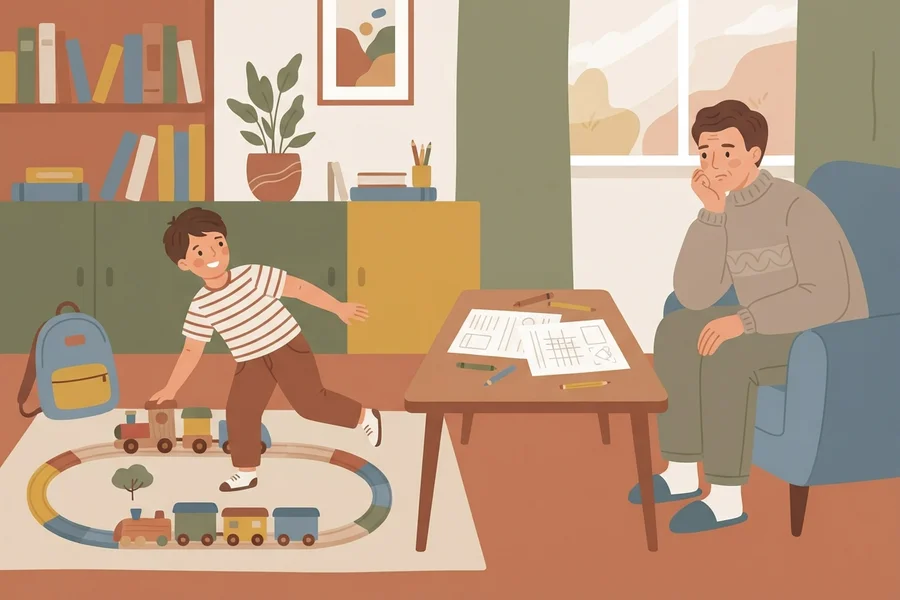
Vanderbilt ADHD Assessment: your result
Strong Current you see marked signs of ADHD in the child.
Your answers describe marked signs of ADHD in the child. Inattentive, restless and impulsive behavior is clearly present in more than one setting, and it reaches at least two areas of day-to-day life, for instance school and home, or friendships and activities.
You can see the shape of the pattern and know where it bites: the unfinished task, the interrupted game, the evening that stretches on. That clear sight is the strength of this result, and it is no small thing.
The cost is strain. It falls on the child, who is working hard to meet the day, and on the adults who keep steering. The trying deserves credit.
Still, this is a level of signs seen through one pair of eyes over recent months, and it stops there.
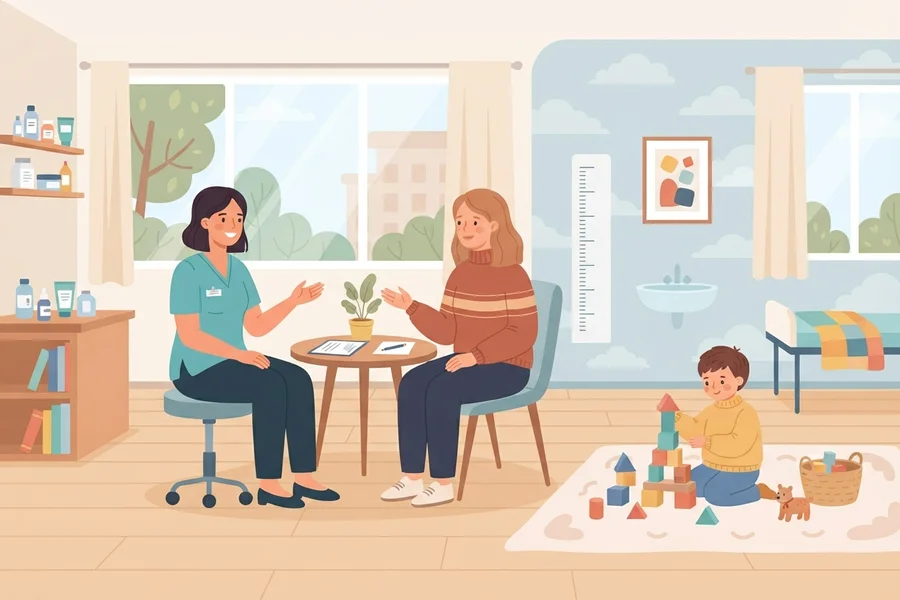
Vanderbilt ADHD Assessment: your result
Rolling Surf you see pronounced signs of ADHD in the child.
Your answers describe pronounced signs of ADHD in the child: strong inattentive, restless and impulsive behavior that has lasted for months and shows up in several settings.
Many parts of the child's days are touched, whether schoolwork, family routines, friendships or clubs. Evenings can take a lot out of everyone at home, and you may be tired of carrying them.
There is a strength in this result as well. You hold a clear, detailed picture, and a picture like that is exactly what helps in a conversation with someone who works with children.
A good next step is to talk it over with the child's doctor, or another professional who works with children, and to bring along what teachers and other school staff have noticed. The two views side by side say more than either does alone.
This is one adult's level of signs, not a diagnosis, a cause or a forecast, and other adults who know the child may see it differently. Treat it as a starting point for that talk.
Your results are no accident
The classic 16-type personality test rooted in Jung's typology has been rebuilt from the ground up: a new CoreTypes methodology, and a far higher level of accuracy. These might be the most useful ten minutes you'll ever spend on yourself: you walk away with the key to your decisions, your relationships and your results — and it's yours for good.
Take the free testYour result card
More tests like this
 Sensory Processing Disorder Test
Take a private, 18-question sensory processing disorder test to see how strongly touch, sound, light, smell, and movement shape your everyday life right now.
 Teen Autism Test
For parents of teens 13 to 17: see how closely what you've noticed day to day matches signs of autism. About 5 minutes, and not a diagnosis.
 7 Types of ADHD Test
The “7 types” label isn't an official classification — a three-part structure is. This self-report test shows which of three areas stands out most for you today.
How this test works
Methodology
This test asks one adult who knows a child between 6 and 12 well to report what the child has been like over recent months, judged against peers rather than siblings. The answers add up to one level of ADHD signs, built from five strands: attention, restlessness, impulsivity, how far the pattern spreads across settings and age expectations, and how the child gets on at school, at home, with friends and in activities.
The approach follows the tradition of parent rating scales from the Vanderbilt family, where an adult reports on behavior and on everyday functioning. The questions are original, official items and scoring are not reproduced, the bands are not clinical cut-offs, and the test has not been validated. For background on how ADHD is evaluated, see the American Psychiatric Association overview and the MedlinePlus summary.
Anything outside these strands is not covered, and there are no subtypes: one scale, one level. Causes, outlook and care are outside its reach.
One report is one view: home and school can look quite different, and an adult's mood or a rough week colors the ratings.
Please keep in mind that this page is no diagnostic instrument and no replacement for professional care. Deciding what is going on belongs to a clinician who gathers information from several people and settings. None of this counts as medical advice, and none of it calls for changing care already in place. If you are worried, talk to the child's own doctor first.
Frequently Asked Questions
Can this test diagnose ADHD?
No. A result here shows how strong the signs look to one adult and nothing about what lies behind them. Settling whether ADHD is present is the job of a trained clinician (a pediatrician or other primary care doctor, a psychologist or a child psychiatrist) who weighs what parents and teachers report from different settings. School staff cannot make that call. If you want to act on a worry, the doctor who looks after the child is the first door to knock on.
How accurate is an ADHD test for kids like this one?
Treat it as a rough reading. The questions are original and the test has not been validated. Even the rating scales used by clinicians are only moderately accurate, and they can raise a flag for children whom a full evaluation later clears. What you get here is a level of signs, never a verdict.
What does a high score mean for my child?
That over recent months the signs you have watched are strong. It reflects a single adult's eyes, so it is worth sharing with the doctor who knows the child, next to what the school sees. The score cannot say why the signs are there or where they lead.
Can I use this ADHD test for myself or a teenager?
Not really. The questions fit children between six and twelve, answered by a grown-up who sees the child day to day, and they do not fit self-rating. Younger children, teens and adults need different tools.
Can a teacher fill this out too?
Yes. A teacher, relative, coach or anyone else close to the child can answer, as long as the answers come from what they have witnessed themselves. Home and classroom can show very different children, so it is useful for two adults to answer separately and compare.
References
- Bard, D. E., Wolraich, M. L., Neas, B., Doffing, M., & Beck, L. (2013). The psychometric properties of the Vanderbilt attention-deficit hyperactivity disorder diagnostic parent rating scale in a community population. Journal of Developmental & Behavioral Pediatrics, 34(2), 72–82. doi:10.1097/DBP.0b013e31827a3a22
- Willcutt, E. G., Nigg, J. T., Pennington, B. F., Solanto, M. V., Rohde, L. A., Tannock, R., Loo, S. K., Carlson, C. L., McBurnett, K., & Lahey, B. B. (2012). Validity of DSM-IV attention deficit/hyperactivity disorder symptom dimensions and subtypes. Journal of Abnormal Psychology, 121(4), 991–1010. doi:10.1037/a0027347
- Anderson, N. P., Feldman, J. A., Kolko, D. J., Pilkonis, P. A., & Lindhiem, O. (2022). National norms for the Vanderbilt ADHD diagnostic parent rating scale in children. Journal of Pediatric Psychology, 47(6), 652–661. doi:10.1093/jpepsy/jsab132
- Narad, M. E., Garner, A. A., Peugh, J. L., Tamm, L., Antonini, T. N., Kingery, K. M., Simon, J. O., & Epstein, J. N. (2015). Parent-teacher agreement on ADHD symptoms across development. Psychological Assessment, 27(1), 239–248. doi:10.1037/a0037864