
Facial Expressiveness Test
Questions: 15Time: ≈ 4 min
Read each situation and pick the answer that sounds most like you. There are 15 questions, and it takes about 4 minutes. At the end you get one of four results describing what your face tends to show and how much of it you hold back.


Facial Expressiveness Test: your result
Still Water You keep a calm, level face by default, even when something is hitting hard inside.
Your face keeps its level by default. Something can land hard inside, and the people across from you still see the same steady expression they saw a minute earlier.
That doesn't mean less is going on in there. Feeling just doesn't turn into display on its own, and holding a calm face costs you little, because little is pushing to get out. What's going on stays underneath until you decide to say it.
The upside is privacy by default. A room doesn't get a running broadcast of your reactions, and people find you steady to be around. The tradeoff is that others may miss the moments when you'd actually welcome a question.
This result describes what shows on your face. It says nothing about how much you feel or how well you put it into words, and the test never asked.
Facial Expressiveness Test: your result
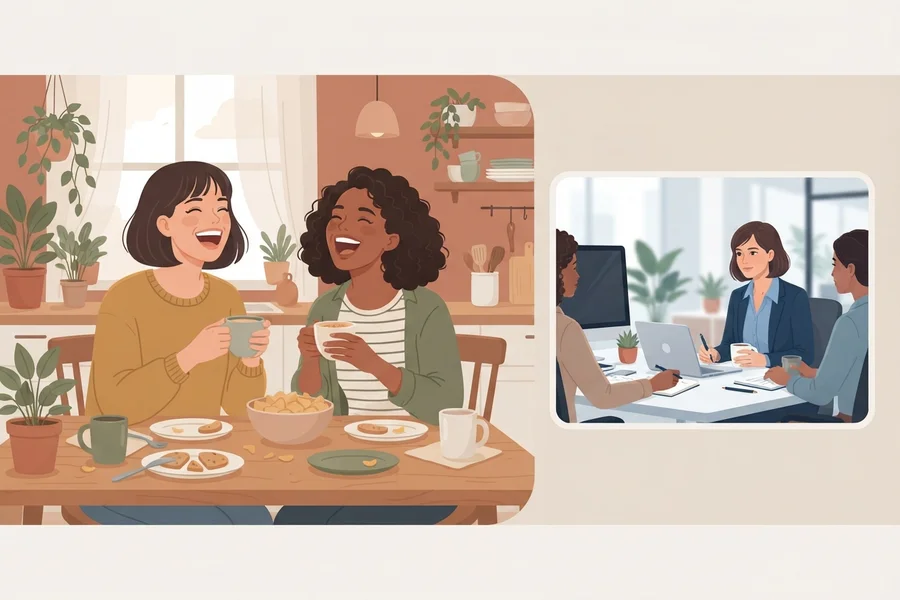
Dimmer Switch You show feeling with the people and in the moments that call for it, and hold back everywhere else.
Your face turns up for the people and the moments that call for it. With close friends, with family, or when something truly matters, it opens quickly and easily.
Elsewhere it dims. Around strangers, in low-stakes moments, or in rooms you don't know, you keep things quieter, and that composure generally holds without much strain.
The strength is placement. The feeling you show lands where it counts, so your openness carries weight, and you get to choose which rooms see the full version.
A quieter face in those settings doesn't mean the openness is gone. Those moments just haven't called for it yet, and the right company or the right stakes bring it out in seconds.

Facial Expressiveness Test: your result
Open Window You wear an open face that shows readily in most everyday moments.
Your face changes quickly and visibly across a wide range of everyday moments, not just with your closest people or when the stakes are high. A reaction can reach your features before you've decided anything about it.
A face like this is easy to read: a feeling can come across before a word is said.
That legibility is a real strength. You're easy to connect with, and a face that shows what's going on makes conversations simple.
The flip side is exposure. Little stands between a private reaction and the people nearby, so what you feel shows in settings where a quieter face might be more convenient. It's a different mode from a contained face, with its own gift and its own price.

Facial Expressiveness Test: your result
Held Breath You try to hold your face steady when it counts, and the feeling shows through anyway.
When a moment calls for composure, you go for it. You push the feeling down on purpose and aim for a steady face, and the feeling still finds its way out.
This is its own pattern, separate from simply having an open face. The attempt is real, and the leak happens despite it, not for lack of trying. It tends to turn up in the very moments that call for privacy: a hard conversation, a solemn room, a feeling you'd rather keep to yourself.
What breaks through tends to read as sincere. Others see something unrehearsed, and that can build trust faster than polish would.
The cost is the effort. Holding composure together is work you feel, and it can leave you drained even when the moment itself goes fine.
Your results are no accident
The classic 16-type personality test rooted in Jung's typology has been rebuilt from the ground up: a new CoreTypes methodology, and a far higher level of accuracy. These might be the most useful ten minutes you'll ever spend on yourself: you walk away with the key to your decisions, your relationships and your results — and it's yours for good.
Take the free testYour result card
More tests like this
 Creativity Test
Take the Creativity Test to see how much creative behavior actually shows up in your daily life right now — a quick, honest self-report, not an ability score.
 Face Blindness Test
Quick questions about recognizing people in everyday life — see how pronounced your face-blindness signs are, in and out of context, in about 5 minutes.
 Trust or Check Test
A short self-report test on whether you trust a first impulse or pause to check it — not the classic puzzle, and it never grades your answers.
How this test works
Methodology
People who search for this phrase usually expect photographs of faces and a list of emotion words to pick from. This test has no photos, no video, no timer and no answer key. It builds on an approach from research on emotional expressiveness: a self-report about your own face, not a measure of how well you read anyone else's.
Your answers cover three areas. The first is how readily your face shows a feeling before you've decided to show it (the APA dictionary entry on facial expression is a handy definition). The second is how well you can keep a feeling off your face when you try, including the times it gets out anyway. The third is whether your own sense of how readable you are matches what the people around you say they notice. For more on what a face does and doesn't show, see this APA Monitor article on the science behind a smile.
Everything rests on your own account and on what others have told you, so the result is a reflective snapshot and can't stand in for a coded video study. None of the four results ranks above another: a quiet face and an open face are two modes, each with its own gifts and costs. The test doesn't diagnose anything, autism included, and it doesn't ask whether you can put your inner feelings into words.
Frequently Asked Questions
Does this test show photos and ask me to name the emotion?
No. You won't see a single photo or video, and no answer is right or wrong. The questions are about your own face: how much it shows without your say-so, whether you can keep a feeling off it, and whether the way you picture your face matches what people around you tell you. How well you read other people's expressions isn't something this test checks.
Why can't I hide my emotions when people always know how I feel?
Faces differ in how much of a feeling they carry by default, and attempts to hold a feeling back differ in how well they work. Those are two separate things, and you can land high on one and low on the other. The questions on how fast a feeling reaches your face and on what happens when you try to hold it back will show where you stand on each.
My emotions show on my face right away. Can I choose my expression?
Holding a face steady is a capacity of its own, and it varies from person to person independently of how much your face shows to begin with. This test shows where you stand on that side of things. It doesn't teach a technique or promise that your face will change.
What is resting face, and is it real?
It's real. People call it resting face when a neutral expression gets read by others as irritated, bored, or sad while nothing of the kind is going on inside. A couple of questions here ask about exactly that gap between what you feel and what people tell you they see.
Can a facial expression test tell me if I have autism?
No. Autism can only be assessed by specialists, and no online questionnaire can settle it. This test doesn't try to.
References
- Kring, A. M., Smith, D. A., & Neale, J. M. (1994). Individual differences in dispositional expressiveness: Development and validation of the Emotional Expressivity Scale. Journal of Personality and Social Psychology, 66(5), 934–949. doi:10.1037//0022-3514.66.5.934
- Gross, J. J., & John, O. P. (2003). Individual differences in two emotion regulation processes: Implications for affect, relationships, and well-being. Journal of Personality and Social Psychology, 85(2), 348–362. doi:10.1037/0022-3514.85.2.348
- Ekman, P., & Friesen, W. V. (1969). Nonverbal leakage and clues to deception. Psychiatry, 32(1), 88–106. doi:10.1080/00332747.1969.11023575
- Kavanagh, E., Whitehouse, J., & Waller, B. M. (2024). Being facially expressive is socially advantageous. Scientific Reports, 14, 12798. doi:10.1038/s41598-024-62902-6