
Social Masking Test
Questions: 20Time: ≈ 5 min
This is an independent test on the same subject, not the official CAT-Q questionnaire and not a copy of it. For each of the 20 situations, pick the answer that sounds most like you. It takes about 5 minutes, and at the end you get a reading of how much effort you put into managing how you come across. That effort also exists in people without autism, so a high result says nothing about autism by itself.

Social Masking Test: your result
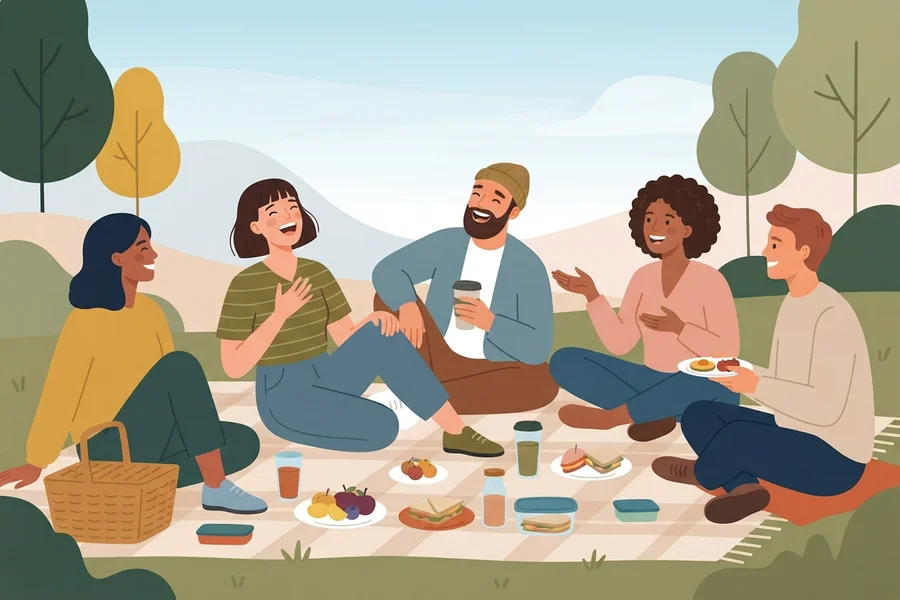
Open Book your masking effort is minimal.
Your public self and your private one are close to the same person. You walk into rooms as you are, and nothing in your answers points to a heavy, ongoing job of adjusting how you come across.
That brings a real ease. You spend little energy switching registers, you say what you mean in the voice you'd use at home, and an evening out isn't followed by a debrief with yourself about what you did wrong.
A low reading has an edge, though. It describes this one kind of effort and nothing else about you. And because it rests on what you notice yourself doing, habits that went automatic long ago can slip by unregistered.
So read it as a snapshot of the work you do. If one particular situation feels unexpectedly costly, it deserves a closer look on its own.
Social Masking Test: your result
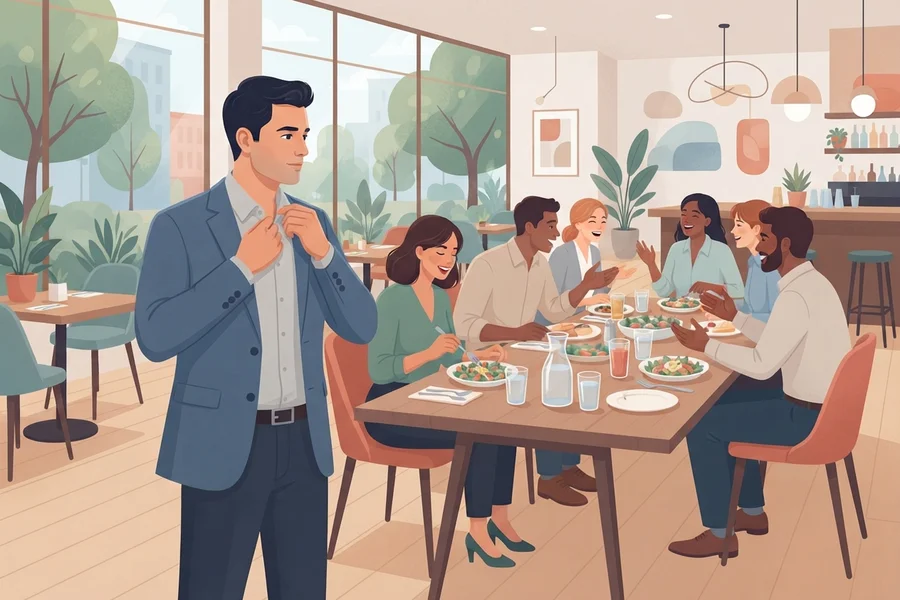
Light Layer your masking effort is mild and depends on the setting.
You do adjust how you come across, but you pull it out when a situation calls for it. Your answers point to a light layer: some preparation before an interview, a smoothed-over reaction at a client dinner.
The strength here is range. You can dial your presentation up when it helps and set it down afterward, so it works for you.
The price is occasional and tends to gather in higher-stakes rooms: an evening afterward when you're quieter than usual, or the passing sense of having been slightly someone else.
What the total can't tell you is where the effort comes from, whether that's the planning, the holding back, the mirroring or the cost. For that, look at specific situations rather than the number: which rooms ask the most of you, and what exactly you do there.
Social Masking Test: your result
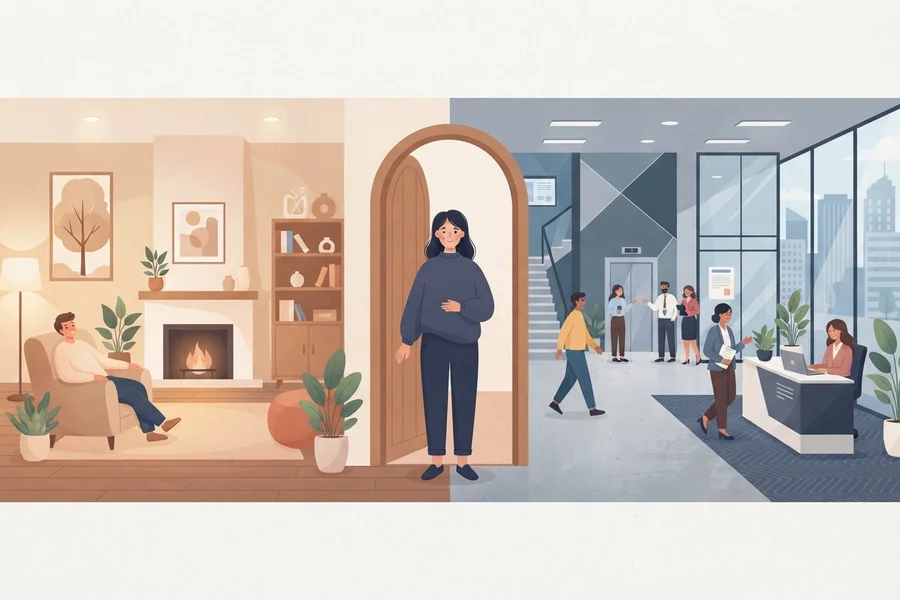
Two Doors your masking effort is a genuinely mixed pattern.
Your answers don't sit at one level. They read like two different lives: strategies working hard in some places and nearly silent in others.
In a result like this, context is usually doing the work. Among new colleagues, in a lobby or in front of a group you may be fully switched on, while on your own sofa or with family you adjust close to nothing. The scatter in your score is a pattern, and a useful one.
Its strength is contrast. You know first-hand what unadjusted feels like, so you have a baseline to hold the costly rooms against.
The total can't say which settings carry the effort and which are free of it. That takes a closer look at individual situations: where you tense up, where you exhale, and what separates the two.
Social Masking Test: your result
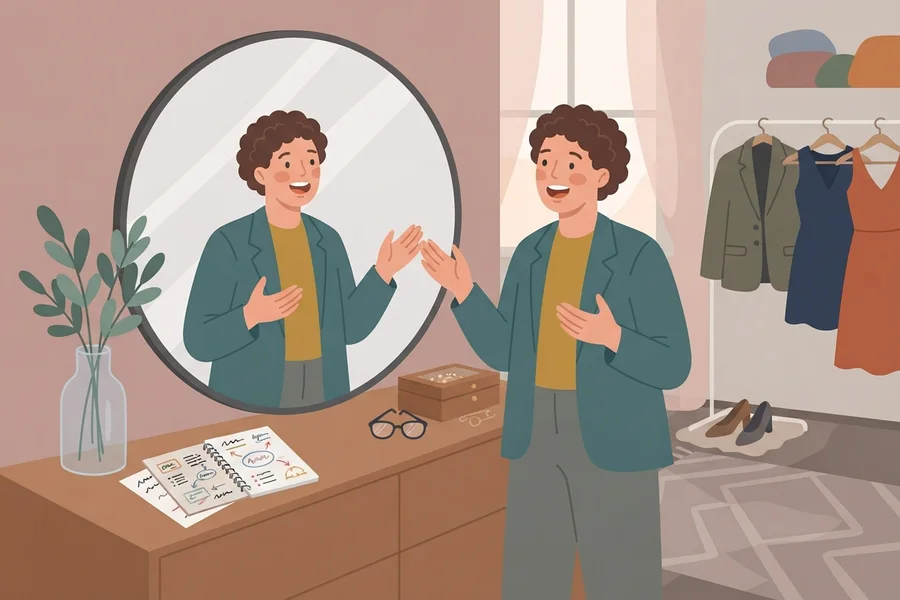
Tailored Suit your masking effort is noticeably elevated.
Your answers show effort that is steady and wide: preparing lines, holding reactions back, matching the people around you, and keeping an eye on how you're landing. It follows you through several situations.
Those are working tools. Prepared material to fall back on, controlled expression and a quick read of the room carry you smoothly through work, social plans and family occasions, and the people around you may never see the stitching.
The cost is real too. At this level the effort tends to be noticeable: a particular tiredness after long stretches of it, and a felt gap between the person on show and the one at home. That gap is information about the work you're doing.
If much of this feels familiar, it's worth mentioning to a professional at some point, with no rush. People without autism report this kind of effort too, so the score speaks to effort and nothing beyond it.
Social Masking Test: your result
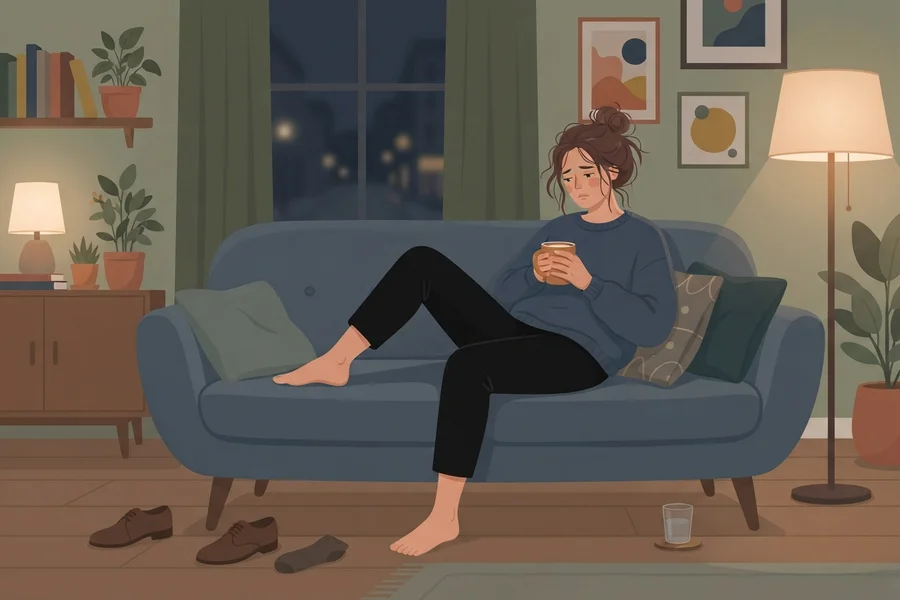
Second Skin your masking effort is consistently high.
For you, managing how you come across is close to the default setting. Planning, holding back, mirroring and watching reactions run across most situations, often before you've consciously decided anything.
There is real craft in that. You can produce the socially expected version of yourself nearly anywhere, and it works, which is probably why it became so automatic.
It is also the highest-cost reading this test distinguishes. Effort at this level tends to come with fatigue, worry and a lower sense of wellbeing, and after wearing a second skin for this long, it gets hard to tell where it ends and you begin.
This kind of effort shows up in people without autism as well, so a high result is not, by itself, a sign of autism. It tells you about effort and its cost, and leaves the reason open.
It's worth talking this over with a qualified professional whenever you feel ready. There's no urgency, and the number implies no conclusion.
Your results are no accident
The classic 16-type personality test rooted in Jung's typology has been rebuilt from the ground up: a new CoreTypes methodology, and a far higher level of accuracy. These might be the most useful ten minutes you'll ever spend on yourself: you walk away with the key to your decisions, your relationships and your results — and it's yours for good.
Take the free testYour result card
More tests like this
 Auditory Processing Disorder Self-Test
Auditory processing disorder test on everyday listening: noisy rooms, fast speech, calls, instructions. See your level of signs in 4 minutes.
 Vanderbilt ADHD Assessment
Vanderbilt ADHD assessment for a child aged 6 to 12: an independent 26-question test for a parent or other adult. About 6 minutes, ends in a level of signs.
 Autism Test
A 30-question self-report autism test across six areas of daily life - a plain reading of how strongly these signs currently show up, not a diagnosis.
How this test works
Methodology
This test is built on research into camouflaging: the work people put into steering how their social traits look to others. It follows the three-strategy picture from that literature, which separates preparing ahead, holding natural reactions back, and copying others as you go. A fourth group of questions draws on separate work about where this effort shows up and what it costs afterward.
What gets measured is the effort you report, and the underlying trait itself stays out of the picture. The five levels are our own. The researchers behind the original questionnaire published no official cutoff, so nothing here reproduces an outside threshold.
Self-report has limits. After years of practice, much of this effort runs on autopilot, and you may notice less of it, or more, than is really there. People without autism also report this kind of effort, which is why a high reading can't point in either direction.
For a plain description of how masking can look in adults, see the NHS guide to signs of autism in adults. If you want to talk to someone, the NHS page on how to get diagnosed explains where to start.
This is not a diagnostic tool and it doesn't replace a professional assessment. Autism is identified by a qualified clinician who looks at your developmental history and observes behavior, and no single questionnaire or score can stand in for that.
Frequently Asked Questions
What does this test measure?
The energy you put into managing how your social traits come across to other people. Two people can share the same trait, and one may hide it carefully while the other lets it show. This test looks at the hiding, the planning and the upkeep, and says nothing about how strong the trait itself is.
What does my score mean?
Your score places you on this test's own scale of masking effort, and it doesn't rank you against anyone else. The questionnaire that inspired this one has no official cutoff, so we drew our own five levels instead of borrowing a number that nobody published.
Can this test tell me if I'm autistic?
No. Autism is diagnosed by a qualified clinician, who works from your developmental history and from watching how you behave, and a questionnaire can't replace that. If you want to explore it, the NHS link under Methodology explains where to start.
Does a high score mean I'm autistic?
No. Plenty of people without autism work hard at managing how they come across, whether from social worry, a demanding job or a habit picked up in childhood. A high score tells you that the effort is large, and it leaves the reason open.
Why do the questions jump between planning, holding back, copying and tiredness?
Because masking isn't one behavior. Some people prepare lines ahead, some hold their reactions in, some mirror whoever they're talking to, and all of it has a price at the end of the day. Each kind gets its own questions, so the total reflects the whole picture rather than a single habit.
References
- Hull, L., Mandy, W., Lai, M.-C., Baron-Cohen, S., Allison, C., Smith, P., & Petrides, K. V. (2019). Development and Validation of the Camouflaging Autistic Traits Questionnaire (CAT-Q). Journal of Autism and Developmental Disorders, 49(3), 819–833. doi:10.1007/s10803-018-3792-6
- Hull, L., Petrides, K. V., Allison, C., Smith, P., Baron-Cohen, S., Lai, M.-C., & Mandy, W. (2017). "Putting on My Best Normal": Social Camouflaging in Adults with Autism Spectrum Conditions. Journal of Autism and Developmental Disorders, 47(8), 2519–2534. doi:10.1007/s10803-017-3166-5
- Cage, E., & Troxell-Whitman, Z. (2019). Understanding the Reasons, Contexts and Costs of Camouflaging for Autistic Adults. Journal of Autism and Developmental Disorders, 49(5), 1899–1911. doi:10.1007/s10803-018-03878-x
- Ai, W., Cunningham, W. A., & Lai, M.-C. (2024). Camouflaging, internalized stigma, and mental health in the general population. International Journal of Social Psychiatry, 70(7), 1239–1253. doi:10.1177/00207640241260020