
Moral Scrupulosity OCD Test
Questions: 18Time: ≈ 4 min
Read each of the 18 questions and pick the answer that matches your own experience best; there are no right or wrong choices. It takes about 4 minutes, and at the end you will see how pronounced your signs of moral scrupulosity are.


Moral Scrupulosity OCD Test: your result
Quiet compass Your signs of moral scrupulosity are minimal.
Moral scrupulosity barely shows up in your answers. A doubt about your honesty or kindness may cross your mind, but it does not take hold: you look at what happened, weigh it, and move on.
When you do slip, say you snap at someone or forget a promise, the guilt fits the size of the slip. An apology or an honest bit of thinking closes it, and a week later you are not still turning it over.
Behind that calm sits a real wish to treat people well. Your compass stays quiet until something calls for it, which is how a healthy conscience tends to work.
Nothing here points to a conscience caught in a loop of its own making.

Moral Scrupulosity OCD Test: your result
Second glance Your signs of moral scrupulosity are mild.
A stray doubt about whether you were honest or fair does visit you, and it tends to come when something truly was ambiguous. It earns a second look before it settles.
That look is enough. You may replay a conversation on the way home or feel a pang over a careless remark, and then the matter closes without anyone having to tell you it was fine.
Underneath is a conscience that cares about getting things right and notices nuance other people walk past. The price, for now, is a few minutes of mental housekeeping.
What keeps this level mild is that a lapse still ends. Pay attention to the difference between a doubt that closes and one that comes back, because that difference is what the higher levels are made of.

Moral Scrupulosity OCD Test: your result
Right in the middle Your signs of moral scrupulosity are mixed, at the borderline.
Your picture sits right on the border. Some signs of moral scrupulosity are clear: you may replay a conversation in detail, or feel pulled to mention something small that nobody asked about. Other signs hardly appear at all.
Your doubts go both ways. Some close on their own, others need another pass first, and it is hard to know in advance which kind you will get.
What drives this is a conscience honestly trying to get things right, caught between settling quickly and wanting one more check. That is an uncomfortable spot, and it comes from caring, not from anything you have done wrong.
A borderline result does not point in a direction yet. It is a good moment to notice which doubts you drop easily, and what those have in common.

Moral Scrupulosity OCD Test: your result
Long ledger Your signs of moral scrupulosity are noticeably elevated.
Several patterns show up together here, and they show up on a regular basis. A doubt about your own character returns after you set it aside, and a decision you had already made gets reopened so that your motives can be questioned again.
A small slip leaves guilt that lingers long after other people would have dropped it. You may catch yourself asking someone whether you did the right thing, then asking again in different words.
The strength here is a high personal standard for honesty and fairness, and the people around you benefit from it. The cost is a growing share of your attention going to rechecking things that one pass already settled.
None of this says you have behaved badly. It says your standard has become heavy to carry.
Moral Scrupulosity OCD Test: your result
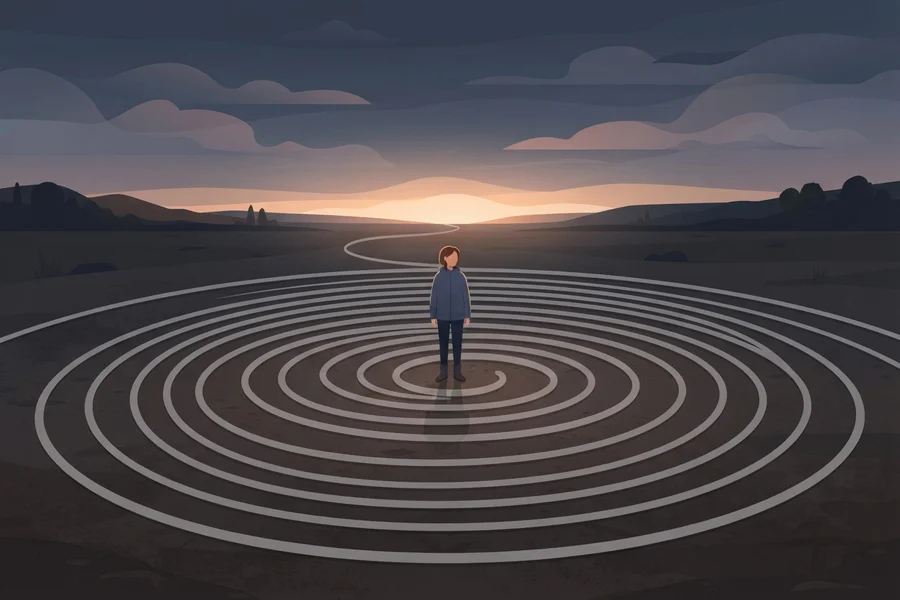
Closed circle Your signs of moral scrupulosity are pronounced.
Most of the patterns are active at once and are shaping your everyday choices. A doubt about your own goodness arrives with nothing to explain it, and your attention cannot move on until you have worked it through.
An ordinary slip gets judged as harshly as a serious one. Checking, admitting and asking for reassurance keep returning even after you have been reassured, and some decisions get postponed or dropped rather than risk being wrong.
Behind all of it stands what stands behind every level of this test: a deep, genuine care about being a good person. That care is real, and it does not mean you have behaved badly.
What this level asks of you is not alarm. When doubt has begun to run so much of your day, talking it over with a mental health professional, someone who knows these patterns well, is a sensible thing to consider.
Your results are no accident
The classic 16-type personality test rooted in Jung's typology has been rebuilt from the ground up: a new CoreTypes methodology, and a far higher level of accuracy. These might be the most useful ten minutes you'll ever spend on yourself: you walk away with the key to your decisions, your relationships and your results — and it's yours for good.
Take the free testYour result card
More tests like this
 Social Anxiety Test
Take a 15-question, 4-minute social anxiety test that separates fear and avoidance from ordinary shyness, then names your level across five facets.
 Drinking Pattern Quiz
A private 16-question self-check on how much room alcohol currently takes up in your coping, control, and daily routine — not a diagnosis, just an honest look.
 Depression Test
A 15-question self-report reading of how often depression signs - low mood, low motivation, poor sleep - have shown up lately. Not a diagnosis.
How this test works
Methodology
This test is based on an approach from cognitive-behavioral research on obsessive-compulsive patterns that gather around right and wrong in daily life: whether you are honest, fair and kind to the people around you.
The 18 questions cover six areas: doubts about your own character that arrive uninvited, treating a bad thought as almost the same as a bad deed, going back over what you said or did, telling others or asking them to confirm you are in the clear, steering around situations where you might misstep, and guilt that outgrows what actually happened. Your answers add up to a level of these signs.
Everything rests on self-report in a single sitting, so the result reflects how you see yourself today and is no substitute for a conversation with a clinician. For broader background, see the NIMH page on OCD and the NHS overview of OCD.
The test is not a diagnostic instrument and cannot stand in for an evaluation by a qualified professional.
Frequently Asked Questions
What is moral OCD, and how is it different from regular OCD?
Obsessive-compulsive patterns can attach to many different themes. When the theme is whether you are an honest, fair and kind person, people often call it moral OCD. The mechanics match the other themes: an unwanted doubt shows up, then comes something you do to quiet it. Only the subject changes, and this test looks at that moral thread alone.
Does an intrusive moral thought mean you are a bad person?
No. Doubts like these tend to land hardest on people who care a great deal about doing right, so the thought tells you about your values, not about your behavior. The harder it nags, the more the question matters to you.
How can you tell moral scrupulosity from a strong conscience?
Look at the size and the ending of the guilt. A strong conscience speaks up when something real happened, and it goes quiet after you have thought it over or put it right. In scrupulosity the guilt is out of scale with the event and keeps going after you have apologized, checked or been reassured, then returns in a new form.
Can this test diagnose scrupulosity or OCD?
No. It shows a level of signs based on your own answers, and nothing more. A diagnosis comes only from a qualified clinician after talking with you. If these doubts take up a large part of your day, your family doctor or a mental health professional is a good first stop.
References
- Abramowitz, J. S., Huppert, J. D., Cohen, A. B., Tolin, D. F., & Cahill, S. P. (2002). Religious obsessions and compulsions in a non-clinical sample: The Penn Inventory of Scrupulosity (PIOS). Behaviour Research and Therapy, 40(7), 825–838. doi:10.1016/S0005-7967(01)00070-5
- Abramowitz, J. S., Deacon, B. J., Olatunji, B. O., Wheaton, M. G., Berman, N. C., Losardo, D., Timpano, K. R., McGrath, P. B., Riemann, B. C., Adams, T., Björgvinsson, T., Storch, E. A., & Hale, L. R. (2010). Assessment of obsessive-compulsive symptom dimensions: Development and evaluation of the Dimensional Obsessive-Compulsive Scale. Psychological Assessment, 22(1), 180–198. doi:10.1037/a0018260
- Abramowitz, J. S., & Jacoby, R. J. (2014). Scrupulosity: A cognitive–behavioral analysis and implications for treatment. Journal of Obsessive-Compulsive and Related Disorders, 3(2), 140–149. doi:10.1016/j.jocrd.2013.12.007
- Miller, C. H., & Hedges, D. W. (2008). Scrupulosity disorder: An overview and introductory analysis. Journal of Anxiety Disorders, 22(6), 1042–1058. doi:10.1016/j.janxdis.2007.11.004