Social Anxiety Test
Answer all 15 questions about specific social moments — before, during, and after — and it takes about four minutes. At the end, you’ll get a result naming your level of social anxiety signs across five related facets.

This test is for informational purposes only and is not a substitute for a professional diagnosis. Consult a qualified professional for medical or psychological advice.
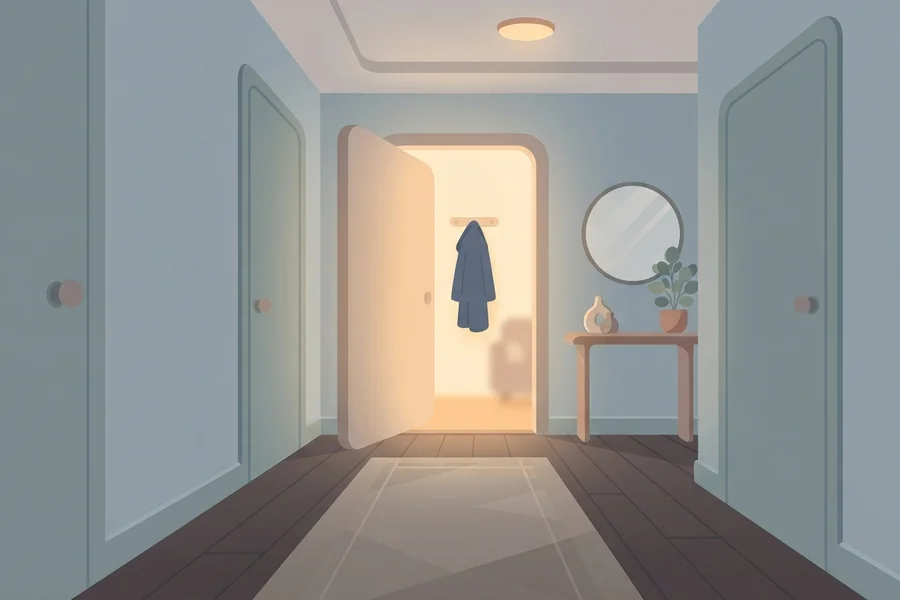
Open Door. Signs of social anxiety are minimal.
Most of what the five facets in this test look for — the rehearsed sentence, the tracked heartbeat, the tactic you can't do without, the replay that won't quit — barely shows up in your answers. You walk into an ordinary conversation and just have it.
That's not nothing: plenty of people spend real energy managing a room before they can be in it, and you mostly skip that step. New people, familiar people, low-stakes small talk, higher-stakes conversations — none of it seems to need much preparation from you.
One thing this result can't tell you, on purpose: whether you actually enjoy company or would rather have less of it. Scoring this low on every facet fits an extrovert who loves a crowded room exactly as well as it fits an ordinary introvert who prefers a quiet evening — this test measures fear and avoidance, not how much company you want or how fast you want to be alone again.
What's genuinely left open is what you do with all that spare room once fear isn't taking up any of it.
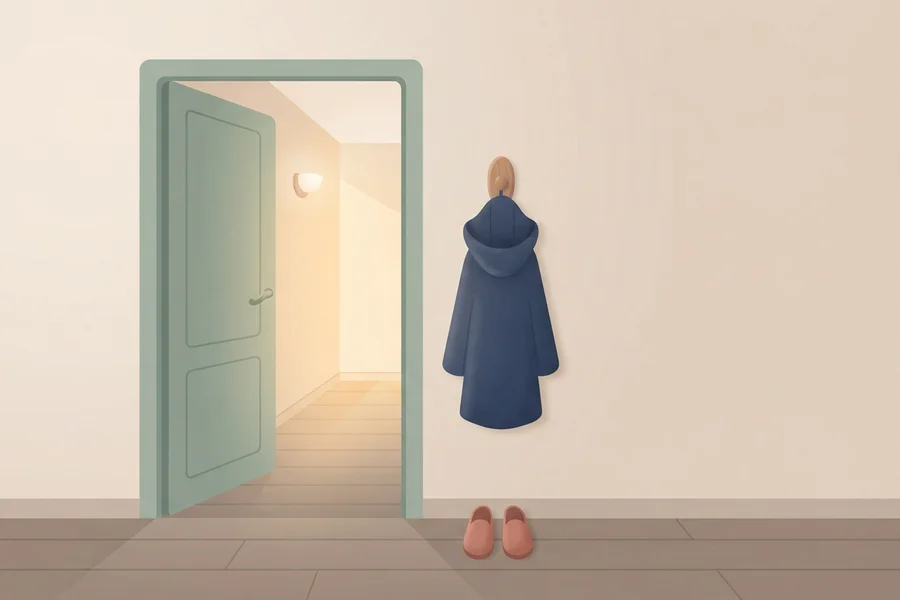
Door Ajar. Signs of social anxiety are occasional.
For most ordinary social contact, none of this costs you anything extra. The rehearsing, the tracked pulse, the tactic you lean on, the replay afterward — they show up, just not as a constant backdrop to your week.
It's a recognizable subset of situations that still ask more of you: maybe it's a specific person, a specific kind of room, a specific stage you have to get through before things ease up. The rest of your social life runs on its own.
The cost is real even when it's contained — a particular conversation you're still turning over that evening, a specific invitation you quietly manage rather than simply accept, costs a bit more rehearsal or aftermath than it looks like from outside.
A single check-in like this can't tell you whether this is a passing stretch tied to something going on right now, or a steadier pattern that's just easy to miss because it only shows up in a few places. That part stays genuinely open.
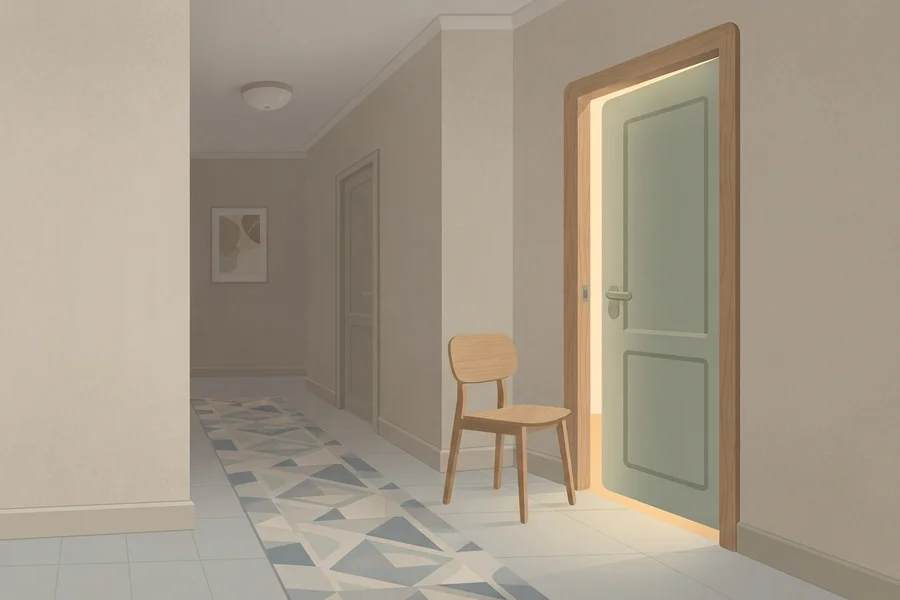
Hallway Chair. Signs of social anxiety are noticeable.
Your answers land almost exactly in the middle of this scale — not a tilt toward one side, an actual midpoint. Some of the five patterns this test tracks show up clearly; others barely register at all, and which is which depends a lot on the specific situation in front of you.
A work presentation might pull the rehearsing and the tight chest right to the surface, while a dinner with old friends leaves almost none of it in view. That inconsistency is the honest read here, not a softened way of saying "borderline."
The strength in this is real: whole categories of social contact still cost you nothing extra. The other side of it is that you can't always predict in advance which situation is going to be the one that does.
Whether this settles toward more ease or more difficulty over time isn't something one answer sheet can say — this result is a snapshot of where things sit right now, nothing more, nothing less.
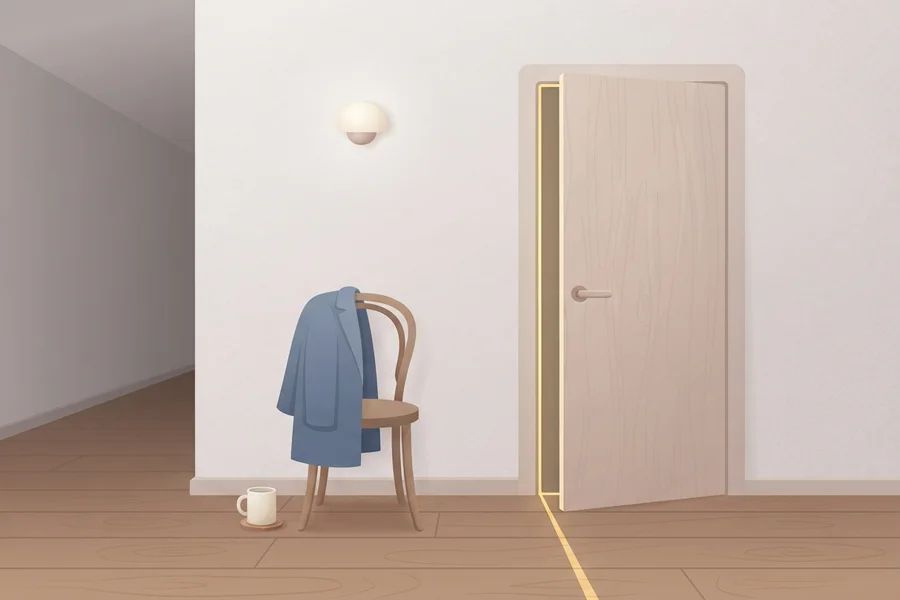
Half-Closed Door. Signs of social anxiety are frequent.
Across most of the situations this test asks about, the pattern shows up: the rehearsed line, the tracked pulse, the private tactic, the replay that runs longer than the conversation did. This isn't occasional anymore — it's close to the default setting for a lot of your week.
What's changed at this level isn't just how it feels in the moment. Real invitations start getting quietly declined or reshaped, and familiarity doesn't do what it usually does for other people — a person or place you've known for years can still cost you the same as a stranger would.
You're still managing day to day, and that's worth naming plainly — this isn't a picture of someone unable to function. But managing at this frequency has a real, growing cost, and the opportunities it's starting to reshape are the clearest sign of that.
Talking this over with a professional is a reasonable next step from here — not a verdict, not an emergency, just an ordinary way to get a second, trained set of eyes on a pattern this consistent.
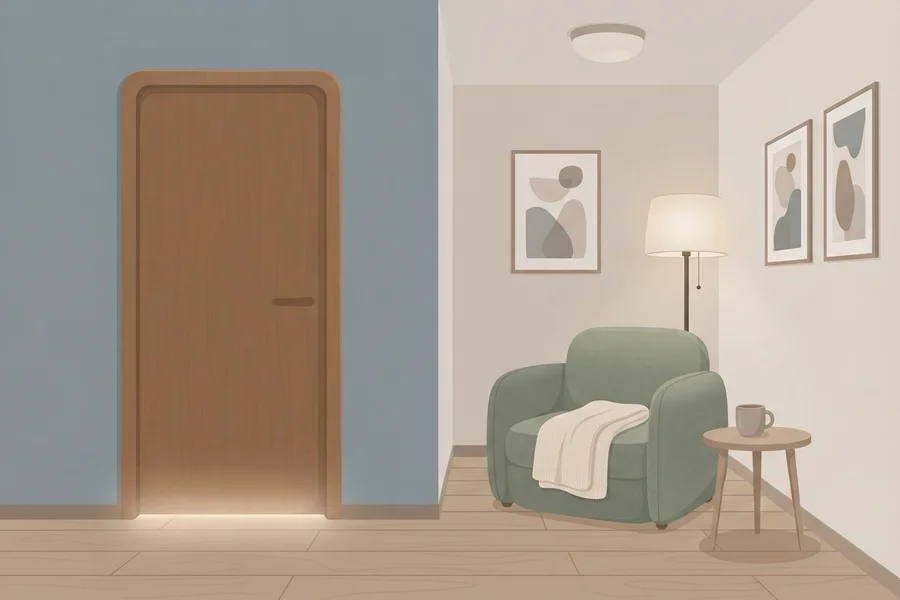
Furnished Corner. Signs of social anxiety are pronounced.
Nearly every facet this test tracks shows up often in your answers, and the ones about lasting impact — opportunities turned down or reshaped, discomfort that doesn't ease no matter how familiar the person or place, the pattern following you across many settings for months at a stretch — are some of the clearest in the whole set.
This doesn't have one single face. It can look like someone quiet in a corner, but just as often it's someone who talks plenty, hosts, shows up everywhere — and still runs every one of those situations through a script, a tactic, a body on high alert the whole time. The mechanism defines this result, not how withdrawn anyone looks from the outside.
You've built real ways of getting through things at this level, and that persistence is its own kind of strength. The cost is that it's rerouting real decisions now, not just uncomfortable evenings.
A conversation with a professional is a genuinely useful next step here — not because something is wrong with you, but because this is exactly the pattern a trained person is equipped to help with, at whatever pace makes sense.
Your results are no accident
The classic 16-type personality test rooted in Jung's typology has been rebuilt from the ground up: a new CoreTypes methodology, and a far higher level of accuracy. These might be the most useful ten minutes you'll ever spend on yourself: you walk away with the key to your decisions, your relationships and your results — and it's yours for good.
Take the free testFrequently Asked Questions
Can this test tell me if I have social anxiety disorder?
No. A self-report questionnaire like this one can show you a pattern in your own answers, but it can't take a full history, ask follow-up questions, or rule out other explanations the way a clinician does. Diagnosis is made by a licensed mental health professional, not by any online test — if your result here has you wondering, that conversation is the next real step.
Is this the same as a shyness or introversion test?
No, and the difference matters. This test asks specifically about fear, avoidance, physical arousal, and rumination tied to social situations — not about how much company you want or how quickly you'd rather be alone again. Someone can score low on every facet here and still be a committed introvert, or someone who simply prefers a smaller social circle; this test isn't measuring that at all.
What's the actual difference between social anxiety and ordinary shyness?
Mostly the mechanism, and how long it sticks around. Ordinary shyness tends to be mild, tied to specific new situations, and it eases once a person or place becomes familiar. What this test asks about is fear-driven and doesn't reliably ease the same way — the same colleague you've known for two years can still cost you as much as someone new.
How do I know if what I'm noticing is social anxiety?
The most honest answer a test like this can give you is your own result level — a self-reported pattern across five specific facets, not a diagnosis. If your result names a frequent or pronounced level, treat it as a reasonable prompt to talk it over with a professional, not as a label to carry around on its own.
Methodology
This test is built around four specific, well-documented patterns from research on social fear: anticipating negative judgment before anything has happened, physical arousal that gets noticed and monitored in the moment, avoidance and safety behaviors used to get through a situation, and rumination that continues well after a conversation ends. Fifteen questions look at those patterns across five related facets, rather than asking one broad "how anxious are you socially" question.
What it measures is the everyday, self-reported presence of those patterns — not a clinical diagnosis, a clinician's severity rating, or how long the pattern has lasted. A single sitting can't gather the fuller picture a professional would, and it can't rule out another explanation for a similar set of answers. It also skips a clinically calibrated scoring system — the five bands here organize a self-report, not a clinical cutoff.
For more on where the line sits between social anxiety and everyday shyness, the U.S. National Institute of Mental Health has a clear overview: social anxiety disorder: more than just shyness. If a conversation with a professional feels like the right next step, the NHS has practical guidance on where and how to get support for social anxiety.
This test is not a diagnostic tool and is not a substitute for an assessment by a qualified professional. It can point out a pattern worth paying attention to — it can't tell you what's causing it or what, if anything, you should do about it.
References
- Rapee, R. M., & Heimberg, R. G. (1997). A cognitive-behavioral model of anxiety in social phobia. Behaviour Research and Therapy, 35(8), 741–756. doi:10.1016/S0005-7967(97)00022-3.
- Clark, D. M., & Wells, A. (1995). A Cognitive Model of Social Phobia. In R. G. Heimberg, M. R. Liebowitz, D. A. Hope, & F. R. Schneier (Eds.), Social Phobia: Diagnosis, Assessment, and Treatment (pp. 69–93). Guilford Press.
- Kashdan, T. B., & McKnight, P. E. (2010). The Darker Side of Social Anxiety. Current Directions in Psychological Science, 19(1), 47–50. doi:10.1177/0963721409359280.
- Leary, M. R. (1983). A brief version of the Fear of Negative Evaluation Scale. Personality and Social Psychology Bulletin, 9(3), 371–375. doi:10.1177/0146167283093007.