Introvert or Extrovert Test
Answer eighteen quick questions about your everyday habits and preferences, and in about four minutes you’ll get a clear placement on the introversion-extraversion scale, along with a full breakdown of what it actually means for you.

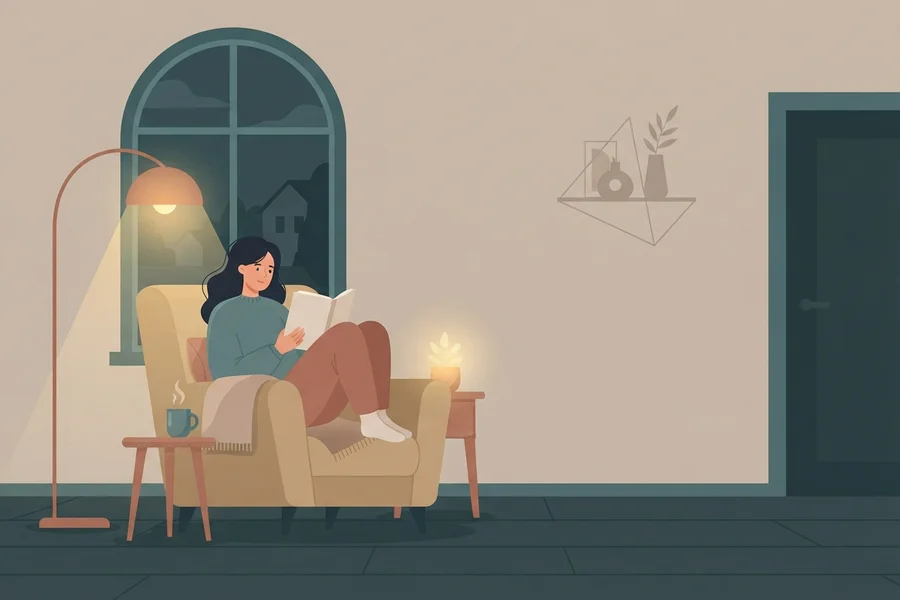
The Inner Room. Clearly an Introvert.
Across the board, your energy comes from within. You recharge in quiet, need real downtime after being around people for a while, and a small, well-known circle means more to you than a wide one. Listening comes more naturally than leading, and whatever you feel tends to come through as a quiet shift in tone.
This pattern keeps a lot of attention available for depth: sustained focus, a handful of relationships invested in properly, ideas worked through before you say them out loud. It shows up as a real strength in steady creative work and in a style of leading that starts with listening.
The cost shows up in the wrong room, not in you: open-plan offices, constant networking, an expectation of nonstop socializing all ask you to run on borrowed fuel. That's a mismatch with the surroundings, not a flaw in the pattern - worth saying plainly: this result isn't something to fix.
None of this says anything about being nervous around people or finding them hard to deal with - that's a separate trait this test doesn't touch. It also can't tell you which of the six areas above carried the most weight.
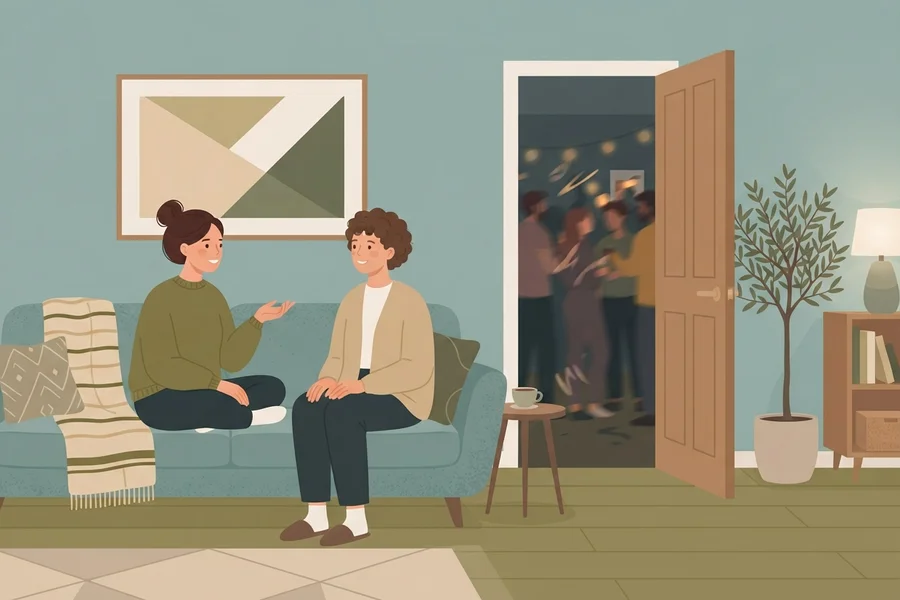
The Half-Open Door. Leaning Introvert, Not Fully.
Across the six areas this test looks at, the introverted pattern is your more frequent default - recharging through solitude, a smaller circle, more listening than initiating, a steadier pace - but it isn't the whole story. Genuinely extraverted responses still show up on a regular basis, not as rare exceptions.
You get the same depth-oriented payoff as someone further toward the introverted end - sustained attention, relationships you've actually invested in - but with enough regular contact with the outward-facing side that a more social, faster-moving situation isn't unfamiliar territory when it shows up.
The accommodation cost documented at the far end of this side still applies, just less constantly. It surfaces mainly on the occasions your pattern leans furthest from what a situation assumes; the rest of the time it sits quietly in the background.
This isn't shyness or social anxiety, and the total can't tell you which of the six areas drove your result. Next to the exact middle result, this one can look similar at a glance - the difference is that your balance point sits closer to the introverted end than to dead center.
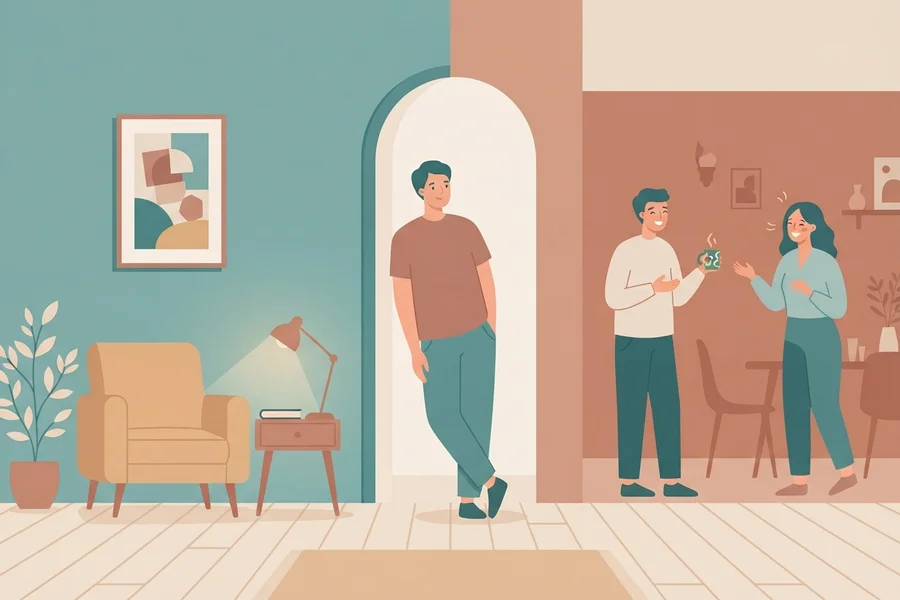
The Crossroads. A True Ambivert.
Your pattern doesn't settle consistently on either side. Sometimes your energy comes from within, sometimes from company; sometimes a small circle feels right, sometimes a wider one does; sometimes you listen first, sometimes you lead. This is the center of one continuous scale - a real, definite position in its own right.
That center carries its own signature - a flexibility to move between listening and asserting, between quiet stretches and social ones, depending on what the moment calls for. That movement is documented as an advantage in its own right in at least one well-studied setting.
The same flexibility that lets you move between modes also means less of one well-worn default to lean on automatically - reading what a moment calls for takes more active judgment.
Landing exactly here takes answers that balance both sides almost perfectly across all eighteen questions - this band covers only a narrow slice of the scale this test can produce. That narrowness is a property of the scale's own division, not a statistic about how many people land here - and it doesn't show which of the six areas tipped the balance most.

The Open Window. Leaning Extrovert, Not Fully.
Across the six areas this test looks at, the extraverted pattern is your more frequent default - outward energy, a wider circle, readier initiative, visible enthusiasm - but it isn't the complete picture. Genuinely introverted responses still show up regularly, not as rare exceptions.
You get real outward-facing advantages - quick engagement with new people and new situations, energy that tends to build the longer you're around people - paired with enough regular contact with the quieter side that a slower, low-key stretch never feels foreign when it comes.
The trade-off documented at the far end of this side still applies, just less constantly: the pace of engaging outwardly leaves less built-in room for sustained listening than a quieter pattern falls into on its own, on the occasions you lean furthest toward your own side.
This isn't a claim that you never need quiet. Next to the exact middle result, this one can look similar at a glance too - your balance point simply sits closer to the extraverted end than to dead center. The total can't tell you which of the six areas drove it.

The Wide Plaza. Clearly an Extrovert.
Across the board, time around people leaves you with more energy than you started with. New stimulation and novelty pull strongly, and you're usually the one who goes looking for them. A wide circle of contacts feels as comfortable as a close one, and speaking up or taking the lead comes readily.
Warmth and enthusiasm show up outwardly, and a full, fast-moving stretch with several things happening at once is your natural default over a slower, single-focus one. This outward orientation engages quickly and readily with new people, situations and opportunities - a pattern documented showing up clearly in career and leadership settings.
The same outward orientation carries its own real trade-off: the pace of engaging outwardly leaves less built-in room for sustained listening than a quieter pattern falls into naturally. And even at this end, some real stretch of quiet, low-stimulation time is still part of the picture.
The total can't tell you which of the six areas carried the most weight, and none of this predicts that the outward mode runs constantly, in every circumstance, without exception.
Your results are no accident
The classic 16-type personality test rooted in Jung's typology has been rebuilt from the ground up: a new CoreTypes methodology, and a far higher level of accuracy. These might be the most useful ten minutes you'll ever spend on yourself: you walk away with the key to your decisions, your relationships and your results — and it's yours for good.
Take the free testFrequently Asked Questions
How do I know if I'm an introvert or an extrovert?
No single habit settles it on its own - the pattern across several separate areas of your life does: where your energy tends to come from and go, how you respond to new and stimulating situations, how wide a social circle feels comfortable, how readily you take initiative, how visibly your feelings show, and what pace of activity feels natural. A structured test like this one adds those patterns together into a single placement on the introversion-extraversion scale, which is usually more reliable than judging from one habit alone.
Can you be both an introvert and an extrovert?
Introversion and extraversion sit on one continuous scale, not in two separate boxes, so landing near the middle is a real, describable place on that scale. It doesn't mean the test failed to decide - it means your patterns balance out close to the center, which is exactly what this test is built to show.
What does it mean if I'm an ambivert?
It names a real position at the center of the same one scale, not a third category sitting apart from introversion and extraversion. That middle range has its own signature - a flexible movement between listening and taking the lead, between quiet stretches and social ones, depending on what a given moment actually calls for. That flexibility is itself the substance of this result, even without a strong lean either way.
Is it bad to be an introvert?
No. Neither end of this scale is a deficiency or something to work on compared with the other - both are equally valid patterns, each with its own genuine strengths and its own genuine costs depending on what a given environment happens to assume. An introverted pattern brings real advantages in sustained focus and depth; an extraverted one brings real advantages in quick engagement with new people and situations. Neither one is the correct answer.
What's the difference between introversion and shyness or social anxiety?
Introversion is a preference about where your energy comes from and how much stimulation feels comfortable - it isn't about fear. Shyness and social anxiety are separate, fear-based patterns that research treats as only loosely connected to introversion, not the same thing under a different name. This test measures introversion-extraversion only; it isn't built to screen for shyness or social anxiety.
Methodology
This test is based on the approach of measuring introversion-extraversion as one continuous personal dimension, not a set of fixed types. It looks at where your habitual patterns sit along a single continuum, built from six separately observable facets: where your energy comes from, how you respond to novelty and stimulation, how wide a social circle feels comfortable, how readily you take the initiative, how visibly your feelings show, and what pace of activity feels natural.
The test uses eighteen first-person statements and one shared five-step intensity scale. Exactly half of the statements are worded at the introverted end and half at the extraverted end - a deliberate, even split that keeps a general tendency to agree from quietly pulling your result toward one side. Your eighteen answers are added into a single score, which places you on the same continuum described in the field's own reference definition of introversion-extraversion, where modern trait research treats extraversion-introversion as one continuous spectrum.
Like any self-report measure, it reflects what you notice about yourself and are willing to say - not a prediction of how you'll behave in every situation. It measures this one continuum only, not shyness, social anxiety, or any four-letter typology. A result near the middle is a real, substantive position, and neither end of the scale is better than the other. This test is not a diagnostic or clinical tool, and it isn't a substitute for a qualified professional where that's genuinely needed.
References
- Jung, C. G. (1921). Psychologische Typen. Rascher Verlag. English: Psychological Types (H. G. Baynes, trans., 1923; rev. R. F. C. Hull, 1971), Collected Works Vol. 6, Princeton University Press / Bollingen Series.
- Costa, P. T., Jr., & McCrae, R. R. (1992). Revised NEO Personality Inventory (NEO-PI-R) and NEO Five-Factor Inventory (NEO-FFI) Professional Manual. Psychological Assessment Resources.
- Grant, A. M. (2013). Rethinking the extraverted sales ideal: The ambivert advantage. Psychological Science, 24(6), 1024–1030.